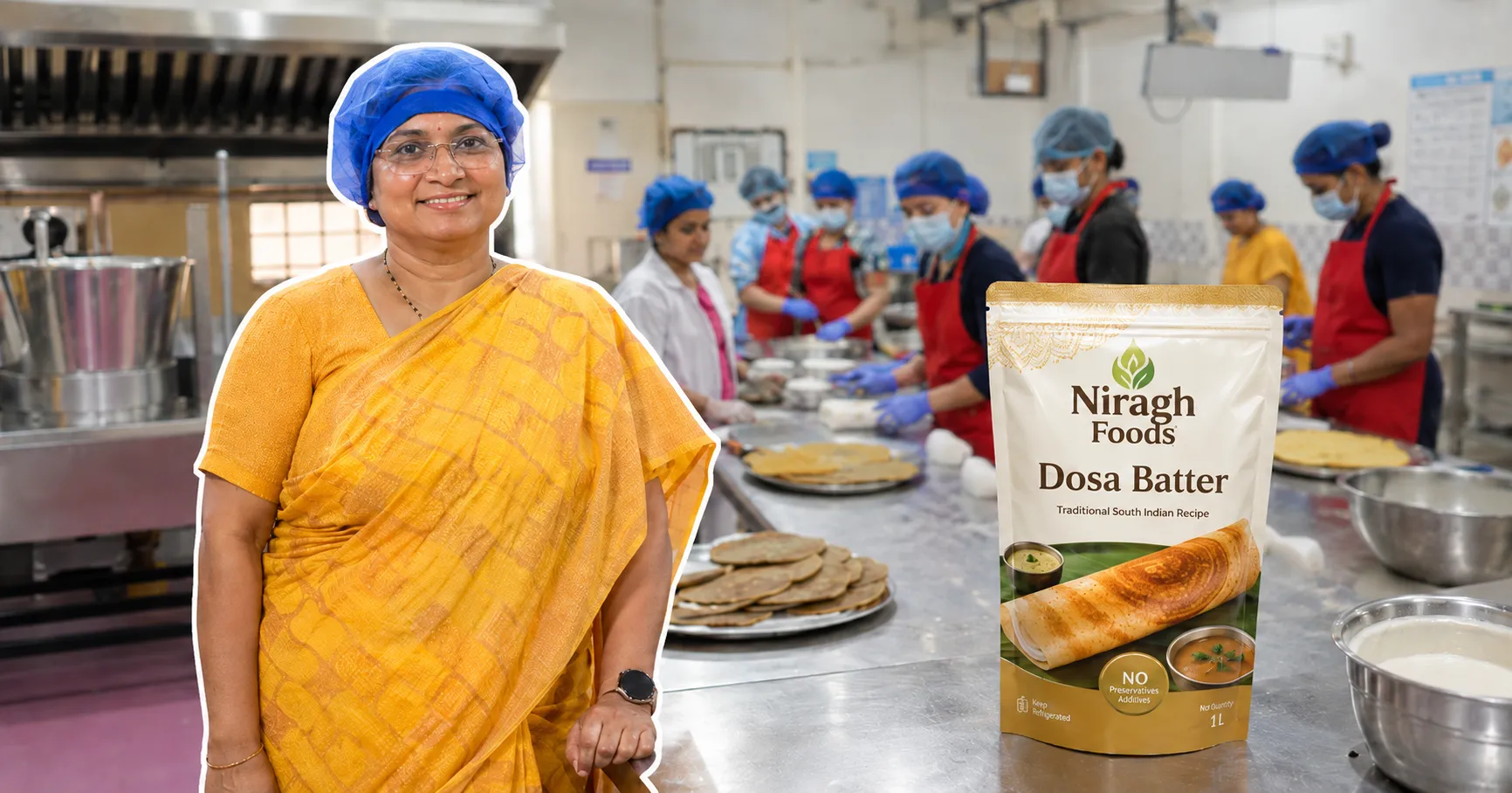
“Earlier, my life was primarily managing the house and raising the children. My husband is an auto driver. We managed, but it was tight. There was not much room for anything extra,” says Nandini, a production staff member in Bengaluru, recalling a time when every day felt like stretching limited means across endless responsibilities, where even small changes in routine had to be properly thought out.
There are homes where mornings begin before the day even feels like it has started. Where the first thoughts are not about breakfast, but about time, money, and what can be managed within both.
In such homes, cooking is not a shared experience. It becomes something squeezed between work, fatigue, and responsibilities that do not pause. Over time, meals begin to happen separately, or not together at all, and what once felt like the natural centre of family life slowly fades into the background without anyone consciously deciding to let it go.
In one such home in Bengaluru, Nandini remembers years where stability meant getting through the day without falling behind. Work outside the home was not something she could easily step into, not due to lack of ability, but because the structure of life itself left very little room for anything beyond what was already being managed. It was a life built around duty, where personal growth felt like a distant thought.
It is within these ordinary realities that a different story slowly started to form elsewhere in the same city, where Saainirmala Raghunathan Perumall began noticing that what looked like small household struggles were, in fact, part of a much larger shift in how families were beginning to live, eat, and relate to one another.
When home stopped feeling like a shared table
Saainirmala, now 58, was born and brought up in Chennai and trained as a mechanical engineer at a time when very few women entered technical fields. Her early professional life took her from engineering into the automobile sector after she moved to Mysore in 1991, where she worked for several years in automotive roles before shifting to Bengaluru in 1996 as India’s IT industry began to expand rapidly.
“I moved from machines to software, but I carried the same logical way of thinking with me,” she says.
In Bengaluru, she worked with companies such as Sonata Software and later Yahoo India, building a long career in software testing and eventually becoming a group manager leading teams. It was a fast-paced corporate life, guided by deadlines, systems, and precision.
“I was always solving problems, and over the years, that became my comfort zone,” she tells The Better India. In 2007, she stepped away from corporate work, initially thinking it would be temporary.
“I thought I would go back, but life does not always return you to where you started,” she says.
‘I kept hearing the same patterns in different families.’
Her next chapter led her into psychotherapy and counselling, where she completed her MSc in psychotherapy and counselling in 2009 and later founded Tranquil Gardens, a practice focused on counselling and training. For over a decade, she worked closely with individuals and couples, listening to the complexities of relationships and the issues that often sit beneath them.
What she began to notice, however, was not always about emotional distress alone, but about the cadence of daily life inside homes.
“It was never just one issue, but I kept hearing the same patterns repeat across different families,” she says. One pattern stood out and repeated itself across conversations.
“Couples were talking about very basic things, who is cooking, what is being eaten, and whether meals were happening together at all, and it kept coming back to food and daily routine as the centre of their concerns,” she explains.
Over time, she realised that something subtle but important was changing. “Even one proper shared meal was becoming rare,” she says. “That was when it really stayed with me.”
When the pandemic turned everyday habits into urgent questions
The COVID-19 pandemic in 2020 made these observations impossible to ignore. At home, her daughter had just delivered a baby and was coping with early motherhood in an uncertain environment where daily support systems were limited, and routines were constantly disrupted.
“She was managing everything, and even cooking felt like an extra burden on some days,” Saainirmala says. At the same time, she began reflecting more extensively on how food habits in cities were changing, not suddenly, but gradually, over the years.
“I started noticing how often families were eating separately,” she says. “Not because they wanted to, but because life had become too fast.” Out of this reflection came a belief that slowly became critical to her thinking.
“At least one shared meal should still exist in a home, and it should not disappear,” she says.
A 600 sq ft room and a decision that was not a business plan
In 2020, she began something small from a single-bedroom setup in Bengaluru under the name ‘Sasta Breakfast Solution’. There was no roadmap to follow, only a simple intention influenced by what she had seen and lived through, and by the food traditions she had grown up with, watching her mother and grandmother cook with care and familiarity.
“It started with idli batter and dosa batter,” she says. “Then we added millet pongal, rice pongal, and a few instant mixes, all rooted in what I had grown up seeing at home, my mother and grandmother making food from scratch every day, soaking, grinding, fermenting, and cooking with a kind of ease and instinct that stayed with me.” By September 2021, this initiative became Niragh Foods Private Limited.
/filters:format(webp)/english-betterindia/media/media_files/2026/06/23/saainirmala-niragh-foods-2026-06-23-17-53-36.png)
The first production unit was a 600-square-foot kitchen space in Konanakunte Cross, Bengaluru. She began with four homemakers, who were stepping into work after years at home, along with herself, making the early team strength five people in total.
“They were not trained in factories, I found them through word of mouth in the neighbourhood, but they already understood food, and that mattered more,” she says.
The setup was basic, with two grinders, one dehydrator she sourced from CFTRI in 2021 after training there in food technologies, and packing systems, all guided by the principles she picked up during that time on preserving food without losing its authenticity. She does not use any preservatives or artificial additives.
“I had one rule,” she says. “If I will not feed it to my grandson, I will not sell it.”
When WhatsApp groups became the first marketplace
There was no advertising in the beginning. Growth and support came silently through neighbourhood networks, apartment communities, and WhatsApp groups where trust travelled faster than branding.
“It was all word of mouth, people would try the batter, tell a neighbour, ask to be added to my WhatsApp group, and slowly the orders kept growing from one home to another,” she says.
The early products included idli batter, dosa batter, millet pongal premix, rice pongal premix, along with traditional spice mixes like sambar and rasam powders.
Some days, customers would place orders within minutes of her sending a message in the WhatsApp group about a fresh batch being prepared the next morning. “I would say I am making adai (a dosa variety) batter tomorrow,” she recalls. “And by evening, orders would already be full.”
For nearly two years, the business remained local, consistent, and closely connected. Later, platforms like Amazon, Flipkart, and Jiomart expanded their reach beyond Bengaluru. But the real shift came when quick commerce entered the picture.
From neighbourhood kitchens to pan-India shelves
In 2023, Supr Daily, later integrated into Swiggy Instamart, onboarded Niragh Foods after product testing. That moment represented a change in scale and visibility.
“After that, things changed very dramatically because our products were suddenly reaching far beyond the apartment communities and neighbourhoods that knew us through word of mouth, and people across different cities had started ordering and recognising our food,” she says.
In April 2025, integration through Noice during its early rollout phase further expanded distribution, helping the brand reach new regions through rapid commerce networks. From there, growth accelerated. The story that began as a single kitchen in Bengaluru gradually became a multi-city presence through digital platforms.
In just over a year, production expanded from 3,000 square feet to nearly 10,000 square feet across two units. The team grew from 14 people to around 60.
“It never felt sudden to us because every bit of growth came from years of consistency and hard work slowly coming together,” she says.
‘We do not rush food, we respect it’
Even as the scale expanded, the production process remained ingrained in traditional preparation methods.
Rice and urad dal are soaked separately, washed thoroughly, ground independently and then mixed in precise proportions. The batter is left to naturally ferment under controlled conditions, with careful monitoring of temperature and pH levels.
/filters:format(webp)/english-betterindia/media/media_files/2026/06/23/saainirmala-niragh-foods-2026-06-23-17-57-24.png)
“We do not rush fermentation,” she says. “That is where the taste develops.”
Traditional methods still sit alongside scientific checks. One basic test continues to guide quality decisions. “If the urad batter floats correctly, we know it is right,” she says.
Products like chikki are still made in small batches, using jaggery syrup and roasted peanuts, rolled and cut manually before packing. Across the facility, around 25 products are made, including batters, premixes, snacks, chips, peanuts, madhur vada, theplas, and sweets.
“Some things should remain simple because the moment you overcomplicate them, they begin to lose what makes them special,” she adds.
A workplace that became a family system
For those working there, the space is more than a factory floor.
“When I walk in, it feels like home, and that changes how you treat the work,” says Lakshya, production supervisor.
Nandini, who once managed only her household and is now part of the production team, speaks about independence. “I earn my own money now,” she says. “That has changed how I see myself.”
Kaveri, also part of the production team, describes the emotional connection differently: “We may never meet the people who eat our food, but we are part of their mornings,” she says.
From one kitchen to thousands of homes
From a 600-square-foot room in Konanakunte Cross to a 10,000-square-foot multi-unit setup in Bengaluru, Niragh Foods now reaches households across India through quick commerce and retail platforms.
The company follows FSSAI compliance, maintains HACCP readiness, and is working towards ISO 22000 certification as it scales further.
/filters:format(webp)/english-betterindia/media/media_files/2026/06/23/saainirmala-niragh-foods-2026-06-23-17-59-20.png)
However, Saainirmala keeps returning to the same thought that began it all. “This was never about building something large,” she says. “It was about bringing back food that feels like home.”
And even now, despite the scale and systems around her, her belief remains unchanged. “If I will feed it to my grandson, I will feed it to everyone else, too,” she says with a smile.
All pictures courtesy Saainirmala.
Disclaimer : This story is auto aggregated by a computer programme and has not been created or edited by DOWNTHENEWS. Publisher: thebetterindia.com