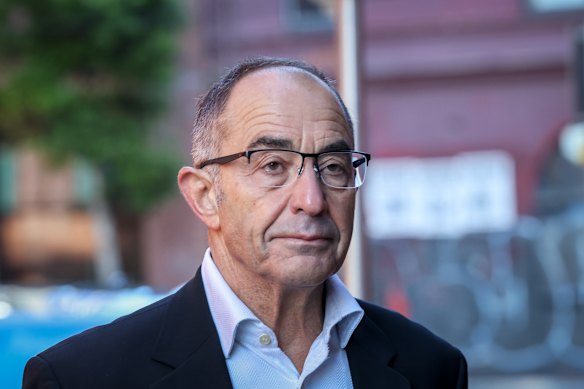
Chris Kourakis, the retired judge in charge of the Building Bad royal commission, is overseeing a delicate operation.
It is commonplace once a government is voted out of office for a political party to subject itself to post-mortem examination. It is rare thing for the autopsy to be performed while the patient is still living.
There is no question that Victorian Labor is seriously crook. If we treat this week’s Resolve Political Monitor published by this masthead as an accurate read of the party’s vital signs, voters are preparing to administer the last rites on November 28.
Nonetheless, it seems slightly Monty Pythonesque for Kourakis and his team of counsels assisting to be slicing open the body and prodding vital organs while the government still has a pulse.
“Ere, ′e says ’e’s not dead!”
“Well, he will be soon – he’s very ill.”
The gravity of wounds already inflicted during the first three days of royal commission public hearings has raised questions about whether the Carroll government was high on pethidine when it established this inquiry.
John Holland project manager Joe Aygur’s testimony that the government threatened to black ball his company from future work unless it appeased the industrial thuggery of the CFMEU goes to the heart of why the Big Build turned so bad.
The apparent absence of concern expressed by former premier Jacinta Allan, when told in a ministerial briefing that the CFMEU’s absurd wage demands for people who hold stop-go signs at building sites would add $400 million to the government’s tab, indicates an extraordinary disregard for how public money was being spent.
As this paper’s own one-man royal commission Nick McKenzie told Radio 3AW listeners at the start of the week: “By Friday, Premier Ben Carroll will likely regret having called the royal commission.”
It is a good line. But at the risk of picking a fight with the most fearsome journalist to sit on a 60 Minutes stool, it misunderstands Carroll’s motivations and Labor’s quandary.
A royal commission was not forced upon Carroll. He nominated it, in his discussions with caucus colleagues, as a precondition for any leadership challenge against Allan. He did this because he believed a royal commission was owed to taxpayers and necessary to repair a Labor movement that had badly lost its way.
“He wasn’t doing it as an electoral ploy,” a government minister reflected this week. “He was doing it because he had a very fundamental view that the long-term integrity of the Labor Party depended on it and that ultimately, it was the right thing to do.”
Without meaning to sound sucky, this last point deserves emphasis. Carroll does not have the political acumen of Daniel Andrews but he is principled. Doing the right thing – or at least trying to – matters to him in a way it never much did to Victoria’s longest serving Labor premier.
Carroll’s insistence that he would call a royal commission if he became premier is one of the reasons he didn’t challenge Allan when colleagues, union leaders and factional bosses were urging him to do so in June. They wanted him to do the job but wouldn’t agree to his condition, which was staunchly opposed by Trades Hall.
His view was that any leadership change would be futile without a royal commission and a broader reset in government policy.
When Carroll did challenge at the end of July, a trio of senior ministers – Anthony Carbines, Melissa Horne and Gabrielle Williams – put the hard word on Allan in her final cabinet meeting to call a royal commission.
Allan, as the minister responsible for major projects since the start of the Andrews government, would not agree to this. She could see no way for her leadership to survive a public inquiry. On the basis of this week’s evidence before the royal commission, her judgment was spot on.
Carroll’s argument was that a royal commission was needed, not only to give Labor some hope of contesting this election, but to bring cultural change to a political organisation that had forgotten the value of a taxpayer dollar and the importance of governing with fiscal restraint. This is the moral sclerosis that is killing the party.
“It wasn’t just about this election, it was about the subsequent three elections,” one of Carroll’s caucus backers says.
Besides, if this government hadn’t called a royal commission the next government would have. One way or another, a reckoning was coming.
As bad as the electoral outlook now is for Labor, it is difficult to see how it would have been any better under Allan, a politician whose public image was imprinted next to Andrews, in hard hat and hi-vis.
Before he quit parliament, Andrews shifted Labor’s factional plates to bake-in an Allan leadership. He did this not for any great love for Allan but to protect his own legacy.
“He needed someone as invested in his agenda and his mistakes as he was,” one of their cabinet colleagues explained. “The only person you can trust is the person who buried the body with you.
“People like JA [Allan] got shit done. That’s what he used to say – she gets shit done. But at what cost?”
The cost to Labor, in the short term, will be savage.
It is difficult to reconcile what people are telling pollsters about their voting intentions with Labor’s electoral dominance in this state. Are only one in five voters planning to stick with the party that has governed us for 23 of the last 27 years?
Such a result would not only produce an emphatic Coalition victory, it would reshape Victoria’s political topography in the regions, in Melbourne’s west and the northern suburbs.
While we ponder such matters, Kourakis will remain at the operating table, scalpel in hand. His work will continue well after this government has drawn its last breath and the next one moves in.
Chip Le Grand is state political editor.
The Opinion newsletter is a weekly wrap of views that will challenge, champion and inform your own. Sign up here.
 Chip Le Grand leads our state politics reporting team. He previously served as the paper’s chief reporter and is a journalist of 30 years’ experience.Connect via email.
From our partners
Disclaimer : This story is auto aggregated by a computer programme and has not been created or edited by DOWNTHENEWS. Publisher: www.smh.com.au