
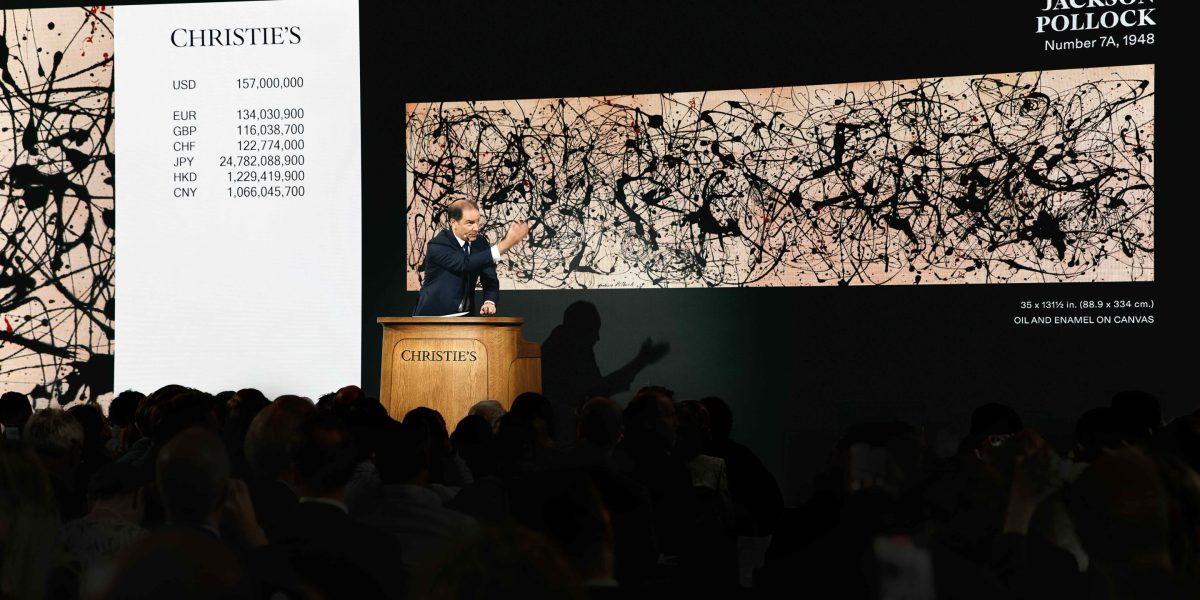
It was the kind of drama an auction house dreams of. As part of its spring week auction in mid-May, Christie’s was selling a 1948 Jackson Pollock dip-and-splash painting, one of the largest held by a private owner. Bidding seemed to stall around $150 million until suddenly a bidding war among four prospective buyers broke out, lasting seven minutes and driving the price up to ultimately fetch $181 million, including fees.
In all, Christie’s auctions in New York during its Spring Auction series—its most important event of the year, which can generate between 10% and 20% of annual sales—brought in $1.45 billion. Including sales outside the U.S., Christie’s took in to $2 billion that week, 50% more than the previous year. Blockbuster sales included highly coveted pieces such as a Mark Rothko painting and a Brancusi sculpture, which each fetched astronomical prices.
The stellar week illustrated how the fine arts market has continued to rebound after a few slow years. Last November, Sotheby’s sold a Klimt from the collection of the late cosmetics heir Leonard Lauder for $236.3 million, a new record for a piece of modern art sold at auction.
A UBS report in December estimated that global art sales increased by 4% year-on-year to an estimated $59.6 billion, returning it to growth after two years of sharp declines. The market had struggled from inflation, geopolitical uncertainty, and tariffs that many worried would hurt the economy, as well as fewer blockbuster pieces coming to market.
The great art transfer
But experts are confident this robust art market is likely to be helped for years by a factor presaged by the strong sales in May at Christie’s and other auction houses: the so-called Great Wealth Transfer. That refers to the huge handoff of assets over the next two decades from the Silent Generation and Baby Boomers. Those assets have appreciated enormously in recent years from the strong stock market and high real estate values. The value of these assets is estimated at around $84 trillion by 2045 or as much as $124 trillion by 2048. Heirs who don’t want to hang on to inherited art or need to liquidate their assets may turn to the auction markets—and some will likely become art-buyers themselves.
Indeed, a great number of pieces in the recent blockbuster Christie’s auctions came from estate sales of notable figures in the art world. The Pollock painting and the Brancusi sculpture of a women’s head, called Danaide, were owned by Conde Nast founder S.I. Newhouse, who died in 2017. The Rothko painting, which fetched just under $100 million, had belonged to Agnus Gund, an arts philanthropist and former president of New York’s Museum of Modern Art, who died last year.
“So much of our success depends on the supply that we have to sell,” Christie’s CEO Bonnie Brennan told Fortune in a segment of our “Behind the Business” video series. “A lot of that comes from the wealth transfer we know is taking place. A lot of the great collectors of our generation have sadly passed on and therefore we are seeing those collections come to market.”
Indeed, the estate sales of late have brought extremely high-quality pieces, many of which have been off the market for decades, to the auction block. That will continue to give collectors an opportunity to snag coveted pieces by artists that rarely come up for sale. Christie’s sales also included works by iconic artists such as Gerhard Richter, Pablo Picasso, Roy Lichtenstein, and Piet Mondrian.
“There’s a very limited supply of art because historical art is already in museums,” explained Drew Watson, managing director and head of art services at Bank of America, who advises clients on their art collecting and investments. “So when you see a cache of very high-quality historical art come to market, it creates a moment that draws collectors out and often results in competitive bidding.”
And it’s not just valuable high art hitting coming on to the market. Collectibles are also fueling the auction house boom. In March, a 1969 black Fender Stratocaster guitar that Pink Floyd member David Gilmour played on that band’s most iconic albums, including “Dark Side of the Moon,” and owned by the late billionaire Jim Irsay, went for $14.55 million at a Christie’s auction. That was more than double the $6 million record set in 2020 for a guitar. A Pokemon card recently sold for $16 million, while rare wine bottles are fetching record prices.
Not everyone is swept up in the excitement. Jerry Saltz, the Pulitzer Prize-winning senior art critic at New York Magazine, wrote of watching the Pollock sale at Christie’s, and coming away feeling a kind of grief for the art—”stripped bare of meaning and placed naked on the block with only a price to define it.”
Calling these high-ticket-price auctions “blood sport for the ultrarich,” Saltz remarked: “The entire spectacle feels especially grotesque in the spiritual atmosphere of our current era, where vulgarity has become aspiration and every human endeavor is translated into ratings, clickbait, branding, and leverage.”
A young art-buying clientele
Some art lovers may be turned off, but younger buyers are turning up in droves. Brennan says that about half of bidders at Christie’s auctions are Millennials or younger. At the Irsay auction, a guitar owned by Nirvana’s Kurt Cobain was a draw. “It had a very deep bidding audience of younger people,” says Brennan. “We see a tremendous new young audience really interested in vintage automobiles, so that’s something we’ve added to our portfolio.”
The opening IPO market in U.S. will also create “liquidity moments” as Brennan puts it and further expand the pool of buyers. And one of the destinations for that wealth are art and collectibles markets that can offer some diversification to a portfolio.
“You will see a lot of that wealth creation gravitate toward assets that are perhaps non-traditional,” says Bank of America’s Watson. “We know that those are on the rise, especially among younger generation cohorts.” He expects that some $1 trillion worth of art will change hands over the next decade. That will certainly keep the auction houses busy.
Disclaimer : This story is auto aggregated by a computer programme and has not been created or edited by DOWNTHENEWS. Publisher: fortune.com



