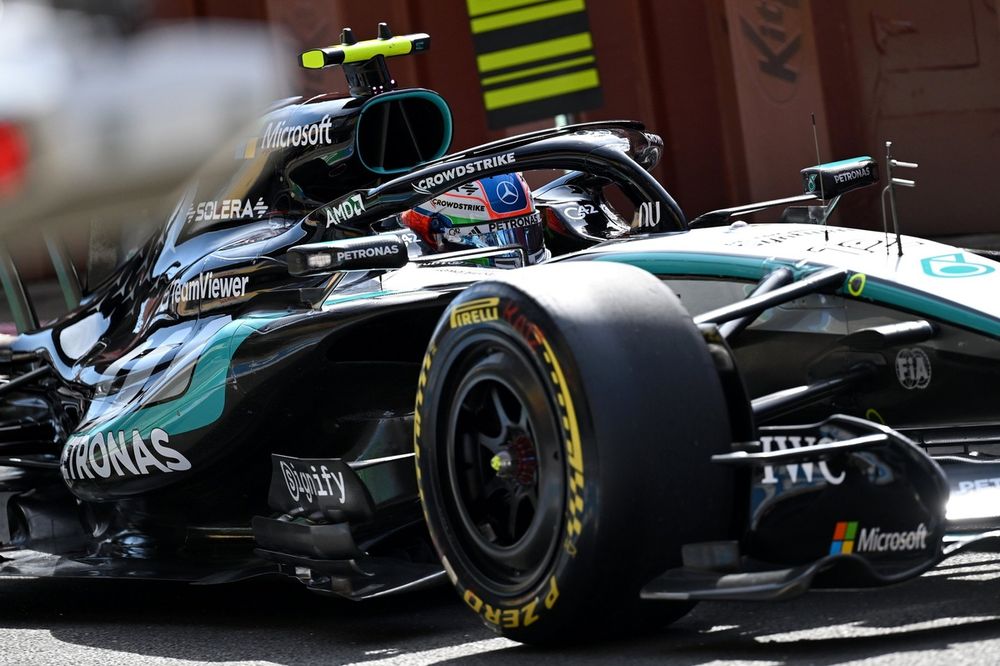
Lewis Hamilton topped practice for the British Grand Prix by two tenths of a second from Kimi Antonelli, then edged him out of pole position for Saturday’s sprint race by the altogether narrower margin of 0.011s.
Despite the final order of practice it was by no means ordained that Ferrari would be quickest around Silverstone – and Antonelli was visibly disappointed afterwards to have fallen short of pole.
“It was so, so close and it was a shame,” said the championship-leading Mercedes driver afterwards. “To be fair, in SQ1, I felt a bit bad. I didn’t feel great in the car, but then we made a slight balance adjust and SQ2 felt night and day different – and we suddenly were back in the pace.
“SQ3 there was a little bit left on the table, but it was a decent lap and unfortunately it was super close to Lewis, but of course congrats to him.”
Sprint qualifying in Silverstone unfolded against a background of increasing rancour between Mercedes and Ferrari, after Mercedes boss Toto Wolff openly questioned how the Scuderia could afford under F1’s budget cap to keep applying upgrades to its SF-26 car. Between practice and sprint qualifying at Silverstone, during the FIA’s press conference for team principals, Ferrari boss Frederic Vasseur became increasingly irritated by further questions on this topic.
Ferrari introduced a new engine in Austria, taking advantage of performance breaks granted to it under the first of the FIA’s quarterly Additional Development and Upgrade Opportunities (ADUO) assessments, but high ambient temperatures arguably masked the potential of the upgrade. So far this season the Scuderia has emerged as the closest challenger to Mercedes, with a car which is arguably the quickest around slow and medium-speed corners, but which is lacking slightly in electrical deployment.
Andrea Kimi Antonelli, Mercedes
Photo by: Sam Bagnall / Sutton Images via Getty Images
The picture of relative performance remains unclear at Silverstone given that this circuit is far less deterministic for harvesting/deployment strategies than the four tracks preceding it in the calendar. There is a relatively conventional mix of straights and corners early in the lap, but from the Wellington Straight onwards the ratio of straights to corners shifts – and the corners that are there tend to be quick, offering few opportunities to harvest energy.
So from the exit of Luffield onwards, there is the potential for harvesting and deployment strategies to diverge over the rest of the lap, since the electrical component is starved of input unless the drivers lift-and-coast or super clip into corners. The FIA has dialled down the recharge limit for qualifying to 6.5 megajoules, in effect trading peak straightline speed to reduce the requirement for super clipping.
Antonelli’s team-mate George Russell, whose victory in Austria last weekend moved him back past Hamilton into second in the drivers’ standings, struggled to match Antonelli all day, finishing three tenths off the other Mercedes to claim fifth place on the sprint grid.
“Very surprised,” said Russell. “You know they’ve [Ferrari] been on the back foot with the PU [Power Unit] and energy management – and here they look the best at the moment, so that’s been a real surprise. We’ve always known they’ve had a great chassis but, yeah, I think some things aren’t quite making sense.
“If I were to have predicted, I’d have said Ferrari quick last week and us to be quick this week. Obviously Kimi did a great job but still Ferrari have had the upper hand all day.”
We want your opinion!
What would you like to see on Motorsport.com?
– The Motorsport.com Team
Disclaimer : This story is auto aggregated by a computer programme and has not been created or edited by DOWNTHENEWS. Publisher: motorsport.com