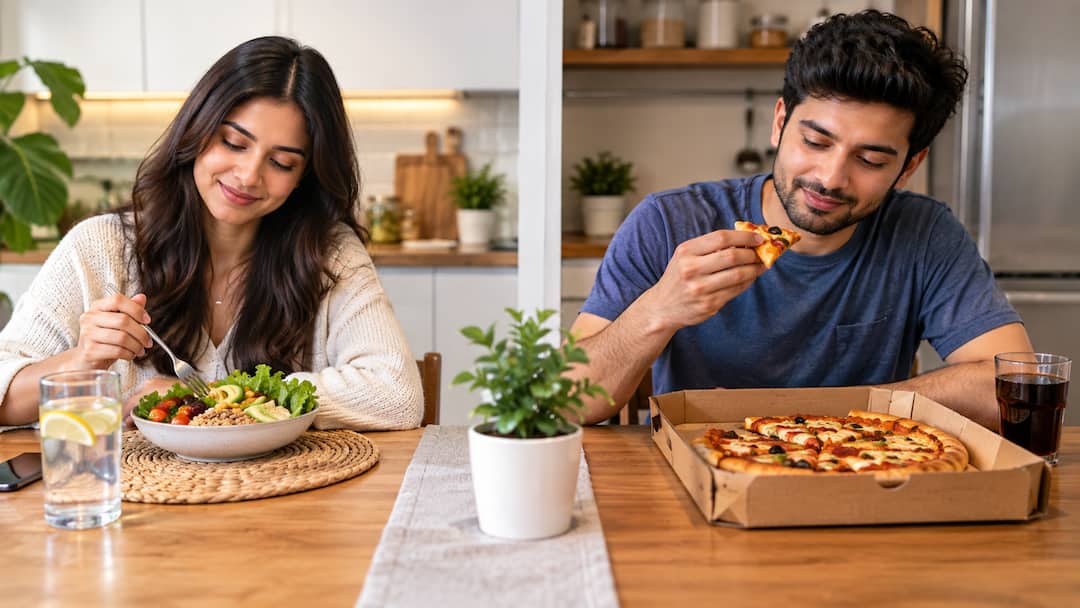
- “Food Divorce” addresses daily arguments over couples’ meal choices.
- Partners independently choose preferred foods, reducing conflict and stress.
- This arrangement respects individual preferences, not necessarily harming relationships.
Food Divorce Trend Among Modern Couples: Small arguments are common in every relationship, but not every argument has to become a major crisis. Many times, the reason for tension between couples is not a serious issue, but a simple everyday question: what will be cooked for dinner today? One partner wants light and healthy home-cooked food, while the other feels like ordering something from outside. Some get hungry at 7 in the evening, while some like to eat late at night. If different preferences start becoming the reason for daily arguments, then some couples are now adopting an easy solution to it, which is being called ‘Food Divorce’.
While the name may sound like a breakup, its true meaning is quite different. It’s not a separation, but rather a separation between husband and wife, or partners. They simply decide to have different food preferences. This means that if eating the same food together every day is causing arguments, they can now choose their own preferred food.
A “food divorce” doesn’t mean the couple is separating. It simply means they no longer feel the need to compromise or argue over food every time. They live in the same house, their relationship remains the same, but they no longer have to decide together what to cook for dinner.
For example, one partner may prefer vegetables and roti, while the other may prefer noodles. In such a situation, both partners don’t have to agree on a single option. They can both cook and eat whatever they prefer. Similarly, if one person wants an early dinner and the other gets hungry later, eating at different times can also be part of this arrangement.
ALSO READ | Delhi Air Pollution: IITM Pune Study Finds High Mercury Levels In Air, Raises Health Concerns
Sometimes, diet, allergies, vegetarian or non-vegetarian food preferences, or even aversions to certain foods can lead to food disagreements. Everyone has different food preferences, and choosing meals based solely on each other’s preferences can be challenging for many.
When Everyday Becomes A Headache
In most households, the question begins as soon as evening arrives: “What should we eat today?” The answer is, “I don’t know, please tell me.” Afterward, both parties spend a long time mulling over what to cook. One wants pasta, the other wants rice. One wants to cook, while the other is in the mood to order from outside.
It’s okay if this happens for a day or two, but if these conversations turn into arguments every day, even something as simple as eating can become stressful. Buying food, preparing it, cooking it, and then adjusting to each other’s preferences can become a daily chore. In such a situation, the idea of a “food divorce” may be a way for some couples to reduce this pressure.
ALSO READ | Pitru Paksha 2026: 3 Mistakes To Avoid Doing After Tarpan And Shraddha
It Is Not Necessary To Compromise Every Time
In this arrangement, no one decides that they will never eat together again. It simply means that eating together is not seen as a rule or an obligation. They can eat together whenever they feel like it, have breakfast together on weekends, or go out for dinner on special occasions. But if one day their preferences differ completely, there’s no need to argue about it. One person can eat their favorite food, and the other their favorite. This way, neither person has to compromise on their own wishes every day.
Why Might Some Couples Like This Method?
Eating isn’t just about eating. It involves many decisions: what to cook, who will bring the ingredients, who will cook, and whose preferences will be prioritized. When these are frequent disagreements, even small matters can become a problem. Eating separately can reduce this pressure. No one needs to explain to their partner why they should eat pasta today. Nor is there any debate about whether ordering food from outside is appropriate. Both can make decisions based on their convenience and preferences.
Is Eating Separate Meals Bad For A Relationship?
Not necessarily. Every relationship has its own unique characteristics, and there’s no rule that couples must always do everything together. Some partners have different bedtimes, some have different hobbies, and many even spend their evenings doing their own activities.
This can also be true when it comes to food. For some, eating meals together is an important part of a relationship, while for other couples, it’s less so. Both approaches can be fine in their own way. However, if eating separately is simply because partners consistently avoid spending time together, it could be a sign of a larger issue. But eating separately just because of different food preferences doesn’t necessarily mean relationship problems.
Disclaimer : This story is auto aggregated by a computer programme and has not been created or edited by DOWNTHENEWS. Publisher: abplive.com