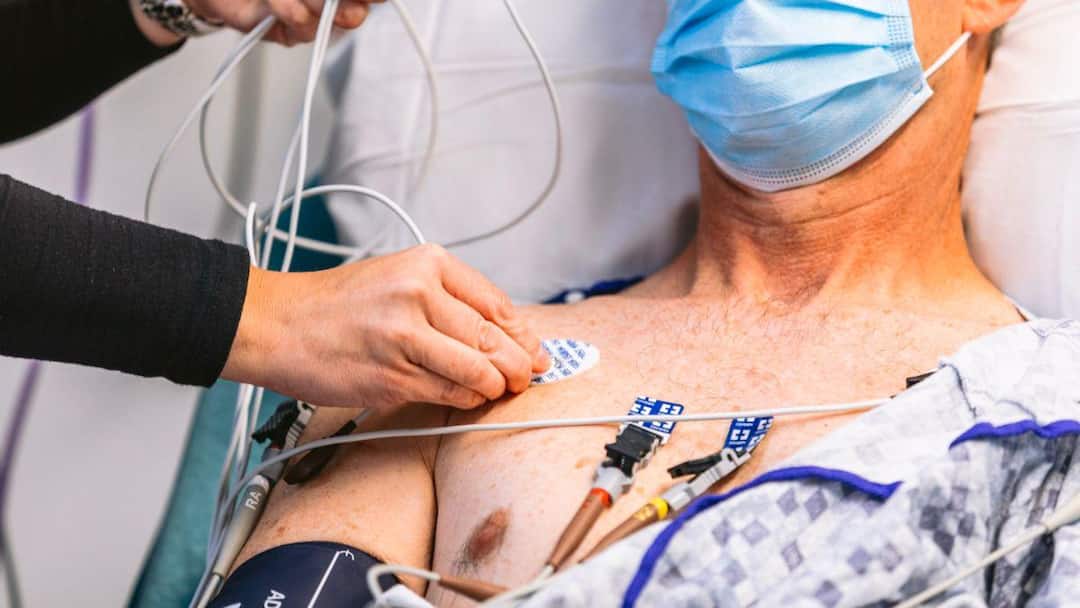
- Louie Quiros’ asthma-like symptoms were initially misdiagnosed.
- AI tool EchoNext identified severe cardiac issues from his ECG.
- Doctors confirmed rare heart condition, enabling life-saving treatment.
- AI tools improve early diagnosis, assisting doctors and saving lives.
Artificial intelligence is quickly emerging as a crucial support tool in contemporary health, assisting medical professionals in identifying illnesses that could otherwise go undiagnosed. The New York Times reported that a recently created artificial intelligence tool assisted in identifying a potentially fatal cardiac problem in a man whose symptoms were first thought to be related to asthma. The instance, which was subsequently published in the journal Nature Medicine, demonstrates how AI could revolutionize the early detection of cardiovascular illness by seeing minute warning indicators that might not be apparent to the human eye.
When Asthma Wasn’t The Real Problem
Louie Quiros, a 45-year-old man, went to the emergency room in New York after many days of increasing dyspnea and blood in his cough. He was having trouble breathing and his heart was pounding quickly, but a chest X-ray revealed no visible abnormalities. Despite being irregular, his electrocardiogram (ECG) did not lead medical professionals to a conclusive diagnosis. Emergency doctors first assumed Mr. Quiros had asthma and released him with an inhaler and medication after discovering that he had just been exposed to wildfire smoke while traveling to California, according to The New York Times.
ALSO READ |When Period Pain Is More Than Just Cramps: Understanding Endometriosis
AI Flagged What Doctors Could Not See
A clinical trial assessing EchoNext was being conducted at the hospital where Mr. Quiros was treated. A program created by Dr. Pierre Elias, a cardiologist at Columbia University Irving Medical Center and the Medical Director of Artificial Intelligence at New York-Presbyterian. EchoNext examines regular ECGs for minute electrical patterns associated with cardiac disease that medical professionals could miss during routine interpretation. Doctors recalled Mr. Quiros for testing when the AI system detected indicators of significant heart malfunction.
A Life-Saving Diagnosis
Mr. Quiros’s heart was only pumping around 10% of its blood with each heartbeat, according to the cardiography, which indicated serious heart failure. Significant mitral valve leakage was also discovered by the doctors. A rare inherited heart condition linked to rapid cardiac death was discovered through additional genetic testing, and the only effective treatment is a heart transplant. The journal Nature Medicine subsequently published the results.
ALSO READ |Persistent Headaches, Seizures: 5 Brain Tumour Symptoms To Watch For
AI Could Transform The Future Of Heart Disease Detection
The instance, according to Dr. Roxana Mehran, President of the American College of Cardiology, demonstrates how artificial intelligence could help decrease missed diagnoses, especially in crowded emergency rooms where minute ECG abnormalities are readily ignored. Even while many ECGs seem abnormal, only a small percentage show serious heart illness, according to Dr. Pierre Elias. AI can assist in determining which patients are most likely to benefit from further testing because it would be difficult to perform echocardiograms on every patient with an irregular ECG.
The US Food and Drug Administration (FDA) has approved EchoNext, which will soon be accessible for free via the medical platform. OpenEvidence allows medical professionals to examine ECGs for indications of impaired heart function, damaged valves, aberrant heart muscle thickening, and high blood pressure that affects the lungs. Experts emphasize that artificial intelligence is not meant to take the job of physicians, but they think it can improve clinical judgment by seeing tiny trends that could otherwise go overlooked. Technologies like EchoNext may become more crucial in enhancing early diagnosis, assisting doctors, and ultimately saving lives as AI develops.
Disclaimer: The information provided in the article is intended for general informational purposes only. It is not a substitute for professional medical advice, diagnosis, or treatment. Always seek the advice of your physician or other qualified healthcare provider with any questions you may have regarding a medical condition.
Check out below Health Tools-
Calculate Your Body Mass Index ( BMI )
Calculate The Age Through Age Calculator
Before You Go
Could a Single Injection Replace Chemotherapy and Radiation in Cancer Treatment?
Disclaimer : This story is auto aggregated by a computer programme and has not been created or edited by DOWNTHENEWS. Publisher: abplive.com