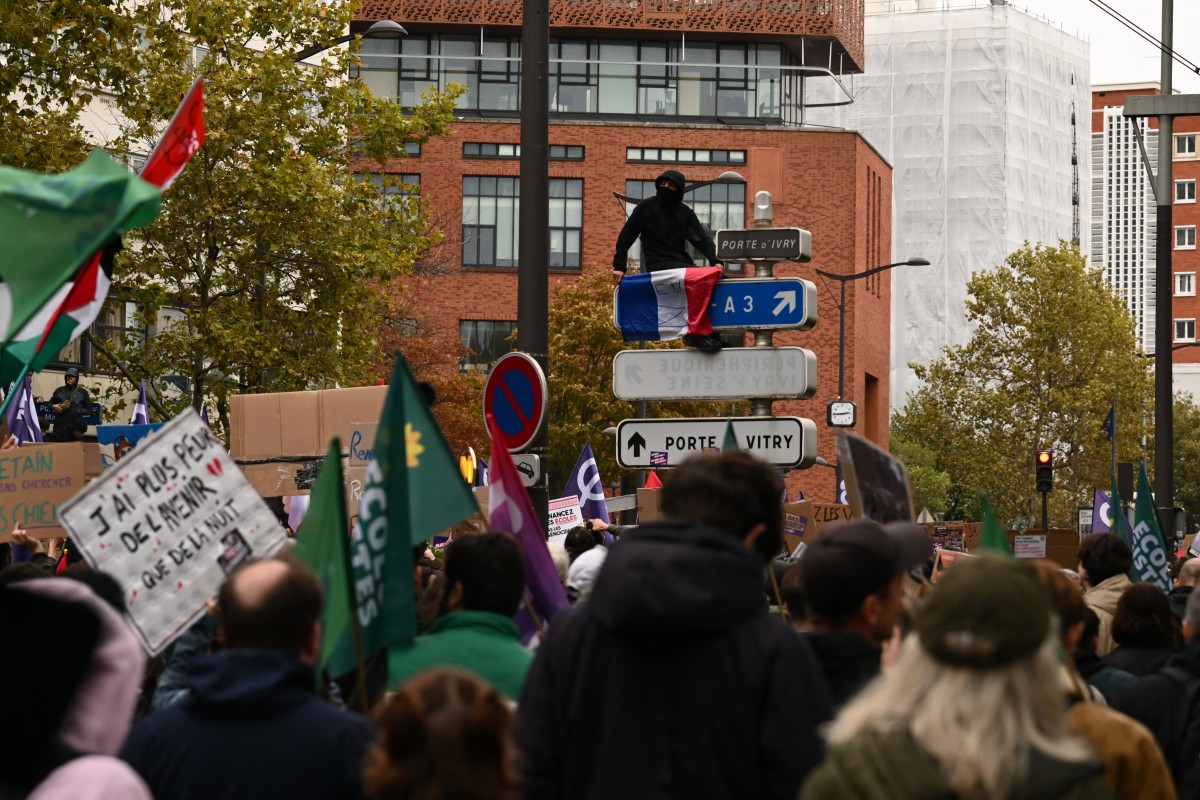
Young people have been called on to take to the streets in German cities on October 31st in a stand against the rising cost of living, conscription and to demand better education. Here’s the latest, and what you should know.
Young French people started the movement – and now protests are set to come to Germany.
The ‘Gen Z regelt’ (Gen Z regulates) initiative is calling for nationwide demonstrations in nearly 30 cities from 2pm on Saturday, October 31st.
Tens of thousands of people have indicated they want to join the demonstrations.
However, concerns over the organisation of the events have come up, while worries remain over the potential for violence. Here’s what we know so far.
READ ALSO: Huge protests at German Gen Z protests on Halloween
Who is behind the initiative?
Gen Z regelt sees itself as an independent, non-partisan alliance of young people in Germany who are campaigning for “education, health, climate action and an affordable life, against conscription and against austerity”.
“We are young people who no longer want to watch decisions being made about our future without us being heard,” they say on their website.
The group set out its agenda in a position paper calling for action on things like “dilapidated schools” as well as calling out increased surveillance and the shortage of skilled workers in Germany.
The movement also slams what it sees as an unfair distribution of the financial burden, arguing that government budget cuts disproportionately affect younger generations while large companies continue to benefit and billions of euros are spent on the military.
The group heavily opposes recent changes to military conscription and the related mandatory medical screening of young men.
“We are expected to be trained for wars we have never had a say in,” the initiative says.
The movement says they are inspired by youth protests across Europe, including France, Belgium and Spain.
However, resistance against German government policies has been stirring for several weeks, particularly among young people in Berlin, with a number of small-scale demonstrations and school walkouts taking place.
What are the concerns about the initiative itself?
Questions have emerged over some of the organisers and groups that have joined the alliance.
According to German newspaper Tagesspiegel, the Berlin Gen Z regelt organising team appears to have collapsed and activists who had been involved have reportedly withdrawn.
The paper said this week that practical arrangements for the planned rally at Brandenburg Gate, set to begin at 2pm Saturday, including a stage, stewards and a list of speakers, had yet to be organised.
Former members have also questioned the initiiative’s handling of donations. More than €11,000 has been raised through a GoFundMe campaign but there have been disagreements about the protests’ aims and how funding should be used.
Earlier this week, the Bundesschülerausschuss or Federal Students’ Committee distanced itself from the protests due to “opaque organisational structures”.
It stated that there was “a risk that the serious concerns of young people could become a pawn in political manipulation and polarisation”. It added that this did not do justice to the concerns and demands for a good education and secure future.
Where are the demos set to take place?
The protests are scheduled to go ahead in 28 cities around Germany, with Gen Z regelt directly organising the events in Munich, Berlin, Cologne, Hamburg and Frankfurt. Partner groups are organising the demos in other cities.
Around 144,500 people had indicated that they planned to attend the protests as of Wednesday.
Are the protests expected to be peaceful?
Organisers have explicitly rejected violence. “Only through peaceful means can we achieve something together,” says Gen Z regelt.
However, there are worries about calls for violence circulating on social media, including in Telegram groups, and about the potential involvement of radical groups or individuals.
It comes after recent unrest elsewhere in Europe involving extremists. In France, largely peaceful mass protests have seen major disruption and looting in several places. Shops and public buildings have been damaged while some police officers have been injured.
READ ALSO: Protest violence – Is it safe to come to France this autumn?
A protester holds a French flag bearing Gen Z sign during a demonstration in favour of purchasing power, the protection of public services, and fiscal and social justice, in Paris on October 24, 2026. (Photo by Aris MESSINIS / AFP)
In response to an enquiry from AFP, Germany’s Interior Ministry emphasised that a clear distinction must be made between “peaceful student protests” and a “violent extremist scene” which “may use the protests to spread violence”.
Politicians have weighed in, with conservatives raising concerns about bad actors.
“The network within the far-left extremist scene is international and coordinated,” Marc Henrichmann (CDU), chair of the Bundestag’s Intelligence Services Oversight Committee, told Handelsblatt.
SPD home affairs politician Sebastian Fiedler, said the focus should be on those who “stir up tensions in the digital sphere”.
The opposition has struck a different tone, with a focus on peaceful protests.
Green party parliamentary leader Britta Haßelmann said “young people have a right to be heard and to peacefully protest for their future”.
In recent years, the younger generation in Germany has demonstrated peacefully on many occasions, including against climate change, military conscription and fascism.
How are the authorities preparing for the protests?
Federal and state security authorities are liaising closely, including through the Joint Centre for Countering Extremism and Terrorism (GETZ).
“In close consultation with partner countries”, the security authorities are “conducting ongoing threat assessments”, a spokesperson for the Interior Ministry said.
The Federal Office for the Protection of the Constitution is also stepping up its monitoring of relevant websites and social media channels “where calls for violent participation or for the use of the demonstrations to spread violence could be shared”.
Thousands of police officers are set to deployed at the demonstrations on the day.
The German Police Union (DPolG) pointed out that protests coincide with Halloween, which presents additional challenges for law enforcement – for instance, in enforcing the ban on wearing face coverings.
Disclaimer : This story is auto aggregated by a computer programme and has not been created or edited by DOWNTHENEWS. Publisher: thelocal.de