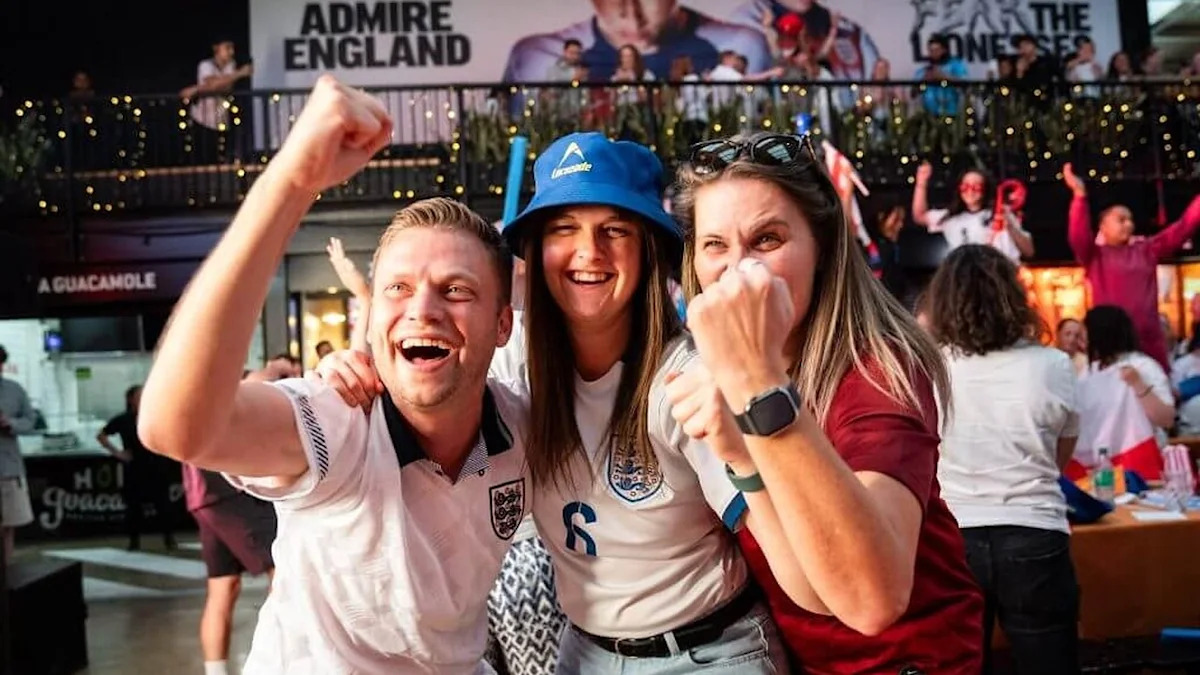
It’s official: the 2035 Women’s World Cup belongs to the United Kingdom.
This shouldn’t come as a surprise. England, Scotland, Wales and Northern Ireland were the only bidders for the tournament, with the decision confirmed at a special FIFA meeting on Monday.
Advertisement
Even so, the announcement is significant. The UK has not hosted a senior World Cup, men’s or women’s, since England staged (and won) the men’s edition in 1966.
Nine years can feel like a long way away and, in the history of Women’s World Cup bidding rights, it is. Never before has a host nation for the women’s tournament been confirmed this far in advance.
For the UK, it means time is both on the four home nations’ side and of the essence. The bid was clear in its expectations and ambitions: 104 matches, 48 teams, a potential 22 stadiums, 16 host cities, 4.5 million fans attending and 3.5 billion watching from their televisions around the globe.
But what other ambitions does the UK have and what unknowns remain? The Athletic outlines the main talking points below.
Advertisement
What do we know about dates and venues?
Despite being the only bidders in the process, there are still many unknowns.
Exact dates are to be confirmed, though we do know the tournament will consist of 104 matches over 39 days, with 48 teams competing (16 more than will be involved in next summer’s World Cup in Brazil).
In the UK’s official bid, 19 venues were definitively included, the majority (14) of which are in England, with two from both Wales and Scotland and one in Northern Ireland.
England’s venues are: Villa Park (Birmingham), the Amex (Brighton), Ashton Gate (Bristol), Elland Road (Leeds), Hill Dickinson Stadium (Liverpool), Emirates Stadium (London), Selhurst Park (London), Tottenham Hotspur Stadium (London), Wembley (London), Etihad Stadium (Manchester), St James’ Park (Newcastle), the City Ground (Nottingham), the Stadium of Light (Sunderland), and Old Trafford (Manchester).
Advertisement
The Scotland venues are Glasgow’s Hampden Park and Edinburgh’s Easter Road. Wales’ stadiums are Cardiff City Stadium and the Principality Stadium, both in Cardiff, while Northern Ireland’s Windsor Park (Belfast) is also included.
Wembley is currently the only venue listed as a potential host for the competition’s final.
However, that doesn’t mean other stadiums cannot still be a potential host venue — or even a venue for the final. In fact, Birmingham City’s new ground, Wrexham’s redeveloped Racecourse Ground, and any new Chelsea stadium can also be in the mix.
No timeframe for when the stadiums must be finished has been provided, with such deadlines falling under FIFA’s jurisdiction, according to the Football Association’s director of women’s football, Sue Day.
Advertisement
Day said the choice of stadiums was a reflection of the anticipated attendance at matches both from FIFA and the host nations themselves. England arguably underestimated this when hosting the Women’s Euros in 2022, with many matches held at smaller venues sold out and fans clamouring for tickets.
Where specific groups of games will be held, if they will be geographically locked, or limited to a certain number of miles, is also to be determined at a later stage in planning.
Is Wembley going to host the final?
Wembley was the only stadium listed under potential venues for the final, but Day says this is not a guarantee that it will host the showpiece match. Rather, it is the product of Wembley being the only stadium meeting the technical requirements for a final venue.
Advertisement
If other venues — including Manchester United’s new stadium or Birmingham City’s new stadium — meet these standards during their redevelopments, there is opportunity for them to be up for selection for the final.
Will the home nations qualify automatically?
It is common for World Cup hosts to receive automatic entry to the tournament without the need to qualify, as evidenced in the men’s World Cup this summer by Canada, Mexico and the U.S. men’s national team.
But it is not yet clear whether the four home nations will be granted places automatically for 2035.
FIFA is yet to inform England, Northern Ireland, Scotland or Wales of the details around this issue, though the tournament is still nine years away and qualification would not begin until around two years before the competition.
Advertisement
A FIFA spokesperson said: “The slot allocation for the 2031 and 2035 edition of the FIFA Women’s World Cup will be confirmed in due course by the FIFA Council.”
Once FIFA has decided on the automatic spots, then the onus is on UEFA, European football’s governing body, to come up with a qualifying procedure which will then need to be ratified by FIFA.
For those who do qualify, going as far as possible in the tournament is paramount to building support for the team and for women’s football in that specific country, but also for the energy around the entire tournament.
Yet, where the home nations sit in the wider women’s football ecosystem is incredibly stratified. England are in the top five of FIFA’s rankings and have won successive Euros. Neither Wales nor Northern Ireland have reached a Women’s World Cup, while Scotland have only done so once, at the 2019 edition in France. All three sit outside the world’s top 20 and do not have fully professional domestic top flights, but rather a mix of professional and semi-professional clubs.
Advertisement
Day says there is an understanding between all of the home nations about the importance of improving all four nations’ prospects of competing, not just qualifying. “Part of the work going on in the background is all of that work, driving participation, building pathways,” said Day. “Some of that will be joint, but a lot of it is about each home nation working in their own geography with their own circumstances to do that.”
The UK associations have been critical about FIFA’s leadership. Will that cause friction?
It’s no secret that the various home nations’ associations have been critical of FIFA president Gianni Infantino. But Day insisted the issue of FIFA leadership is separate to that of hosting a Women’s World Cup.
Women’s football at FIFA is under the leadership of Jill Ellis, with whom Day and the other home nations’ FAs feel positive about working. There is also an expectation that, by 2035, FIFA “will be in a different place”.
Advertisement
What can we expect around ticket pricing?
The stated aim is for 4.5 million fans to attend matches at the 2035 tournament, but ensuring they can afford the tickets in the first place will be a big factor in securing that number.
As of now, the model for pricing (whether dynamic or set prices) falls under the jurisdiction of FIFA, but it remains one of the areas that critics of the current leadership feel needs to be addressed.
Next summer’s Women’s World Cup has announced tickets as low as $5 (£3.80), a price ostensibly aimed at encouraging fans to travel to Brazil in the first place.
Day says there is hope the UK bid can influence decisions on pricing to show the commercial viability of women’s football and make it as accessible as possible.
Advertisement
“It’s FIFA’s tournament, but we have eight-and-a-half years to think about how to make it the best possible,” Day said. “We want them to have an experience that is as affordable and as great as possible.”
Are falling WSL attendances a concern?
Falling attendances at women’s football matches have been a major talking point over the past two seasons. First, it’s worth pointing out that attendances are, barring the Premier League, dropping or stagnating in almost every league across Europe, so women’s football is not unique in this sense.
Even so, there is an ongoing debate about the best way to grow and attract attendees and to retain them. Leading up to the 2035 edition, there is a desire to ensure there is more excitement about and visibility of the domestic leagues, not just the WSL and English pyramid, but also the Scottish Women’s Premier League, Wales’ Adran Premier League, and Northern Ireland’s Women’s Premiership.
Advertisement
“There are a lot of conversations about attendance,” Day said. “What I would say is growth never goes like that. It’s not linear. You’re testing and learning, trying new things, working through the challenges that come with different stages of growth and economy and all those kinds of things. We will be working very closely with the WSL to use this as something to build towards, generating excitement, for commercial growth and attendances. 2035 will be a massive part of that.
“We want commercial growth as much as we want participation growth, as much as we want player pathway growth. So we’ll be working very closely with them.”
Could 2035 affect the UK’s chances of hosting a men’s World Cup?
Winning the right to host another men’s World Cup has been a challenge for the FA, having failed to do so twice since 1966.
Advertisement
Whether a successful Women’s World Cup could influence the fortunes of another bid is a matter of opinion, but there is a thinking within those behind the 2035 bid that it certainly cannot hurt.
Day says any legacy of the Women’s World Cup relies on ensuring the tournament is the best it can be.
What do the FA think the legacy of this tournament can be?
Day did not stutter when she insisted this World Cup could “change the world”.
The 2022 Euros arguably had a butterfly effect not just across England, but Europe, from investment to attendances to grassroots development and participation. The World Cup, then, is an extension of that.
Advertisement
Specific legacy impacts are important, though. Increasing the number of female coaches is one of them, as is showcasing the commercial viability of women’s football around the globe.
There is also the societal impact of hosting the first World Cup on UK soil since 1966. Day sees this as an opportunity not only to inspire women and girls to participate in and embrace women’s football, but to do the same for boys and men as well.
“This can touch everyone in the country and show everyone that girls can do this, too, so for me it’s a DNA leveller,” she said. “We’ll need to be more deliberate and specific in our intentions and ambitions and that’s to come. But something so big and impactful can change perspective, and that’s the goal here.
“I appreciate it’s overused, but this is genuinely once in a lifetime, a once-in-a-generation opportunity. We need to collectively grasp this moment and think of it as a catalyst for growth, inspiration and something to springboard from.”
Advertisement
This article originally appeared in The Athletic.
England, Scotland, Wales, Northern Ireland, Women’s Soccer, FIFA Women’s World Cup, England England, Scotland Scotland, Wales Wales, Northern Ireland Northern Ireland, Top Sports News
2026 The Athletic Media Company
Disclaimer : This story is auto aggregated by a computer programme and has not been created or edited by DOWNTHENEWS. Publisher: Sports.yahoo.com