It’s a step in the right direction
Lando Norris: “I certainly think that’s a great direction, we all welcome that as drivers, we all want that, I think that will eliminate a lot of the talks that we have about not going on throttle here and doing this and that.
“Maybe it’s not perfect, and it’s not the perfect world that we all want, but it certainly will be in the correct direction. And that’s what we want for the future, it’s what we want for racing, it’s what all of us want as drivers, so the FIA are doing as much as they can, you still have to try and please a lot of people, but if you want the sport to be better, if you want the racing to be better, if you want the drivers to be better and happier, that’s certainly the correct direction to go.”
Max Verstappen: “It’s definitely heading into a very positive direction. It’s like the minimum I was hoping for and it’s really nice that that’s what they want to do. That’s definitely what also the sport needs.”
Isack Hadjar: “It’s something I think is 100% a huge step in the right direction and it’s something we want to see happen and we take the right decision.”
It’s good, but it’s not the fix
Oscar Piastri: “It’s a step in the right direction, but if it’s a step, it’s not the fix. Even with the previous engines we had, which were 80-20 or 85-15 split, even at some circuits, we didn’t have full deployment everywhere. We were very close, and at a lot of the circuits we did, but until you find a split where you can maintain that full electrical power everywhere, it’s always going to be a little bit odd for us as drivers on the straights.
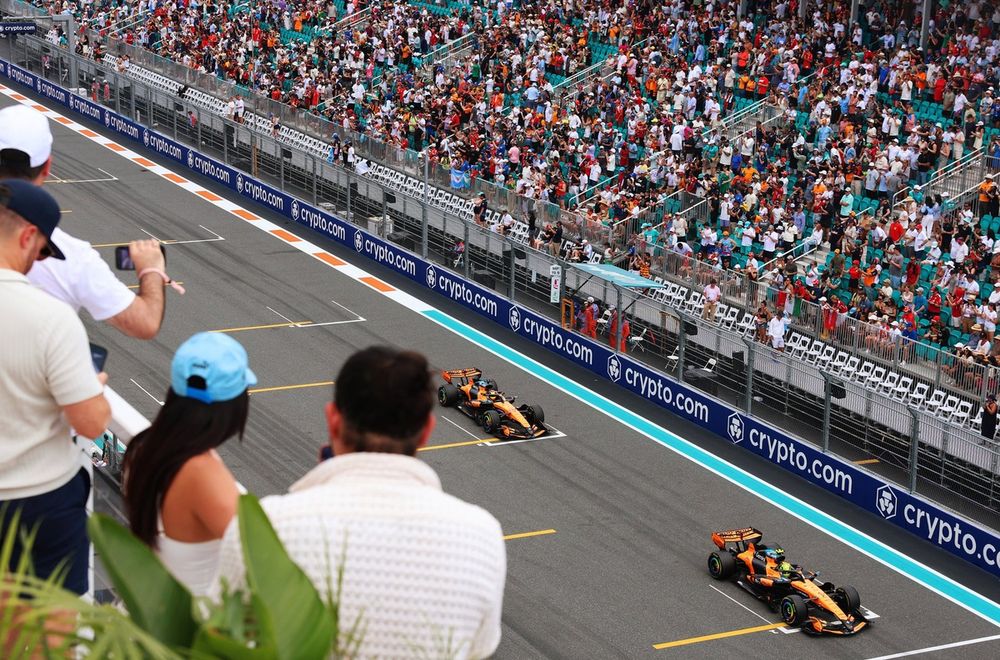
Lando Norris, McLaren, Oscar Piastri, McLaren
Photo by: Steven Tee / LAT Images via Getty Images
“And no matter what the split is, you’re going to have these troubles with opening a qualifying lap, getting the battery in the right level. It’s such a fine and difficult balancing act of having the battery in the right state, because either you start the lap with not a full battery or you start it with no boost pressure in the turbo, and there’s not really a solution to that apart from changing the hardware. So that’s really the only full fix, but it is a step in the right direction if we do that.”
I have no idea
Sergio Perez: “Until we run, what it means at 60-40, we don’t really will know. And it will vary from circuit to circuit so much. It was really nice to see the steps FIA and F1 were willing to do in Miami. They were really much better in a much better direction. So yeah, let’s see a couple of races like this and see if we can adjust for the future.”
Let’s make sure it works for everybody
Charles Leclerc: “First of all there have been a few steps that have been going in the right direction already. Is this enough? There are still some other steps that we can make. Which are the ones that we need to do? This is another topic.
“Obviously those rules have been a big change and teams have been working since many years now in order to make sure that we are ready and that you take kind of a direction of development for these few years, and with the change of next year you need to be careful not changing the balance of what has been done in the past years, so that’s the trickiest point.

Charles Leclerc, Ferrari
Photo by: Sona Maleterova / Getty Images
“We have to do something to try and make it better, sure, but we need to be cautious in which way we do that, because every team has very different designs and very different ways they approach those rules, and to find something that makes sense for everybody and that is fair for everybody is probably a lot more complex than what we initially thought, so that’s why I think it’s going to be tricky to find something that is good for everybody but I know everybody is working towards that.”
It’s likely not enough
Liam Lawson: “It all helps. It’s just a question of whether it’s enough. I don’t fully know. It’s positive that we’re moving in this direction – improving things, trying to improve things. Whether it’s enough to make a big enough difference, I really don’t know.
“It’s great that we’re making this step, but the cars are a lot down on downforce than what we were in the past, almost compensate for the lack of battery that we have. Honestly, it wouldn’t be fair of me to say ‘no’ until we drive them. But in my head, it’s probably still not enough.”
Alex Albon: “We’ll see, because I think it’s not finalised yet. I’m always just wondering, is it enough? Are we taking away the issues of, ‘Is it pure? Is it genuinely the fastest car, the fastest driver, does the fastest lap time?’
“I don’t think it would be totally fixed from what I’ve seen so far. As long as we can just get rid of that stuff, get rid of throttle, driving styles affecting different things, all these kinds of things, then we’re kind of good to go.”
These cars can’t be saved

Carlos Sainz, Williams
Photo by: Sona Maleterova / Getty Images
Carlos Sainz: “For us drivers that will never be enough. We all love what we love which is if there is electrical it should be an add-on rather than a dependency on electrical power like we have now. In the past we’ve had KERS, we’ve had the previous power unit regulations which the electrical felt more like an add-on on top of already what was a solid power unit. For drivers, purists, even journalists like you guys, we will always believe a 60-40 probably is still also not enough but at least something you can race with until real racing and real engines come back in 2030.”
Fernando Alonso: “The DNA of these power units will always be the same, and it will always reward going slow in the corners.”
Additional reporting by Filip Cleeren, Stuart Codling and Ronald Vording
We want your opinion!
What would you like to see on Motorsport.com?
– The Motorsport.com Team
Disclaimer : This story is auto aggregated by a computer programme and has not been created or edited by DOWNTHENEWS. Publisher: motorsport.com