“Do you know how to work with this?” reads the text on banners erected across Tehran, emblazened with the image of a rocket-propelled grenade, a sniper or assault rifle, or other military or communications equipment.
The Iranian authorities’ public messaging campaign is part of a push to train and arm volunteer civilians who would serve as part of state security under the Basij militia arm of the Islamic Revolutionary Guard Corps (IRGC).
Recommended Stories
list of 4 itemsend of list
The Islamic Republic first unveiled the messages as part of a major mobilisation drive – called Janfada or “those who sacrifice their life” – in late March at the peak of the war with the United States and Israel.
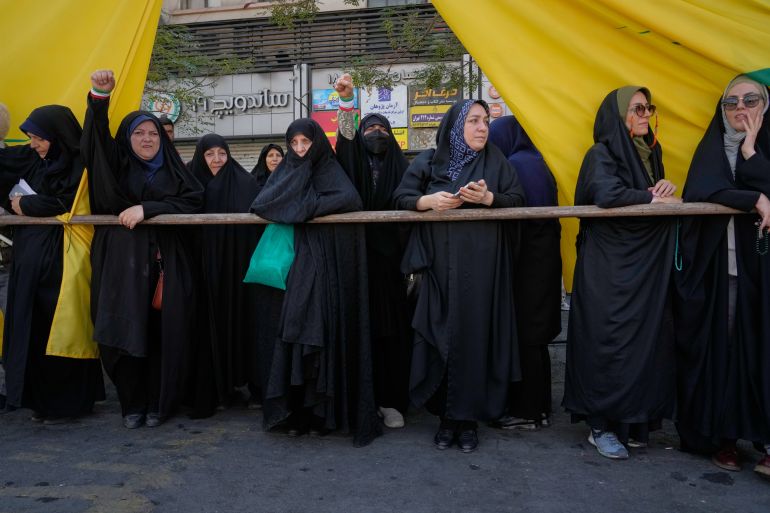
Janfada recruits held their first public “military exercise” on Friday in Tehran, where thousands of children, women and men – many masked and wearing shades – marched on downtown streets.
Prior to the event, the authorities called it a march of 313,000 people, although footage broadcast by state television did not appear to justify this claim. In Twelver Shia tradition, 313 is the number of the core companions of Mahdi, the messianic hidden imam who will reappear near the end times to establish justice.
Hassan Hassanzadeh, head of IRGC in Tehran, told state broadcaster IRIB that more than 600,000 people had heeded the call this week for the active mobilisation part of the campaign by registering on a website.
The authorities said more than one million people were expected to sign up, and that they had already formed an initial 1,000 units, described as “battalions”.
The Janfada campaign raised eyebrows just one month after its launch in late March when authorities claimed that more than 31 million people – which represents just over a third of Iran’s total population – had registered. It would also be more than half of the over-12 population, men and women.
Advertisement
Foreign-based activists accessed the website’s source code, which showed that fewer than four million people had registered. Only a phone number was required for registry, with no national identification number needed.
After the controversy, a ticker showing the number of recruits slowed down significantly, but then, the IRGC’s Hassanzadeh claimed on Friday that 33 million people are now registered. Authorities have not released documentation to back their figures.
The mobilisation effort is not exclusively military, as organisers said 26 percent of registrants selected military and security work, with other categories including rescue, social services, media, and financial support.
President Masoud Pezeshkian asked the volunteers during Friday’s parade to tangibly help his administration by consuming less fuel, electricity and other resources at a time when the country is challenged by energy imbalance and wider economic turmoil.
The government increased the price of fuel and limited petrol quotas allocated to personal vehicles earlier this month as it battles a budget crunch and fuel production shortfalls related to the war.
Iranian households and industries have also been afflicted, with intermittent power blackouts throughout the summer, with the upcoming cold season expected to bring more natural gas shortages in the resource-rich country.
Focus on children
The latest display of the “sacrifice” campaign in Tehran focused on children. Some teenagers were shown wielding assault rifles and other weapons during Friday’s military exercise, while others marched in the procession. Armed teenagers have been seen manning checkpoints and roadblocks on the streets of Tehran and other cities over recent months.
Sasan Zare, the spokesman of the Janfada campaign, told the state-linked Iranian Labour News Agency on Saturday that boys over 15 have been allowed to register for the campaign, but that there were also plans for under-15s to be recruited.
“Our effort concerning children and teenagers, first and foremost, is to introduce them to the culture of sacrifice and resistance,” Zare said.
“The stronger their value system is formed from childhood, and the more they become familiar with concepts like patriotism and self-sacrifice, the more significant the impact can be on their future.”
Women also featured heavily during Friday’s display, with many chador-clad volunteers wielding weapons on the streets.
Some of them were shown riding on motorcycles, despite women being officially banned from doing so in civilian life.

What’s the purpose?
During Friday’s parade, Iranian military hardware used in the war against the US and Israel went on public display.
Advertisement
The efforts come as Iran and the US clash over the future of the Strait of Hormuz and the outcome of the war. The US continues to impose a naval blockade of Iran’s southern ports and has intensified its sanctions on the country.
Iran’s security chief Mohsen Rezaei told Al Jazeera that seven conditions for negotiations had been relayed to Washington through intermediaries, but added that commanders were also prepared to resume the war.
The authorities have not elaborated on why they require hundreds of thousands of civilians to take up arms or engage in other security activities, considering that there are no prospects of a ground war with the US in the foreseeable future.
The campaign comes months after thousands were killed during nationwide protests in January, which Iranian authorities describe as a “coup” orchestrated by the US and Israel and armed agents acting in line with their interests.
A United Nations fact-finding mission alleged on Friday that the Islamic Republic committed crimes against humanity while cracking down on the protests. Amnesty International last week presented a lengthy report that identified dozens of senior authorities who engaged in crimes against humanity during the 2022-23 protests over Mahsa Amini, a young woman who died in Iranian police custody after being detained for wearing “improper hijab”.
Iranian authorities have repeatedly warned against more public protests in recent weeks, emphasising that any act perceived to be undermining national security and “social cohesion” is strictly forbidden.
Ali Alfoneh, a senior fellow at the Arab Gulf States Institute, told Al Jazeera that he perceives the Janfada campaign as an effort to rebrand the Basij militia, which has become associated with the violent repression of protests.
He explained that following neighbouring Iraq’s invasion of Iran in 1980, hundreds of thousands of Iranians volunteered for front-line service out of a sense of religious or patriotic duty. These were mobilised through the Basij.
“Since the end of the war in 1988, however, the Basij has evolved into an instrument of domestic coercion and the suppression of dissent, severely damaging the organisation’s public image,” he said.
The public mobilisation campaign could thus be viewed as an attempt to restore the Basij’s former patriotic image in anticipation of future internal and external threats – “if not a US ground invasion of Iran, then the prospect of a US- and Israeli-instigated civil war in Iran’s peripheral regions, as well as large-scale popular uprisings driven by mounting economic pressure”, Alfoneh said.
Disclaimer : This story is auto aggregated by a computer programme and has not been created or edited by DOWNTHENEWS. Publisher: aljazeera.com