

The 70th Eurovision Song Contest has come to a close with a resounding Bangaranga. Bulgaria took home the win, thus squashing Australia’s hopes that Delta Goodrem would eclipse the competition.
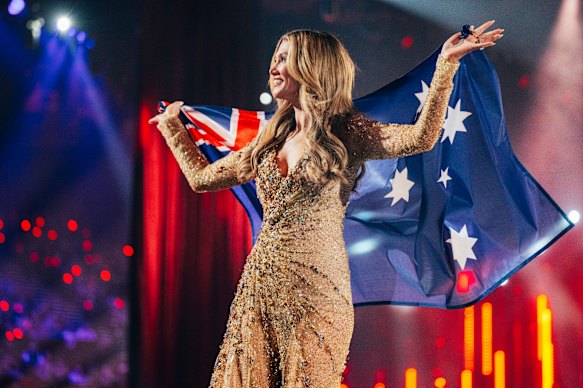
Though victory didn’t come Goodrem’s way on Sunday, the renowned singer-songwriter still managed to make it into the top five with her dazzling performance of Eclipse, placing fourth overall. She was edged out by Romania, Israel and, of course, Bulgaria.
The question on every Aussie’s minds now is: What next? Placing fourth in the world’s longest-running and biggest music competition is no small feat – it takes technical skill and major star power. How will Goodrem capitalise on this result?
Here’s a rundown of what could come next for our golden girl, as well as other key moments from this year’s contest.
Goodrem’s golden era
Before storming the Eurovision stage, Goodrem was already a well-established talent, in Australia and abroad. She even helped previous Eurovision winner Celine Dion write songs.
However, her actual participation in the contest is likely to send her into a new stratosphere of fame, particularly in Europe, where Eurovision is a sacred annual tradition.
With an audience estimated to have exceeded 100 million viewers, Goodrem’s finale performance presumably marked the biggest of her professional career. Beyond the sheer size of the audience, her performance was widely praised, catching the attention of Prime Minister Anthony Albanese and UK television presenter Graham Norton. Professional singing coaches like Tim Welch highlighted her vocals as some of the strongest in the competition.
The spectacle of Eclipse, meanwhile, caught the public’s attention. Her hand-crafted golden gown, co-created by Sydney label Velani and Nicky Apostolopoulos, was covered in 7000 Swarovski crystals, and took more than 500 hours to sew. This masterpiece, replete with a heart centrepiece by Emmanuel Tsakiris’ House of Emmanuele, sparkled over the crowd as Goodrem was raised into air by a Versa Ribbon Lift – an automated stage elevator that has been used by Beyoncé.
If anything, Eurovision marks a new beginning for Goodrem. Days before the semi-final, she announced she would drop new music later this year, marking her first full-length project in five years. The album, titled Pure, will land on November 6.
The timing of the announcement further proves this isn’t Goodrem’s first rodeo – she knows how to make the most of a stellar moment.
“Eclipse is the beginning of a new era,” Goodrem told reporters shortly after the final. “It feels like more than a new era; it feels like a new book right now. I’m ready to step into that with everybody, and step into this new chapter with a full force. It’s kicked off in a really great way.”
Though Australia’s involvement in a European singing contest still baffles some, many Aussies have managed to cement themselves as Eurovision royalty. Dami Im, for example, propelled Australia into the spotlight in 2016 after placing second. She has since toured the world, released studio albums, won The Masked Singer Australia, and served as the Australian spokesperson for this year’s Eurovision.
After coming ninth in 2019, Kate Miller-Heidke became a coach on The Voice Australia, released new albums and reached No. 2 on the ARIA charts. She co-composed the musical comedy Bananaland, which won best musical and best composition at the 2024 Matilda Awards.
Guy Sebastian also came close, placing fifth in 2015 – Australia’s first year in Eurovision. Granted, he was well known ahead of the contest, but his performance arguably further bolstered him as a global talent. It led him to a long stint on The Voice Australia, arena tours, ARIA awards and even the honour of being appointed a Member of the Order of Australia for his service to the music industry and charity.
Like Sebastian, Goodrem was already a household name well before Eurovision. While placing in the top five may not significantly transform her career, it could at least mark a major resurgence after a few years largely away from the spotlight.
Voting madness
Eurovision’s voting system has long confounded, and this year proved no exception. The final scores were determined by public “televotes” and professional jury votes, making it almost impossible to predict.
Though all eyes were initially on Finland, Australia, Greece and Denmark, the only country to actually get into that top four was Australia. The list was rounded out by Bulgaria, Israel and Romania. Bulgaria proved most impressive given it was barely in the conversation before the final.
The vote count was, as always, unpredictable and stressful, as jury votes failed to align with public votes. For example, Malta managed to impress the jury, but its televotes flopped. Moldova, meanwhile, swept the audience votes, even making it to the top of the leaderboard at one point. This was short-lived, however: the public votes brought them down a notch – or eight.
Broken strings
Finland was the one to beat heading into the final. While Linda Lampenius and Pete Parkkonen’s Liekinheitin (Flamethrower) didn’t win (they came sixth), it certainly wasn’t for lack of trying.
While pop star Parkkonen sang about the torture of unrequited love, Lampenius gave everyone in the crowd goosebumps with her ridiculously impressive violin skills, set to the background of actual flames. At one point, she played a solo with such vigorous passion that the strings on her bow snapped off. Now that’s dedication.
It’s even more impressive given they had to receive special permission to have her play the instrument live on-stage. Usually, Eurovision strictly bars live instrumentalists.
All-star medley chaos
Eurovision celebrated its 70th anniversary with a hectic medley of all-star performances, welcoming back some of its most memorable participants. This included Lordi, the monster costume-clad Finnish group that sent the contest into a tizzy in 2006 with Hard Rock Hallelujah. Ukraine’s first-ever winner, Ruslana, also returned, as did Norway’s Alexander Rybak, who in 2009 received the highest Eurovision score ever at the time.
The celebration involved a real whiplash of genres, ranging from headbanging anthems to Alpine folk ditties. But it ended the only way it could: With a rendition of Waterloo, the song that catapulted ABBA from the Eurovision stage to global stardom.
Israel, boycotts and boos
Israel’s participation in this year’s song contest quickly became a key talking point given the war in Gaza, with some countries deciding to boycott the event.
This included Spain, one of the “Big Five” – the biggest members of the European Broadcasting Union ,which automatically secure slots in the final – and Ireland, one of the most decorated countries in Eurovision history.
Also boycotting the event were the Netherlands, Iceland and Slovenia. Some referenced Russia’s ban from the contest following its invasion of Ukraine in 2022, noting that similar action had not been taken against Israel.
According to the ABC, these boycotts meant this year’s Eurovision had the smallest pool of competitors in more than 20 years.
This didn’t stop Israel from placing second overall, with much of its support coming from the public vote. However, boos could be heard throughout Vienna’s Wiener Stadthalle arena. The boos were audible during the performance broadcast and as the scores were read out.
Find out the next TV, streaming series and movies to add to your must-sees. Get The Watchlist delivered every Thursday.
 Nell Geraets is a Culture reporter at The Age and The Sydney Morning Herald.Connect via X or email.
From our partners
Disclaimer : This story is auto aggregated by a computer programme and has not been created or edited by DOWNTHENEWS. Publisher: www.smh.com.au


