

Whether you find yourself watching fireworks over the Rhine, wandering through a medieval market or taking part in a parade through Berlin, July is a month that rewards curiosity.
July in Germany tends to arrive with a certain intensity. Parks fill up, lakes become crowded and riverbanks turn into evening meeting points.
It’s also the month when the events calendar really stretches in all directions. Big city festivals, medieval spectacles, riverside fireworks and local fairs all compete for attention in different corners of the country.
In other words, even if the heat sends you searching for shade – and assuming you can tear yourself away from the football – there’s no shortage of things to do.
Here’s our pick of ten events taking place across Germany this July that are worth making the trip for.
June 19th to July 19th: Tollwood Summer Festival, Munich
The Tollwood Summer Festival unfolds over a full month in Munich’s Olympiapark, gradually building into one of the city’s most varied cultural gatherings. At its heart is a sprawling site that mixes music, theatre and performance with a “Market of Ideas” selling crafts and international food.
One of the defining features of Tollwood is how easy it is to drop into. Much of the programme is open access, meaning you can wander between stages, stumble across live music or settle into one of the many spaces designed for just hanging out.
While entry to the festival grounds is free, larger headline concerts take place in the dedicated Musik‑Arena and usually require a ticket. International acts and established artists due to play in July include Anastacia, Rick Astley, Joss Stone and Emeli Sandé.
READ ALSO: Where are Bavaria’s best swim spots?
July 1st to July 5th: Breminale, Bremen
For five days at the beginning of July, stages, tents and food stalls line the banks of the Weser along the Osterdeich, creating an open-air space where music, art and everyday life blend together.
The Breminale is one of those festivals that seems to take over the rhythm of a city for a few days each summer. The programme is deliberately broad, with live music, theatre, dance, readings and street performance all unfolding side by side.
Circus-style tents host concerts, jugglers and performers move through the crowds and children’s activities sit comfortably alongside more relaxed cultural offerings.
July 3rd to July 19th: Kiliani Volksfest, Würzburg
The Kiliani Volksfest brings a more traditional rhythm to July, transforming part of Würzburg into a classic German fairground.
The festival takes its name from the Franconian patron saint, St. Kilian, who is remembered each year on July 8th. He is also the patron saint of rheumatism.
The atmosphere at the festival revolves around rides, food stands and the easy, slightly nostalgic feel of a Volksfest. Families wander between attractions in the daytime, while evenings tend to feel more sociable, with people gathering to eat, drink and enjoy the buzz of the fair.
READ ALSO: Four reasons to visit a German wine fest this summer
July 4th: Rhine in Flames, Bingen & Rüdesheim
The Rhine in Flames event is built around a simple but memorable idea: take one of Germany’s most scenic landscapes and turn it into a stage for light and colour.
The July 4th event takes place at the gateway to the Rhine Gorge, a UNESCO World Heritage Site where castles, ruins and steep vineyards line the riverbanks on both sides.
Onlookers watch the Rhine in Flames fireworks from the Niederwald Memorial in Rüdesheim, Hesse. Photo: picture alliance/dpa | Andreas Arnold
As evening approaches, boats begin to depart from Bingen and Rüdesheim, joining a slow-moving convoy that drifts past these historic landmarks while the light gradually fades.
As night falls, fireworks are launched at multiple points along the route, lighting up the castles and hillsides in sequence. The spectacle builds gradually, with explosions echoing across the valley, before a final display is launched from a floating platform between the two towns.
Whether you watch from land or from one of the boats, the event is less about rushing from one highlight to the next and more about settling in and letting the evening unfold.
July 10th to July 26th: Kaltenberg Knights’ Tournament, Bavaria
The Kaltenberg Knights’ Tournament transports visitors into a carefully staged medieval world.
Set around Kaltenberg Castle, the event combines markets, music and performances with a large-scale jousting show in a purpose-built arena.
During the day, families wander through the market and workshops, while evenings feel more dramatic, as the main tournament becomes the focal point and the festival atmosphere deepens into night.
July 17th to July 26th: Rheinkirmes, Düsseldorf
Running for ten days along the Rhine, the Rheinkirmes Düsseldorf is a large-scale fair that blends traditional elements with modern spectacle.
The site is packed with rides, beer tents and entertainment, with the programme stretching late into the evening. Highlights during the week include scheduled drone shows and fireworks, adding to the sense that this is as much about visual spectacle as it is about classic fairground fun.
It’s one of those events where the atmosphere shifts depending on when you go – family-friendly during the day and increasingly lively as night falls.
READ ALSO: What fans should know about the Backstreet Boys’ concerts in Düsseldorf
July 17th to July 26th: Kinderzeche, Dinkelsbühl
At first glance, the Kinderzeche looks like a historical re-enactment, but for locals it’s something much deeper.
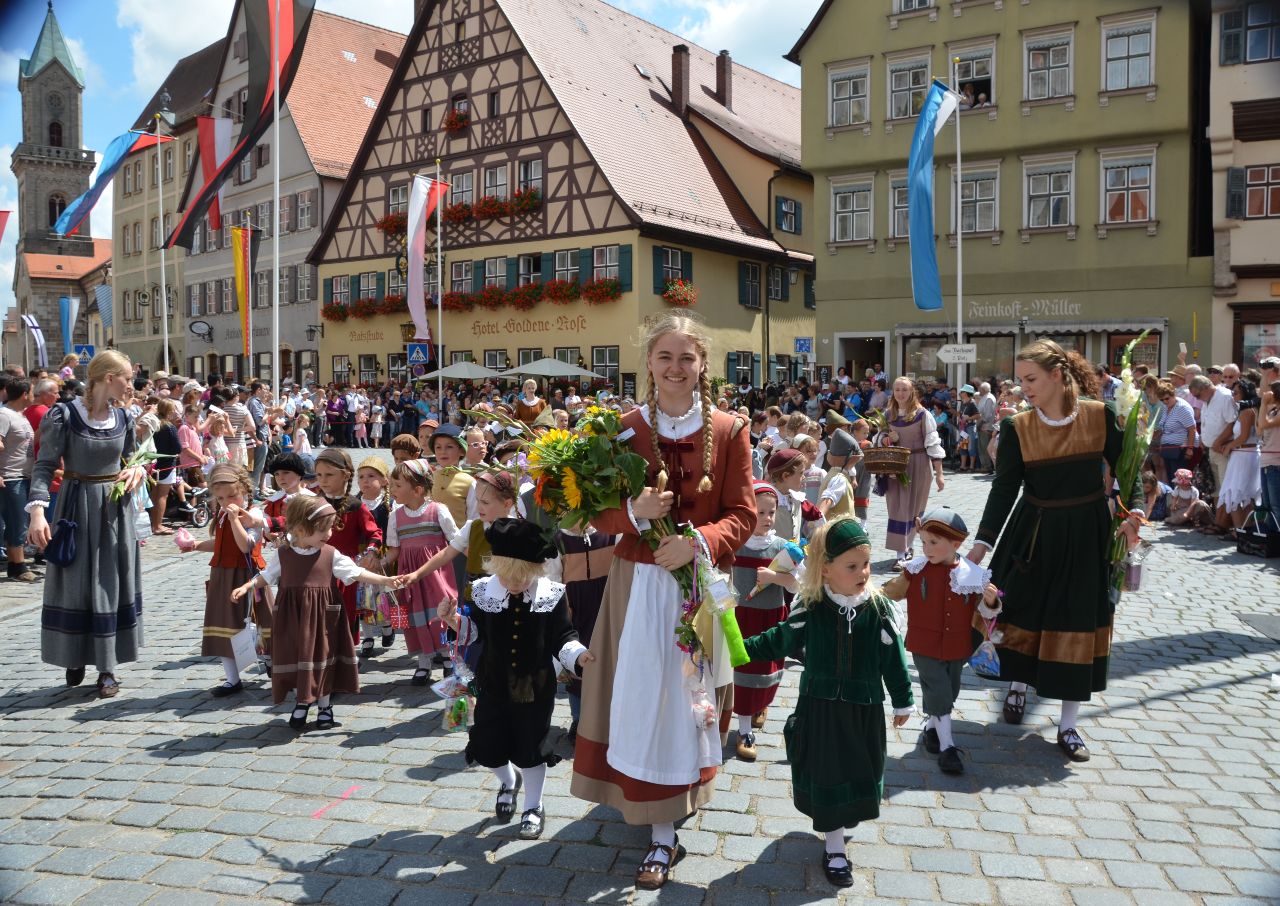
Children perform during the Kinderzeche festival in the Bavarian town of Dinkelsbühl. Photo: picture alliance / Ingrid Wenzel/Touristik Service Dinkelsbühl/dpa-tmn | Ingrid Wenzel
The festival centres on a long-standing story from the Thirty Years’ War in the seventeenth century, when children from the town are said to have persuaded a Swedish general not to destroy Dinkelsbühl. That story is retold each year through performances involving hundreds of participants, many of them local schoolchildren.
The result is an event that feels both theatrical and deeply rooted in community life, with parades, costumes and traditions that have been passed down over generations.
July 23rd to July 26th: DAS FEST, Karlsruhe
Each year at the end of July, the Günther‑Klotz‑Anlage fills with visitors of all ages, turning the park – known locally as “Mount Klotz” – into what organisers describe as southern Germany’s largest family festival.
At its core, DAS FEST is built around music. Headline acts confirmed this year include Beatsteaks, Nico Santos and Zartmann. But alongside the main stage, you’ll also find smaller stages for culture and performance, and even a Sunday morning classical concert.
What really defines DAS FEST, however, is its deliberate openness. Families gravitate toward the children’s areas or the sports zone, where skateboarding and BMX competitions bring a different kind of energy to the park.
Tickets are only required for the main stage where the big headline concerts take place.
July 24th to July 25th: Christopher Street Day, Berlin
The CSD Berlin, also referred to as Berlin’s major Pride event, is not just a parade, but one of the capital city’s most visible public expressions of solidarity and activism.
Each year, large crowds take to the streets to stand up for the rights of gay, lesbian, transgender, intersex and bisexual people, creating an atmosphere that blends political demonstration with celebration.
In 2026, the event spans two days for the first time. It begins on Friday evening with a rally at the Brandenburg Gate, ahead of the main parade on Saturday.
READ ALSO: In pictures – Hundreds of thousands march at Berlin Pride demonstration
The parade route itself winds through central Berlin, starting in Mitte and passing through Schöneberg before finishing at the Brandenburg Gate.
There are also CSD events in other German cities across the country.
Cologne’s Christopher Street Day takes place earlier in the month, from July 3rd to 5th, and is one of the largest Pride celebrations in Europe.
July 29th to August 1st: Wacken Open Air, Schleswig-Holstein
At the end of the month, the small town of Wacken turns into what organisers describe as “Heavy Metal Town,” hosting bands and fans from around the world.
If names like Def Leppard, In Flames, Powewolf and Savatage send a shiver of excitement down your spine, then the Wacken Open Air festival is for you.
Even if this isn’t usually your flavour of music, there’s still something extraordinary about the scale of the transformation – as a quiet rural setting becomes a fully immersive festival dedicated to all things metal.
Disclaimer : This story is auto aggregated by a computer programme and has not been created or edited by DOWNTHENEWS. Publisher: thelocal.de







