The gigantic sculptures, though sedentary, have been on tour. They began in New York City, on Park Avenue, from 34th Street to 39th Street in Murray Hill. Then they made their way down Manhattan to the Seaport, beside the Brooklyn Bridge. One statue (fittingly named “The Diver”) traversed the Atlantic ocean to Paris, where he arched proudly in front of the Eiffel Tower for the 2024 Olympic and Paralympic Games. Then the pieces made their way to Chicago, where they lined Michigan Avenue from the Wrigley Building north toward Oak Street.
Now, 10 of the monumental sculptures — Carole Feuerman’s “Monuments of Stillness” — have journeyed west on the back of two flatbeds and one enclosed truck to Beverly Hills, where they flank Rodeo Drive from Dayton Way to South Santa Monica Boulevard, along the Walk of Style, alongside Dolce & Gabbana, Valentino, Yves Saint Laurent, Chanel, Bottega Veneta, Fendi, Gucci and Prada, where they will remain through sometime next year. (On their way out west, they made a pit stop in Palm Desert at Melissa Morgan Fine Art Gallery to be unpacked, inspected and given any necessary touch-ups.)
“Brooke with Beach Ball” “holds her beach ball close, as though she has found a place where she can feel safe,” Carole Feuerman writes in the exhibition catalog. “I am interested in those small private moments when we let our guard down. Her stillness is tender, but it also takes trust.”
(Carlin Stiehl / For The Times)
“This is a project that I always wished I’d have, and I always wanted to have my work [be] public art because public art, to me, is people’s art,” Feuerman said on a video call late last month. “People, kids walking along the street, everybody can take advantage of public art.”
Exactly that happened on Monday morning, in the bright sunlight of a cloudless sky. Yal Liu and 7-year-old Zoe were visiting Rodeo Drive for the first time from China, and the mother stopped to snap a picture of her daughter with “Patience.” The 7-foot-long sculpture is dressed in a white bathing suit, and leans back in peace, ankles crossed. The model for this piece was Feuerman’s doctor, Holly F. Lofton, and her swim cap is gilded with 24-karat gold leaf.

“Patience is not waiting helplessly,” Feuerman wrote in the exhibition’s catalog. “It is the quiet work of gathering strength.”
(Carlin Stiehl / For The Times)
Zoe, Yal, Yal’s boyfriend Ryan Coder (and their dog Evie) soon stumbled upon the public unveiling of “Monuments of Stillness,” Feuerman’s first major public outdoor exhibition on the West Coast. The 4-feet-10, 81-year-old artist stood on platform shoes with starred soles in front of the tallest creation of the bunch — the towering, 12-and-a-half-foot-tall “The Golden Mean” (another iteration of “The Diver”). Beverly Hills Mayor Craig Corman, Rodeo Drive Committee President Kathy Gohari and Feuerman’s gallerists, Melissa Morgan and Alec Longmuir (of Melissa Morgan Fine Art), joined her.
A woman driving down the ritzy boulevard rolled down her window in curiosity and hollered at the crowd. A possibly dangerous move. Feuerman recalled that the day of the unveiling on Park Avenue (that exhibition was called “Sea Idylls”), one taxi driver almost crashed into another while peering up to see the giants.
“Public art is something that everyone can enjoy, both residents and visitors,” Corman said on a phone call from New York. “It’s something that can bring people to our city to enjoy not just the art but other things that we have to offer. … It’s known worldwide, and it just seemed to me to make the most sense to put world-class art on a world-class shopping street.”


1. The artist Carole Feuerman stands beneath her sculpture, “The Golden Mean,” inspired by Olympic gold medalist Greg Louganis. (Carlin Stiehl / For The Times) 2. A twin version of this sculpture — “The Golden Mean,” by Carole Feuerman — stood in front of the Eiffel Tower for the 2024 Olympic and Paralympic Games. (Carlin Stiehl/For The Times)
On a phone call from Singapore, Gohari said the committee considers Rodeo Drive not just a place to shop, but somewhere to experience creativity, culture and innovation. “We’re all in this very creative environment, and we believe that art should be part of everyday life,” she said. “It shouldn’t just be something that you plan to visit in a museum.”
Gohari first encountered Feuerman’s work more than a decade ago in a Beverly Hills gallery. But not everyone feels comfortable walking into gallery spaces, Feuerman said. Some people might feel intimidated — especially if they aren’t planning on buying anything.
Similarly, not everybody can afford Dior, Louis Vuitton or Loewe, and there is an irony implicit in public art placed in a rarefied atmosphere where some may not feel welcome. But the art is on the sidewalk, free for all to see.
“She’s getting international recognition because of these public exhibitions, and exposing people that maybe won’t walk into a snobby, intimidating gallery in SoHo, but are going to be exposed to this work,” said Longmuir on the joint call with Feuerman. “It’s bringing what people typically expect to be indoors, outdoors, and into the environment, and therefore it’s inviting for everybody.”

Carole Feuerman stands in front of her sculpture, “The Golden Mean,” on Rodeo Drive in Beverly Hills.
(Carlin Stiehl / For The Times)
A statue called “The Golden Mean” marked what Feuerman believes was her first public piece in 2012. It was placed on view next to the Hudson River in upstate New York as part of Peekskill Project V — a citywide art festival that aimed to bring contemporary art out of the museum and into the community. (“The Golden Mean” has a twin, “The Diver,” inspired by Olympic gold medalist Greg Louganis.)
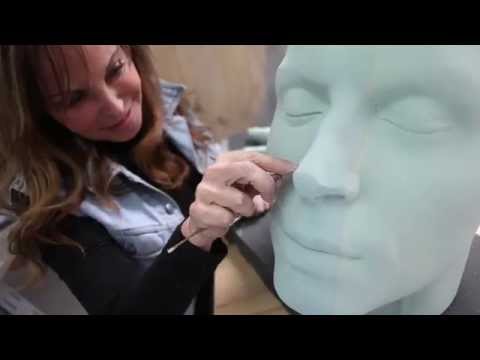
The people of Peekskill loved “The Golden Mean,” Feuerman said. They did handstands next to the 1,500-pound man, trying to re-create his pose. (This is not an uncommon phenomenon with “The Golden Mean” and “The Diver.”) The city of Peekskill and Hudson Valley MOCA wanted to buy the sculpture but couldn’t afford it — a grant and a “friends and family” price changed the equation and the statue remained. Feuerman was hooked.
Before she caught the public art bug, the artist — who won the International Sculpture Center’s 2026 lifetime achievement award — caught the monumental art bug. Her sculptures now are quite literally larger than life, and she considers them superrealism, a step beyond hyperrealism. They have fingernails (sometimes French-manicured), toenails, eyelashes and wisps of hair escaping their golden, crystalline swim caps.

Wisps of “superreal” hair escape from underneath the edges of “Contemplation’s” golden swim cap.
(Carlin Stiehl / For The Times)
In 2007, Feuerman’s first two monumental pieces, “Catalina” and “Survival of Serena,” were placed just outside the gates of that year’s Venice Biennale, beside the restaurant Paradiso. (She wasn’t invited to be in the Biennale itself.) The former was the first of her many Swimmers, and the latter is the oldest of the 10 sculptures on Rodeo Drive.
The artist created the original “Survival of Serena,” first called “Innertube,” in 1981, after witnessing Cuban asylum seekers floating to the shores of Key West, Fla., on inner tubes and driftwood. Serena — dubbed la Serenissima by those in Venice, whose city traditionally went by the same name — was given a scarlet inner tube and a bejeweled swim cap. But the original piece, plain and coated in water droplets, survives on the cover of “Feuerman: Superrealist Sculptures.”
“I changed the name to ‘Survival of Serena,’ because survival is what these brave people did when they came on floats, what the immigrants did,” Feuerman said on a guided walking tour after the unveiling. “The immigrants are extremely brave to leave their country and to hope for the best and to start again. So this is an ode to the immigrants, and she’s a survivor.”
“Justice”—a woman balanced on a sphere— has an origin story too. Feuerman first made the life-size woman on top of “Justice’s” sphere. But it took her more than 15 years to visualize “Justice” on top of her own world.

The artist Carole Feuerman talks to an onlooking crowd about her piece “Justice.” “You’re all part of ‘Justice,’ because when you look in, you see yourselves,” she said. “And wherever the sculpture is in the world, it reflects that part of the world and the people looking at it.”
(Carlin Stiehl / For The Times)
“So in my mind, I said, ‘Women always want justice,’” the artist said on the walking tour. “In today’s world, where we don’t think there’s enough justice, she should be on top of the world, not on top of a beach ball, but actually more serious, on top of the world.”
On Aug. 19 (she remembers the exact date), Feuerman was in Chicago in the pouring rain, showing her husband the exhibition there, also called “Monuments of Stillness,” for the first time.
“We drove down Michigan Avenue, and right in front of the Wrigley Building is ‘Justice,’” Feuerman said on the video call. “There were protesters for the war in Ukraine saying, ‘Free the prisoners! We want justice!’ Holding up signs right in front of ‘Justice.’ That’s the power of public art. That made me feel so good.”
More to Read
Disclaimer : This story is auto aggregated by a computer programme and has not been created or edited by DOWNTHENEWS. Publisher: latimes.com