
Sophie Green
The first piece of vintage clothing I remember buying came from a small shop on 10th Avenue in Vancouver, Canada. The city had – probably still has – a thriving vintage clothing scene.
In this little shop, I found a jewel I still wear, decades later. It is a slim-fitting V-necked sweater in a shade halfway between navy and royal blue. The label says “Ades of California” and the shop assistant told me it was probably a man’s top because of the way it was made.
I wanted to try it on because it was adorned with embroidery that, I thought, was pretty cute – a golf club, tee and ball and, top left, the words “Palm Springs” with a figure sitting under an umbrella. DO NOT DRY CLEAN, the label says, and I never have. It’s versatile and has lasted a very long time, considering the style and label suggest it was made in the 1950s.
I like to imagine the original owner bought it in Palm Springs as a memento of his (or her) time there. Perhaps he owned it longer than I’ve had it now, or maybe there were multiple owners before me. Regardless, its final home is with me as I intend to keep wearing it forever. Plus, I have never seen anything like it anywhere else.
This is a common characteristic of vintage clothing: those who go looking for pieces often do so because they can’t find anything like them now. In an age when almost everyone is trying to look like everyone else – why else would fast fashion flourish if it weren’t for that impulse? – individuality only seems to be prized when we see it first on Instagram or an influencer.
If you buy a vintage piece, you get the chance to make it uniquely yours. Part of the fun is altering a garment to suit you better.
SOPHIE GREEN
What we miss when we don’t want to stand out is the chance to be creative. To play. Instead, there is only uniform. Which can be fine, but one of the most likely reasons you wanted to leave school behind was because you had to wear the same thing every day.
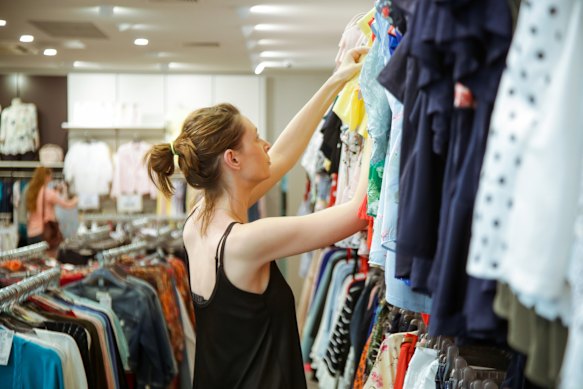
If you’re someone who has flirted with the idea of dressing creatively, even a little bit, vintage pieces can provide a gentle entry. This is partly because you are likely to feel more comfortable browsing in a Vinnies than in a boutique, initially at least, so you’ll have more time to think about the clothes you’re trying on. You may even meet someone working in second-hand shop with extensive knowledge of fashion and the time to share it.
Encountering one such lady at Lifeline in Sydney’s Cremorne ignited the spark that became The Frock Shop, my latest novel. That day, I’d bought a 1980s Trent Nathan blazer in red that had ornate, jewel-toned buttons in different colours. It wasn’t until I arrived home that I realised one of the buttons on the cuff was missing.
No matter. I went online, searching for a button that would work with the others. I found it, ordered it, then sewed it on, making the repair because the blazer was too well-made not to wear. Now, decades after its manufacture, the lining remains intact and the material in great shape. And I still haven’t seen anything else like it.
If you buy a vintage piece, you get the chance to make it uniquely yours. Part of the fun is altering a garment to suit you better, or to work with something else in your wardrobe. And the only way you’re going to do this is – that word again – through play.
Fun, I like to say, is underrated for adults. We expect kids to have fun, but we baulk at pursuing it once we’re past our school years. However, life is too important to be taken seriously and learning to dress playfully is an excellent way to have fun.
It’s fun to find a piece of clothing that was made ages ago and is still in great condition. There’s the thrill of the hunt, of discovery, then taking it home and matching it with other pieces of yours. (If you’re looking for inspiration, there are any number of accounts on social media where women of all ages work vintage pieces into their wardrobes.)
The popularity of vintage clothing is surely one of the reasons my own suburb has an abundance of opportunities to buy second-hand – two consignment shops, a Vinnies, a huge Lifeline. They’ve recently been joined by Uturn, which claims on its website: “By curating pre-loved pieces and connecting them with new owners, we create a circular way to dress, where style feels good, does good, and is accessible to everyone.”
It’s not a requirement of vintage shopping that you feel good about doing it. But perhaps when you do find that piece that is unlike anything else – the one that puts a tingle up your spine – you’ll stop to think about how it’s had a life before you, and perhaps will have one after you. Not to mention how it is so much kinder to this planet we call home to wear clothes that mean something, rather than something that is easily discarded. Because what goes around, comes around. In clothes, and in life.
The Frock Shop (Hachette) by Sophie Green is out now.
Get the best of Sunday Life magazine delivered to your inbox every Sunday morning. Sign up for our newsletter.
From our partners
Disclaimer : This story is auto aggregated by a computer programme and has not been created or edited by DOWNTHENEWS. Publisher: www.smh.com.au








