
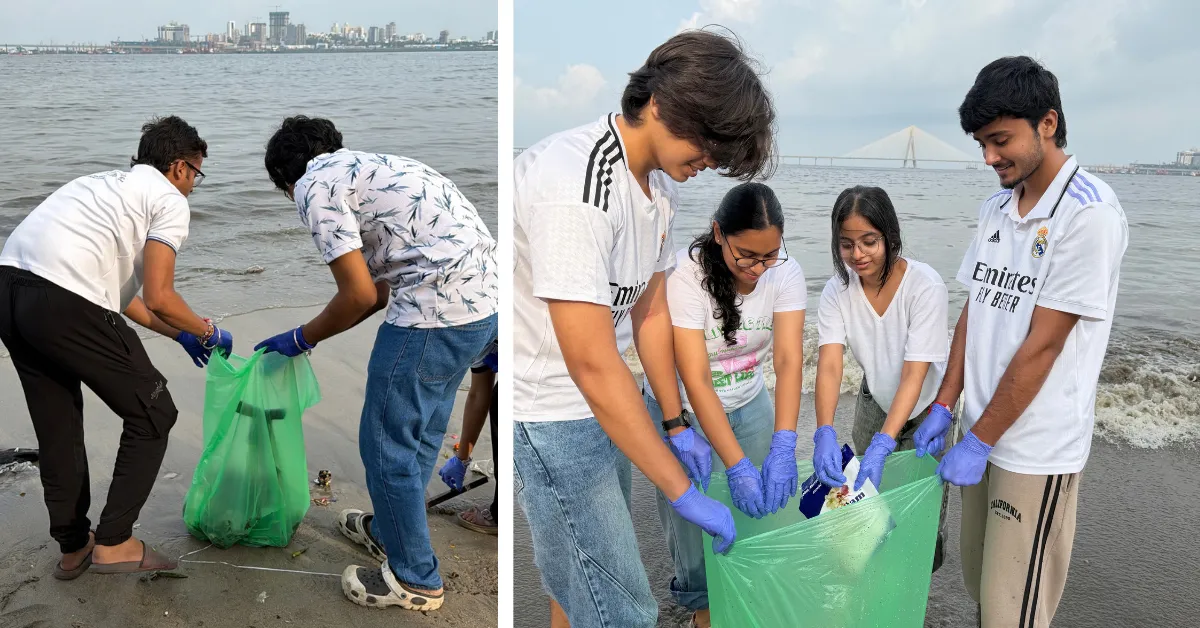
The celebrations were over, but at Dadar Chowpatty, the traces of Ganpati Visarjan remained. Flowers, pieces of cloth, plastic and decorative material were scattered along parts of the shoreline.
Instead of simply walking past the post-festival waste, more than 150 students from K.P.B. Hinduja College of Commerce stepped in to clean it up.
The students came together for a post-Visarjan beach clean-up, joining hands with the University of Mumbai, Brihanmumbai Municipal Corporation (BMC), Maharashtra State and the Coast Guard. For them, it was a way to extend the spirit of the festival beyond the celebrations and do their bit for the city they call home.
For second-year BAF student and DLLE student manager Ritika Kanojiya, the experience offered a perspective that a classroom could not.
“You can talk about the environment all day, but nothing hits like picking up that waste yourself.”
By the end of the cleanup, Ritika was tired, and her hands were dirty. But there was another reason the day felt special — it was her birthday.
“It was also my birthday, and I can’t think of a better way to have spent it.”
Who cleans up after the crowds go home?
The clean-up was part of a wider National Service Scheme (NSS)-led initiative undertaken in collaboration with the University of Mumbai, BMC and the Coast Guard.
Throughout the drive, students covered several metres of the shoreline, collecting and segregating waste left behind after the immersion festivities. Their work included clearing flower offerings, plastic and other decorative materials, cloth and post-Visarjan debris from the beach.
For first-year BCom student and NSS volunteer Prajakta Kulkarni, it was her first time seeing the scale of the problem so closely.
“Before going there, I thought it would just be about picking up waste, but after reaching the beach, I understood how serious the problem of pollution actually is.”
The students collected plastic bottles, wrappers, bags and other waste from the shoreline, working alongside one another to clear the space.
For Prajakta, the experience also changed the way she looked at civic responsibility.
“The activity made me realise that keeping our environment clean is not only the responsibility of the government or cleaning workers. It is our responsibility too.”
The initiative brought home a simple point. Celebrations may last for a few days, but the responsibility of caring for the places where they are held continues long after.
What a few hours on the beach taught them
Dr Navin M Punjabi, Principal, Hinduja College, believes that such initiatives can help students connect everyday actions with larger environmental concerns.
“Our responsibility as an educational institution is not limited to preparing students for their professional lives. We also want them to understand the role they can play as responsible citizens.”
Plastic and debris left on beaches don’t stay there; they eventually make their way into the ocean, where they harm marine life and ecosystems that are already under stress from a warming planet. Drives like this help students see the direct link between everyday civic action and larger environmental challenges while giving them the opportunity to take meaningful action in their own city.
/filters:format(webp)/english-betterindia/media/media_files/2026/09/29/beach-cleanup-mumbai-2026-09-29-16-54-27.png)
That connection is particularly important in a city like Mumbai, where beaches and other public spaces are shared by millions. Keeping them clean is not only the responsibility of civic authorities. Everyday choices, responsible disposal and community participation also form an important part of civic sense.
For third-year BCom student and NSS leader Sarvesh Dubey, that sense of responsibility is something students can pass on.
“As NSS volunteers, it is our responsibility to set an example for our juniors and inspire society as a whole. Today, we are taking this initiative; tomorrow, someone else may be inspired by us to take the same step.”
One morning was enough to change how they saw Mumbai
Hinduja College has been carrying out the beach clean-up initiative for more than 25 years. The NSS unit also organises beach-cleaning drives three to four times a year, alongside other community initiatives such as blood donation and tree plantation drives.
For the students taking part, however, the value of the exercise went beyond the number of bags collected.
Ritika believes that giving just a few hours can help people understand their own role in keeping public spaces clean.
“It takes just a couple of hours, and you walk away with something a classroom can’t give you. You see that small efforts add up. If everyone gave one morning, our beaches would look very different.”
/filters:format(webp)/english-betterindia/media/media_files/2026/09/29/beach-cleanup-mumbai-2026-09-29-16-55-38.png)
Prajakta too hopes to return for more such activities, this time with an experience she can share with others.
And perhaps that is where civic sense begins — not with one big gesture, but with people choosing to take responsibility for the spaces they share.
At Dadar Chowpatty, more than 150 students spent a morning doing exactly that, showing that even after the celebrations end, there is always a way to give back to the city.
All images courtesy of Diksha Talreja, Hinduja College
Disclaimer : This story is auto aggregated by a computer programme and has not been created or edited by DOWNTHENEWS. Publisher: thebetterindia.com




