Persistent noise in your home environment can take a serious toll on your mental and physical health. Here’s a look at the German cities where residents are most affected.
How noisy is your home? Noise pollution, that is steady noise in a given area, is a serious and often overlooked problem in many German cities.
An analysis of EU noise monitoring data shared with The Local reveals that a number of German cities rank among the worst in Europe for noise exposure.
We don’t often think too much about the noisy streets, railways or factories near our homes – naturally tuning them out as much as possible.
But steady, loud levels of noise come with negative effects including increased risk for cardiovascular diseases.
A 2023 study done on behalf of the German Environment Agency found that incessant traffic noise was also linked to a heightened risk of depression. A 10-decibel (dB) increase in road, railroad and aircraft noise raised that risk by up to four, five and eleven percent.
Europe’s most noise exposed cities
Alan Dabul, founder of Decibel Shield, analysed the European Environment Agency’s measured road, rail and aircraft noise data to rank Europe’s most noise affected cities.
The results came with a standout takeaway for Germany: North Rhine-Westphalia, and the Ruhr area in particular, is loud. Several cities in this region ranked among the most noise affected cities in the continent.
The standout is Essen, which ranks 5th loudest in Europe, according to Decibel Shield’s analysis.
Also notably loud and in the Ruhr region were the cities of Herne, Duisburg and Mülheim – all driven by road traffic.
Four of Europe’s ten loudest cities are in North Rhine-Westphalia, including; Essen, Solingen, Aachen and Remscheid. Bonn was also among Germany’s top ten loudest cities.
What does ‘loudest’ city actually mean?
Dabul explained that his analysis measures a “population-weighted average transport-noise level among exposed residents”.
Specifically it ranks cities by the average noise level (Lden) for exposed residents.
In other words, this ranking gives a sense of how loud it is for people who are affected by noise pollution in a given city.
This list below also includes the number of residents exposed to 55 dB or more.
Germany’s loudest cities by this measure:
- Essen (NRW), 63.5 dB, about 434,000 exposed
- Solingen (NRW), 63.5 dB, about 70,000 exposed
- Aachen (NRW), 63.4 dB, about 172,000 exposed
- Kassel (Hesse), 63.4 dB, about 168,000 exposed
- Remscheid (NRW), 63.4 dB, about 36,000 exposed
- Wiesbaden (Hesse), 63.3 dB, about 218,000 exposed
- Pforzheim (Baden-Wuerttemberg), 63.1 dB, about 99,000 exposed
- Saarbruecken (Saarland), 63.0 dB, about 116,000 exposed
- Bonn (NRW), 62.9 dB, about 286,000 exposed
- Heilbronn (Baden-Wuerttemberg), 62.9 dB, about 61,000 exposed
Dabul noted that some other noise pollution rankings are weighted for cities’ total populations, which tends to result in larger cities – like Frankfurt, Hannover and Düsseldorf – topping the list.
It’s also worth noting that the average noise level in the top German cities are all within about half a decibel of each other.
So the important takeaway here is that a cluster of cities in west Germany are heavily affected by noise pollution. Not that life for many in Essen is just slightly louder than for those in Aachen.
READ ALSO: ‘I love the clarity’ – Readers reveal the advantages of living in Germany
Why is North Rhine-Westphalia so noisy?
Most noise pollution in German cities comes from road traffic. Residents who live next to the Autobahn, or a high-trafficked road are likely to be affected by noise pollution regardless of which city they live in.
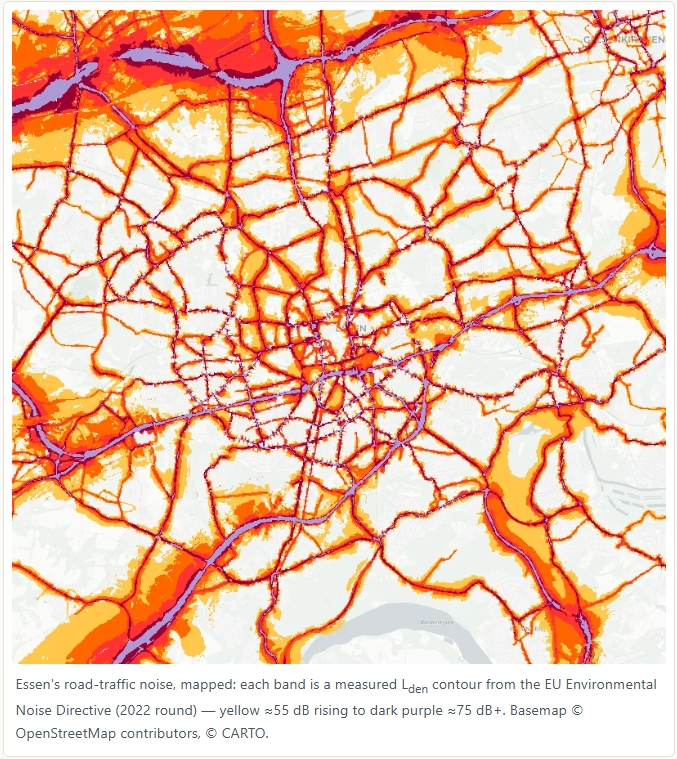
In Decibel Shield’s full European ranking of noise-affected cities, you can click on city names to see exposure maps, based on EU data from 2022.
Map of noise exposure in Essen, Germany. Screenshot taken from DecibelShield.app
In the above map you can see how the areas most affected by noise pollution in Essen follow the city’s major roads.
North Rhine-Westphalia is Germany’s most densely populated and most road-laced state.
Other major German cities which closely followed those ranked above included Munich (11th in Germany and 22nd in Europe), Düsseldorf (13th in Germany, 28th in Europe) and Berlin (18th in Germany, 36th in Europe).
The ranking is based on 2022 data, collected under the EU Environmental Noise Directive via the European Environment Agency.
Decibel Shield is an iOS app that turns an iPhone into a real-time sound level meter. You can also find an online decibel meter on Decibel Shield’s website.
READ ALSO: EXPLAINED – How to deal with a noisy neighbour in Germany
Disclaimer : This story is auto aggregated by a computer programme and has not been created or edited by DOWNTHENEWS. Publisher: thelocal.de