
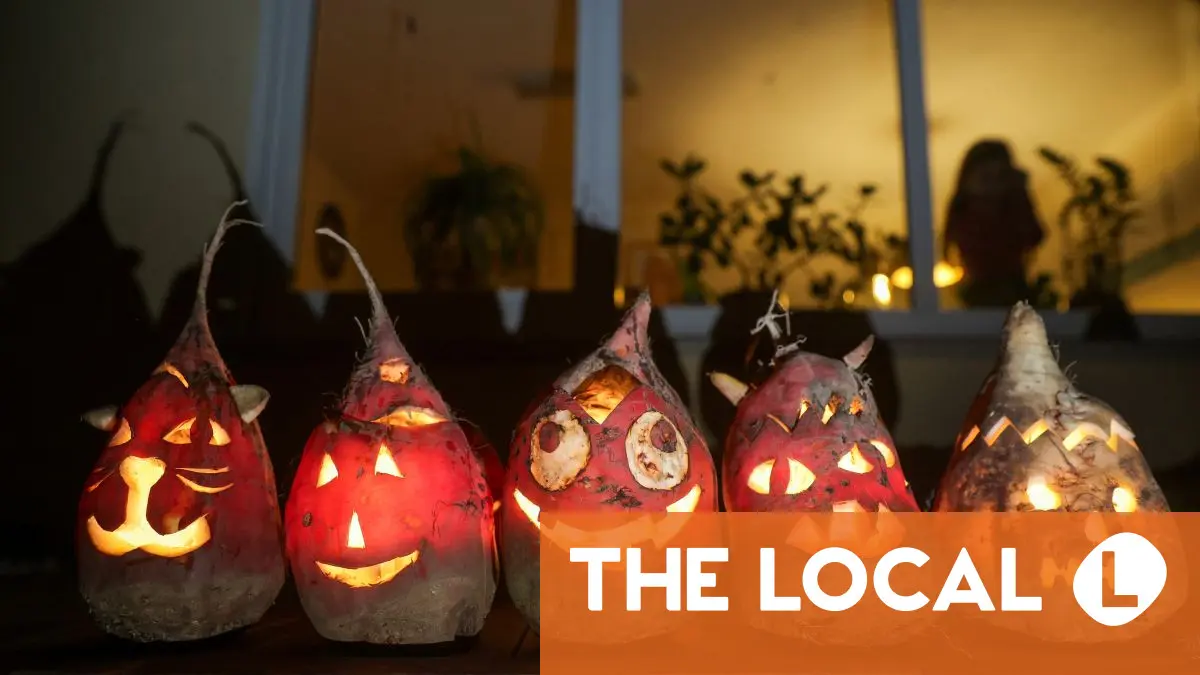
In some parts of Germany, glowing turnips with eerie faces still light up streets and gardens around this time of year, keeping an almost-forgotten seasonal tradition alive.
For many foreign residents in Germany, October means pumpkin displays, Halloween decorations and children preparing for trick-or-treating.
But venture into certain parts of the country and you may come across something stranger: grotesque faces carved into large turnips and illuminated by candlelight.
Known as Rübengeister, or turnip ghosts, these spooky lanterns are usually carved from large fodder turnips, a variety traditionally grown as animal feed.
But unlike Halloween pumpkins, they are rooted in local harvest traditions and are not normally accompanied by fancy dress costumes.
Today, After decades of decline, the tradition is even enjoying a modest revival. The custom survives most visibly in parts of southern Germany, particularly Baden-Württemberg and Bavarian Swabia, where community carving events and turnip ghost parades continue to attract families.
Where are turnip ghosts still found?
Southern Germany is the best place to encounter Rübengeister in the wild. Annual carving events and parades take place in communities such as Bad Buchau, Denkingen, Obernheim and parts of the Augsburg region.
In Diedorf near Augsburg, for example, a local festival now attracts around 150 children each year to carve and display turnip ghosts.
But the tradition extends far beyond one region. Local variations can be found in Saarland, Hesse, Thuringia, Upper Lusatia, the Taunus and Westerwald, East Frisia and elsewhere.
READ ALSO: How to prepare for autumn like a German
Depending on where you are, the glowing figures may have different names, including Rummelbooze, Rubebötz and Dickwurzmann. Many of these names are rooted in local dialects and reference turnips, masks or ghostly figures.
What unites them all is the basic concept – children hollow out turnips, carve eerie faces into them and either display them outside homes, carry them through the streets or take them door to door while asking for treats.
More frightening than pumpkins?
Part of the appeal is that turnips naturally look a little unsettling.
Unlike smooth, symmetrical pumpkins, fodder turnips often have twisted roots, bumps and irregular shapes. Carvers deliberately work these features into their designs, turning natural imperfections into crooked noses, warts and sinister grimaces.
The downside is that they’re much harder work. While a pumpkin can be hollowed out relatively easily, carving a dense fodder turnip requires patience, strength and a sharp knife.
Ironically, finding the raw material can be even harder than carving it these days. Because fodder turnips are no longer widely cultivated, some communities now rely on specialist farmers who grow them specifically for autumn events.
READ ALSO: German word of the day – Kürbislaterne
Germany’s version of Halloween?
The parallels here are hard to miss.
Like trick-or-treaters, children in some turnip ghost traditions go from house to house carrying lanterns and asking for gifts or sweets. In parts of southern Germany they even recite rhymes before receiving their reward.
One traditional rhyme goes: Wir sind die Rübengeister, geh’n von Haus zu Haus und bitten um eine Gabe. Dann geh’n wir wieder nach Haus (We are the turnip ghosts, going from house to house and asking for a treat. Then we’ll go home again).
Yet important differences remain. Turnip ghosts in Germany aren’t tied to a single date and are generally associated with the harvest season rather than the night of October 31.
Historians generally seem to agree that people in Ireland and Scotland carved lanterns from turnips long before pumpkins became associated with Halloween in North America. When Irish and Scottish migrants brought the custom to America in the nineteenth century, pumpkins proved easier to obtain and gradually replaced turnips.
But it isn’t clear whether Germany’s turnip ghosts share the same roots or developed independently. According to cultural historians, reliable written evidence for the German tradition dates only from the nineteenth century, making it difficult to establish a definitive origin.
READ ALSO: Halloween vs All Saints Day – How to celebrate in Germany
A tradition that nearly disappeared
The tradition of turnip ghost carving seems to have declined in Germany after the Second World War.
One reason was agricultural change. Fewer fodder turnips were grown, making them harder to obtain. At the same time, pumpkins became increasingly common and much easier to carve.
Over the last few decades, the growing popularity of Halloween has also helped push traditional turnip customs into the background.
But turnip ghosts now seem to be making a comeback, despite the challenges. Increasingly, local museums, carnival associations and community groups are organising carving workshops, festivals and parades to preserve these regional traditions.
Disclaimer : This story is auto aggregated by a computer programme and has not been created or edited by DOWNTHENEWS. Publisher: thelocal.de




