While Pat Cummins conducted his exhausting press conference on Friday in the Cricket NSW indoor centre, shading the dots in a picture more than eight years old in front of a media umbrella field that even Bradman wouldn’t penetrate, a short bounce throw away a more relevant conflict unfolded.
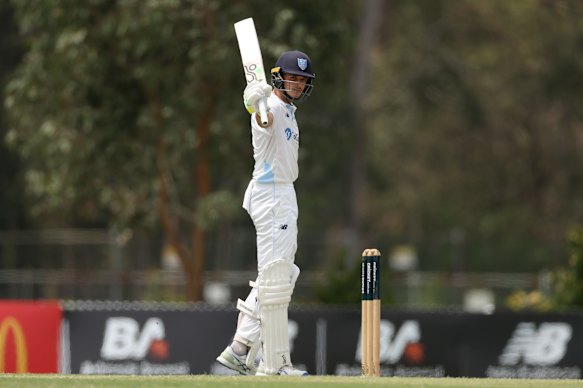
A Sheffield Shield match between NSW and South Australia was heading into the third day’s play and a callow experienced youth named Sam Konstas was walking to the crease with a ton under his belt and looking to lengthen the Blues’ lead.
Konstas went on to make 173, his second century in four matches. The senior partner in his second wicket stand of 117 was Kurtis Patterson, who averages 144 in Test cricket from two matches. Patterson occupied the crease for 88 balls, making 43. Each is in the frame for a Test recall.
Dumped six-Test opener Jake Weatherald scythed a typically rapid 142 in South Australia’s first innings.
Batsmen were suddenly cooking with gas, wind turbine and/or photovoltaic energy at NSW’s Cricket Central at Sydney’s Olympic Park.
Shield cricket in Victoria returned home to the MCG, where the groundsman had found the keys to the mower. Ex-Test batsman Peter Handscomb got a patient 323-ball 169 for Victoria, and former Blue Blake Macdonald hit 116. Left-handed Western Australian rookie Corey Wasley, another of the talent-packed 2024 under-19 World Cup team, responded with 179 not out from 337 deliveries, patience being of valuable virtue.
At the ’Gabba Marnus Labuschagne (12) missed out against Tasmania, playing an unbalanced and careless drive, but young guns Jack Clayton (52), Hugh Weibgen (89) and Hugo Burdon (70), also former Australian under-19s representatives, made half centuries.
Curators around the country must have read and digested Cricket Australia boss Todd Greenberg’s suggestion that match surfaces need to be a little less like the front lawn and a bit more like the concrete path to the clothesline, although the spinners still aren’t getting a lot of overs.
Nic Maddinson, who was surprisingly summoned to open in the South African series, has been batting in the middle order with modest returns on his reinstatement to state cricket, having been replaced by the exuberant Oliver Davies against the new ball.
The bottom line on batting talent and likely Test aspirants has been in the red over the last couple of years as the pitches favoured seam bowling and selectors persisted with failing incumbents while confusing white ball potential with red ball performance.
Cooper Connolly is a case in point – his first Test was his fourth first-class game, having never made a century, but 90 on first-class debut.
Connolly wore the hi-vis on the bench in South Africa instead of playing the early Shield games at home. He was getting loads of net time when he needed match time.
The pathway to the top of the cricket pyramid doesn’t include a statistic for runs and wickets accumulated in the nets and against the “wanger”.
Connolly’s two innings in Cape Town were desultory and no surprise when he failed twice with 29 and nought. Relentless net sessions and full-time drink waiting have never produced improvements in batsmen or bowlers.
Australian cricket needs players of his talent to turn potential into performance – one of rugby league super coach Jack Gibson’s sayings, “potential never won nothing,” stands the test of time.
Connolly finds himself in three weeks of white ball cricket, again missing the experience of Sheffield Shield and the opportunity to grow.
The reality for Connolly is the young guns mentioned above are edging in front of him in the Test match pecking order at a time when spots are up for grabs.
Twenty-year-old Victorian and much-mentioned left-hand bat Oliver Peake finds himself warming the pine at white ball matches instead of turning out for his home state. He has only played 16 first-class games in his nascent career, averaging under 25, so the proof of the pudding has not yet set.
It will be interesting to see over the next two One Day Internationals and five Twenty20s if Peake gets a game for Australia. If not, then his lesson time has been severely restricted.
There are players who see their international careers moulded around 50- and 20-over cricket, and with World Cups and Olympics on the horizon there will be ample opportunities to impress, but choosing Test batsmen on white ball form is bound for trouble. Less so for bowlers, and the debut of Mahli Beardman (6-24) against England is a cause for genuine excitement.
Konstas must have confused his format ambitions in the first innings versus South Australia when he charged down the pitch to the challenging pace of Jordan Buckingham and coughed up a simple chance to the infield.
Perhaps he was intoxicated by the uninhibited stroke play at the other end from Davies, or maybe looking for a slot on an Indian Premier League auction list. His second innings sprung from a study in discipline, well-judged strokeplay, then domination; just what you might expect from a Test-calibre batsman.
Davies may be a “like for like” choice if Travis Head is unavailable – opening the batting when cannon fire is required on a fiery pitch, or settling in to bruise the old ball and tiring bowlers on peaceful decks.
Konstas looks primed to join Matthew Renshaw, taking first guard against New Zealand in three weeks’ time in the first Test in Perth, but the competition for spots all through the order (Steve Smith is safe at four) has found some higher gears thanks to Sheffield Shield performances.
The media scrimmage that semi-circled their wagons around Cummins wrote and filmed the explanations and nuances from a cricket match in the dimming past, admittedly a past with few ghosts.
If they wanted to examine the present and get an impression of what the future of Australian cricket is going to look like, then they needed simply to turn their tripods, their gaze and their recording machines 180 degrees to find the newest field of dreams.
News, results and expert analysis from the weekend of sport sent every Monday. Sign up for our Sport newsletter.
From our partners
Disclaimer : This story is auto aggregated by a computer programme and has not been created or edited by DOWNTHENEWS. Publisher: www.smh.com.au