
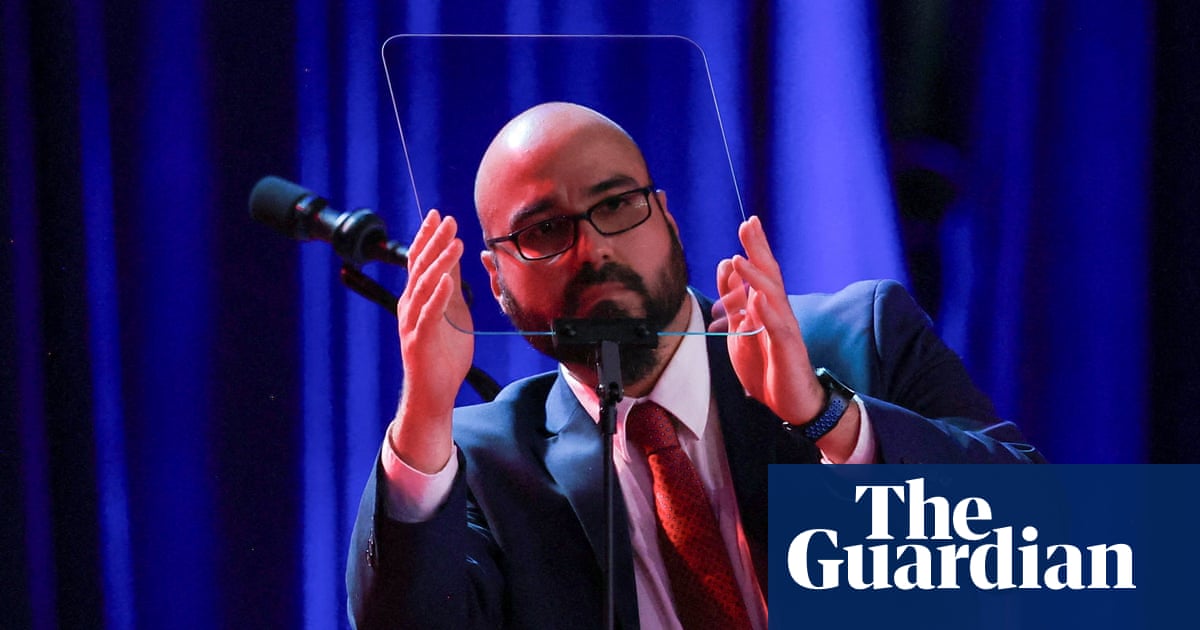
A White House teleprompter operator who reportedly used inside knowledge to make bets about Donald Trump’s speeches on the online prediction market Kalshi is no longer in his post, according to a White House official.
The official, who was not authorized to comment publicly about the personnel matter and spoke on condition of anonymity, said on Tuesday that Gabriel Perez “no longer works in the federal government”.
The official would not say whether Perez resigned or was fired.
The White House confirmed earlier this month that Perez had been placed on unpaid leave after ABC News reported he had used his inside knowledge to win more than $100,000 betting on what the president would say in big speeches, including his State of the Union address earlier this year.
That figure is more than half the $175,000 salary he earned for his teleprompter work, according to White House personnel records.
White House press secretary Karoline Leavitt had described the reports of the insider trading as “deeply unfortunate and, frankly, a disgrace”.
Robert Denault, Kalshi’s lawyer and head of enforcement, said on X following the ABC News report that the “Kalshi surveillance team promptly flagged, investigated and referred these trades” to the US Commodity Futures Trading Commission, the body that has regulatory authority over such matters.
His statement did not name Perez, who has operated Trump’s teleprompter since 2016.
The ABC report described suspicious activity on Kalshi’s “Mentions” market, in which users can place bets on phrases and specific words that might be used in public speeches. Kalshi recently began requiring users to disclose their place of employment, and the platform’s policy prohibits betting based on information that users gain because of their job.
Prediction markets, which allow users to place speculative bets on a seemingly endless list of public events and trends, have exploded recently. Trading volume on Kalshi, one of the two largest prediction market trading platforms, soared from $100m last year to $3bn today, according to an estimate cited by CNBC.
Kalshi recently said it would allow users to bet on drug trial results.
The rise in prediction markets has created a major new incentive for insider trading. In April, federal prosecutors indicted Gannon Ken Van Dyke for allegedly betting on the whether former Venezuelan president Nicolás Maduro would be deposed. Prosecutors say Van Dyke, a US soldier who worked on the operation to remove and extradite Maduro, walked away with $400,000 in earnings.
That same month, Kalshi said it had fined three political candidates who placed bets on their own races. In one case, Mark Moran placed a small bet on whether he would run for office before announcing his bid for a US Senate seat in Virginia as an independent.
The industry’s proponents describe prediction markets as a form of derivatives, a type of contract that allows parties to make bets on the future value of an asset or commodity.
Critics, however, have raised concerns from state authorities who view the industry as little more than unregulated gambling. Minnesota became the first state to ban them entirely in May, but a federal judge temporarily blocked the law before it went into effect.
Trump has defended the prediction markets industry, saying that states should avoid regulating them, leaving the job instead to the Commodity Futures Trading Commission.
Disclaimer : This story is auto aggregated by a computer programme and has not been created or edited by DOWNTHENEWS. Publisher: theguardian.com






