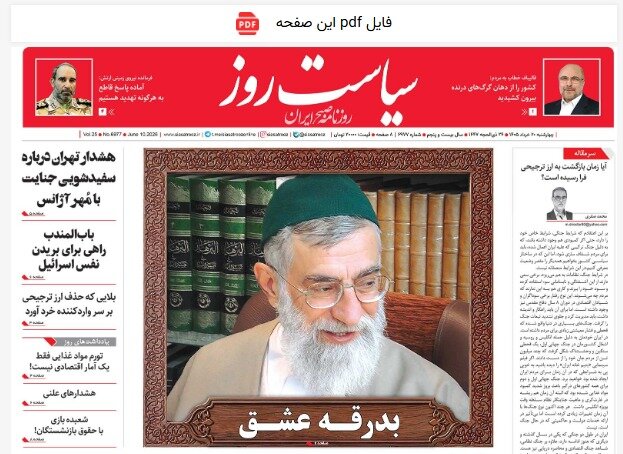
Siasat‑e-Rooz, in an article on Western moves and Rafael Grossi’s actions at the IAEA Board of Governors, wrote: While the United States and some European countries seek to whitewash their crimes against Iran, Tehran warned the Board of Governors about the catastrophic consequences of issuing any anti‑Iran resolution.
The reality on the ground is that the United States and Israel have subjected Iran to military attacks and caused major destruction. Iran’s nuclear facilities have been targeted multiple times; the US has repeatedly threatened to seize Iran’s enriched uranium; and dozens of other hostile measures have been pursued. Now, at the IAEA, the Americans aim to rewrite history and shape the narrative to their liking—whitewashing and normalizing these actions while paving the way for their repetition. Last year’s 12‑day war, too, unfolded under the shadow of the IAEA’s unprofessional conduct and the West’s false resolution.
Shargh: Iran and Israel: Confrontation in the shadow of power and deterrence
Shargh, in an analysis of the 24‑hour clash between Iran and Israel, wrote: The events from Sunday night to Monday afternoon showed that even at the height of diplomatic optimism, a single security incident or military action can rapidly overturn the entire equation. The recent reciprocal strikes confirm that diplomacy is still moving on fragile ground. The calculated confrontations between Iran and Israel—kept below the threshold of full‑scale war—became the most important and sensitive test of the two‑month ceasefire. This test made clear that despite both sides’ readiness to project power and demonstrate deterrence, neither has yet shown the will to cross the threshold into a full regional war or to completely collapse the ceasefire. This was especially evident in the case of the United States, which sought to prevent an all‑out Iran–Israel war and preserve the ceasefire.
Sobh-e-No: Diplomacy is the supporter of the battlefield, not its substitute
Sobh-e‑No, in a commentary on the importance of diplomacy as support for military operations, wrote: Diplomacy without the backing of military strength is “submission,” and military action without diplomacy becomes endless attrition. Last week, when Israeli jets struck nearly all areas of Beirut, Iran, by threatening to halt negotiations and open new fronts, it forced the other side to retreat. In this episode, Iran, through offensive diplomacy and military action, succeeded in imposing a new equation on the region and compelling the adversary to step back. The success in Lebanon showed that diplomacy does not block military operations, nor do operations block diplomacy. Smart statecraft is when they approach the negotiating table with a clenched fist—so they can leave it with an open hand and a favorable outcome.
Khorasan: Proving the coordination of battlefield and diplomacy in war
The experience of the recent war confirms the same reality. Without Iran’s missile capability, there would have been no basis for negotiations from a position of strength. Likewise, without active diplomatic channels, many battlefield achievements could not have been politically consolidated. In hybrid warfare, the enemy seeks less to win militarily and more to disrupt internal calculations. One of the main tools of this project is to create the perception of a rift between officials, between the battlefield and diplomacy, and between different pillars of governance. Whenever such an image takes shape in the public mind, the country’s deterrence is weakened. Perhaps the most important lesson of the recent war is this: one should not rush to judge the performance of officials and institutions. Many strategic decisions only make sense when the full puzzle becomes visible. The past months showed that what sometimes appears as disagreement from the outside is, in many cases, a division of labor within a unified strategy—one that defines the battlefield, diplomacy, and the people not against each other, but alongside one another.
Resalat: A swift and decisive response changed the rules of the game
Resalat highlighted a key point after Operation Nasr, which led to the strike on Israel: What is seen from Iran today is not merely a display of hard power; it is a new configuration of national will. Iran is no longer appearing solely as a reactor but is gradually defining the rules of the arena. In this new logic, it is the enemy that must calculate, retreat, buy time, and move cautiously out of fear of the consequences. This is the point at which deterrence moves beyond slogans and theoretical analysis and becomes a concrete battlefield experience. For years, Israel tried to confine Iran within a narrow framework, but Operation Nasr shattered that calculation. The message was clear: Iran does not play by the geography of threats or the enemy’s timetable. Wherever a will to cross red lines is detected, the response will land right there—with equal clarity and force.
Disclaimer : This story is auto aggregated by a computer programme and has not been created or edited by DOWNTHENEWS. Publisher: tehrantimes.com