The debates were taking shape during a turbulent decade marked by wars in Southeast Asia and the Middle East, liberation struggles in Africa and military dictatorships in Latin America. By the mid-1970s, NAM countries were beginning to put their ambitions for a more equitable flow of information into practice.
In January 1975, a statement by Sri Lankan Prime Minister Sirimavo Bandaranaike was transmitted by telex across participating news agencies from Yugoslavia’s Tanjug news agency to others across the Global South, heralding NANAP’s official launch.
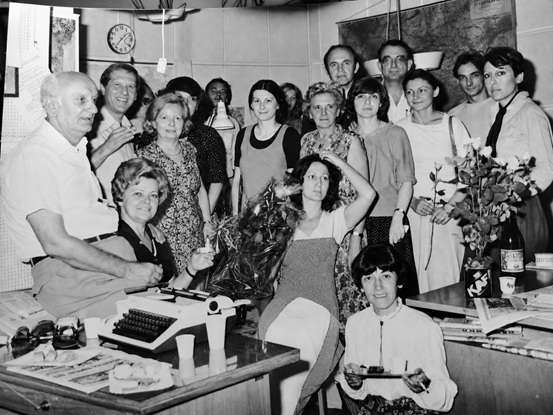
Ljubica Markovic was 24 years old when she started working at Tanjug, the former Yugoslav state media outlet founded by Tito in 1943, which is still in existence today. Markovic worked closely with the designated NANAP news desk during her time on the foreign desk.
Unlike most communist states in Eastern Europe, Yugoslavia was not aligned with the Soviet Union. Its independent position during the Cold War and its leading role in the Non-Aligned Movement made it a natural champion of cooperation between countries seeking alternatives to Western and Soviet influence.
“There was a great deal of enthusiasm for international media cooperation, largely as a result of Yugoslavia’s position in the world at the time,” Markovic, today a 78-year-old grandmother living in Belgrade, tells Al Jazeera.
“With a strong media infrastructure in place, Tanjug was best placed to play a central role in NANAP. It was the backbone of this initiative, but it was neither its centre nor its arbiter. It was a large network of agencies exchanging news, and Tanjug was one of these points, probably among the most active ones,” she says.
Recalling her two decades at Tanjug, she says everyone in the editorial unit had access to the pool’s concept and the news it handled.
At Tanjug, journalists prepared domestic stories for foreign audiences, shortening and translating them before sending them through the network by telex or radio link. The work differed from the foreign desk, which selected reports arriving from other agencies and correspondents for Yugoslav audiences.
“No one questioned the value of the idea of a more equitable exchange of information and culture.”
NAM’s vision for a more equitable global information system inspired further outlets and agencies, including Third World magazine, or Terceiro Mundo, in Buenos Aires, Argentina.
Uruguayan-born journalist Beatriz Bissio cofounded the magazine in 1974 with a group of journalists, including her husband, the prominent exiled Brazilian journalist and politician, Neiva Moreira.
According to Bissio, Moreira was inspired to launch the magazine after attending the Non-Aligned Movement summit in Algiers the previous year.
Published in Portuguese, English and Spanish, the magazine reached a peak circulation of more than 150,000 copies in its Portuguese edition and remained active for more than three decades, Bissio says.
“Although the primary focus was on the coverage of Latin America, we always sought to offer readers information, analyses and historical perspectives on Africa and Asia as we were aware that our history and our destinies as Latin Americans were very closely related to those in these regions,” Bissio, who today works in the history department at the Federal University of Rio de Janeiro, tells Al Jazeera.
NANAP, she says, played an important role in bridging the information gap between Latin America and regions across the Global South.
Although Third World was not a news agency itself, it benefitted from the relationships NANAP helped foster. Bissio says the magazine built direct contacts with journalists and agencies across the Global South, particularly in countries such as Angola and Mozambique, exchanging reporting and gaining access to stories that rarely appeared in Western news coverage.

“Our challenge was to address issues such as the struggles against dictatorships and the fight for liberation in different parts of the world,” Bissio says.
“The mainstream media were not covering these issues, even stories as big as apartheid in South Africa were not known in Latin America. NANAP was really vital for us because it allowed us to have collaborators across many parts of the world.
“To have direct information through those agencies helped us diversify our coverage, and we were able to work with journalists with the same aims as us.”
The flow of information worked both ways, in particular, with the agencies in the newly independent Portuguese-speaking nations of Mozambique and Angola, which formed Agencia de Informacao de Mocambique and Agencia Angola Press (ANGOP) after their independence from Portugal in 1975.
“We met with the journalists from these agencies, formed agreements and exchanged articles. For them, covering Latin America was not easy, so they could take our coverage of Latin American countries and republish and redistribute it in their own way.”
Over a three-decade career with the magazine, Bissio interviewed key political leaders such as Fidel Castro, Nelson Mandela and Hugo Chavez, travelling extensively across Asia and Africa, including Angola and Mozambique, where she reported on the final stages of the liberation struggles.
She was also in the Middle East, reporting from Beirut in 1982 during Israel’s invasion of Lebanon, which was aimed at driving the Palestine Liberation Organization (PLO) out of the country.
These experiences, she says, profoundly shaped her understanding of liberation struggles across different regions.
“Witnessing firsthand the struggle of the Angolan and Mozambican people in such adverse conditions yet driven by very strong ideals of freedom and justice was a defining experience for me. As a Latin American, I had never witnessed people taking up arms and fighting by every means they have against a colonial army.”
Disclaimer : This story is auto aggregated by a computer programme and has not been created or edited by DOWNTHENEWS. Publisher: aljazeera.com