In a Premier League season increasingly shaped by injuries, rotation and congested schedules, what happens when the first choices are unavailable can be incredibly important.
How much quality is available beyond each club’s established starting XI? How much is retained when starters are replaced? Where are squads strongest and weakest, and how often do managers actually use their alternatives?
What impact do current squad players have when called from the bench and how do each club’s resources compare with their expected level, upcoming fixture demands and recent injury record? We’ve attempted to answer all these questions.
Our Overall Squad Depth Index factors all of the above and Arsenal come out on top. The Gunners also lead the separate Competitive Depth Index. Hardly a surprise, but what makes Mikel Arteta’s squad so strong and reliable compared to the rest of the English top flight?
Arteta investing in depth at Emirates
Arsenal concentrated on increasing their depth in the summer transfer window. While the club flirted with blockbuster moves for Vinicius Junior and Julian Alvarez, the additions of Bruno Guimaraes and Ezri Konsa already complement a back four and midfield stacked with talent. Mikel Arteta also had to cope with a large list of injuries last season, something they’ll be hoping doesn’t afflict them this time around.
The combined current market value of Arsenal’s named substitutes in Premier League matches this season has averaged at £367m. No other club comes particularly close.
It’s important to note that these figures are based on listed Transfermarkt valuations – and Premier League clubs, on average, typically paid 36 per cent above these valuations this summer. So, based on that, £367m becomes closer to £500m.
The three promoted sides, Hull, Coventry and Ipswich, have the lowest average bench value but looking further up the table, the position of Brentford is intriguing. They sit just outside the traditional ‘big six’ with an average bench value of £129m.
It is an extraordinary pool of talent outside the starting side for Arsenal. But market value alone cannot tell us whether those alternatives are useful.
So, we also looked at what they have actually done…
Arsenal’s bench can also change games
For every player currently at a Premier League club, we measured their output when entering league matches as a substitute across the previous two full seasons and this season.
To avoid a player scoring once during a 10-minute cameo shooting to the top of the rankings, goals and assists per 90 are adjusted towards the league average according to the size of the player’s substitute sample.
In terms of goal involvements per 90, Arsenal rank behind only Brighton. As a raw total, Mikel Arteta’s side come out top.
Arsenal’s current squad have combined for 27 goals and assists from 4,340 substitute minutes since the start of last season, producing an adjusted rate of around 0.54 goal involvements per 90.
The Gunners are going to need their whole squad after the international break, as their schedule is as demanding as they come.
Having squad depth is one thing – trusting it is another
Just having the numbers to cover your team’s schedule is all well and good, but that means little if a manager or head coach doesn’t utilise it. Every club’s players were ranked by Premier League minutes, before being divided into three groups:
- 1-11: Core players
- 12-16: First rotation group
- 17-22: Deeper rotation group
Tottenham have already distributed a comparatively high share of league minutes beyond their core XI despite not competing on as many fronts. Perhaps Roberto De Zerbi is yet to figure out who makes his strongest team.
Interestingly, Man Utd’s core accounts for more than 88 per cent of their minutes, which is trumped by only Bournemouth and Everton. Though our data suggests they are among the most equipped to handle their schedule, Michael Carrick is yet to put his faith in the rotational options.
In comparison, Arsenal and Man City’s players ranked 12th-22nd have accounted for around 15 per cent of their minutes.
What happens if you replace the entire starting XI?
What if a proper injury crisis struck and wiped out the whole of your first team? Using Premier League playing time to identify the players currently trusted as starters, we constructed a standardised first XI for every club and then built a second XI based on those remaining.
Arsenal’s modelled first XI is valued at £580m, while their second XI is worth around £536m. That means they retain roughly 92 per cent of the estimated value of their starting side – even when all eleven players are replaced.
In contrast, Manchester City’s second XI is worth £428.2m less than the first XI. That is largely down to the drop-off in value up top when Erling Haaland is left out, but it remains a striking comparison.
Two clubs, Aston Villa and Hull, have a second XI that’s more valuable than the usage-based first XI. With both sides making plenty of late moves in the transfer market, expect to see Unai Emery’s and Sergej Jakirovic’s teams change as new arrivals integrate and adjust.
Where is your club strongest – and weakest?
In reality, squad depth tends to become a problem when an individual area becomes sparse. And even the best clubs have glaring weaknesses.
Despite their quality, Arsenal are severely lacking at left-wing after selling Gabriel Martinelli and Leandro Trossard. Liverpool are even worse off on the opposite flank since the sale of Mohamed Salah.
The worst positions for quality and cover across the division are found in the attacking midfield departments of Brighton, Crystal Palace and Newcastle, though the trio tend to play without a recognisable number 10.
Everton rank 20th for centre-forward depth, with a score of 36.1 following the debacle of their attempted move for Folarin Balogun. That doesn’t mean Everton’s starting striker – Thierno Barry – is the worst in the league. It means the established quality of the alternatives behind the starter compares poorly with those available elsewhere.
In terms of squads on the whole, the Premier League champions are among the most well-rounded. Only Aston Villa rank above them for a pure Squad Depth Score, which measures the strength of alternatives relative to the first team.
This has been affected by the departures of players like Morgan Rogers, Ollie Watkins, Youri Tielemans, Ezri Konsa and Emi Martinez. As a result, the gulf between the new starters and rotation options is not as wide.
Who is giving the most opportunities to young players?
While many might not be ready for the level, young players can provide genuine first-team alternatives. Our model includes development players where they have established market value or already earned Premier League minutes.
Chelsea have the most valuable group of young first-team players in the Premier League, with seven players aged 21 or under worth a combined £229.5m. In this instance, they are all players the club has bought such as Willian Estevao and Geovany Quenda.
Manchester City rank second at £190.9m, followed by Brighton (£179.1m), Manchester United (£177.1m) and Bournemouth (£159.5m). But, value and opportunity do not necessarily go hand in hand. Of those five teams, only Brighton (1st) and Man Utd (5th) rank in the top five for minutes played.
That contrasts with Man City, whose group have played only 257 minutes, and Arsenal, where two young first-team players worth £72.7m have accumulated 282. That’s still better than Leeds’ solitary minute, mind you.
Who is one injury away from trouble?
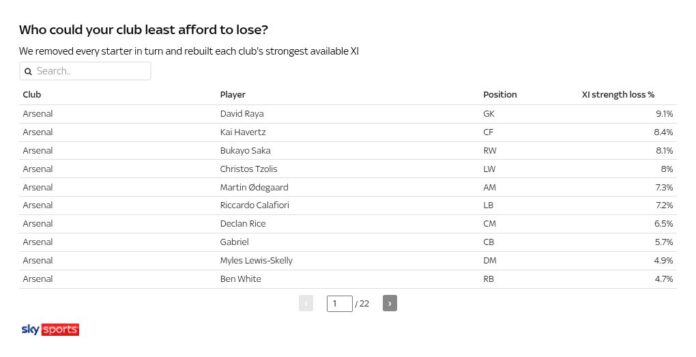
Finally, we simulated the loss of every member of every club’s first XI. The selected player is removed and the model rebuilds the strongest possible line-up from the remaining squad.
That allows us to identify the players and positions whose absence creates the greatest potential structural problem.
As you would expect, the majority of these players are goalkeepers. Brighton’s Bart Verbruggen is deemed to be the biggest loss in the entire league when he doesn’t play.
There are other clubs though whose biggest losses come outfield. Youngster George Hemmings has already become Aston Villa’s. Adrien Truffert is Bournemouth’s and Adam Wharton is Crystal Palace’s.
How deep is your club?
Select a club below to see its squad-depth profile, including second XI value, strongest and weakest positions, bench impact and preparedness for the demands ahead.
Disclaimer : This story is auto aggregated by a computer programme and has not been created or edited by DOWNTHENEWS. Publisher: skynews.com