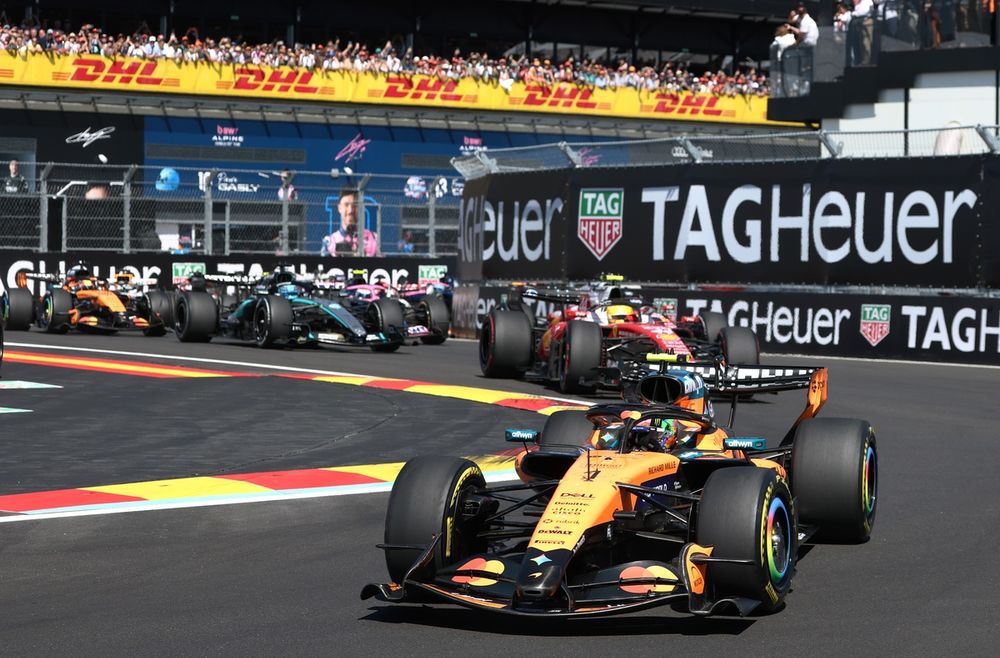
Amid all the admiration for Kimi Antonelli, whose world championship celebrations in Austin on Sunday evening had to be put on ice until Mexico, one rather significant development in the 2026 Formula 1 season almost slipped under the radar: the first major verdict has been delivered.
George Russell and Lewis Hamilton may still be in the title race, at least mathematically. But one driver has officially been eliminated.
After 18 of the 23 scheduled Grands Prix, Lando Norris trails Antonelli, the champion-in-waiting beyond any reasonable doubt, by 154 points. Yet with Mexico, Brazil, Las Vegas, Qatar and Abu Dhabi still to come, there are only 125 points left on the table for any individual driver.
Which means his reign as Formula 1 world champion is officially over. And the coveted number 1, which he had waited so long to carry on his car, now has just a few more weeks left before its farewell tour comes to an end.
In truth, it had been clear for quite some time that the 26-year-old was unlikely to defend his crown. As early as the season opener in Melbourne, the writing was on the wall: Mercedes would be an extraordinarily tough nut to crack in 2026. It took until the fourth race of the season, in Miami, for Norris to even make his first podium appearance.
Then, in July, McLaren introduced an upgrade that arrived (too?) late but nevertheless offered a tantalising glimpse of a possible return to former glory.
Norris won in Hungary, just before the summer break, and again in the Netherlands immediately afterwards. And although it was already becoming increasingly obvious that retaining the title was probably beyond his reach, plenty of observers still had him pencilled in as a potential runner-up in the championship. Myself included, I must admit.
Lando Norris, McLaren
Photo by: Alastair Staley / LAT Images via Getty Images
We now know that Hungary and Zandvoort were little more than a flash in the pan.
The McLaren-Mercedes MCL40 is by no means an inherently slow racing car. But unpredictability is hardwired into its DNA. Or, to borrow Norris’s own explanation: you nail three corners on a lap, then tweak the set-up to improve the next three. And sure enough, those next three corners get better. The trouble is, the balance that made the first three work so beautifully has suddenly vanished.
A classic case of fixing one problem only to create another.
Singapore then marked a new low on Norris’s road to dethronement. In the F1 Sprint, of all places, he managed to drive into his own team-mate Oscar Piastri, earning himself several stern lectures in the process.
Behind closed doors, naturally. You would hardly expect anything else from a team run by Andrea Stella. But the message, it seems, hit home.
It was an incident that may well have left its mark on the relationship between Norris, long perceived by fans as McLaren’s undisputed golden boy, and the team he has called home for so many years.

Lando Norris, McLaren, Oscar Piastri, McLaren
Photo by: Andy Hone/ LAT Images via Getty Images
Norris has never been the sort of driver who radiates unshakeable self-confidence every waking moment. Not in the way Max Verstappen does, for example.
And yet, for much of the 2026 season, he had seemed remarkably at peace with himself. Comfortable in his own skin, secure in the knowledge that he had already ticked off the one great ambition of his life.
Last weekend, however, something felt different.
Two weeks after Singapore and the dressing-downs that apparently followed, Norris seemed a changed man. Gone was the occasionally ironic sense of humour he normally brings to interviews. And over the team radio during the race, there were moments when he sounded almost intimidated. Uncertain of himself.
Like a small child who has just been given a proper telling-off by his parents and no longer dares to speak his mind, even when he secretly believes he is right.
Take the early stages of the race at the Circuit of the Americas.
Norris was running behind Piastri, clearly had more pace than his team-mate, and was asked just how much faster he could actually go.

Oscar Piastri, McLaren, Lando Norris, McLaren
Photo by: Colin McMaster / LAT Images via Getty Images
An invitation to engineer a position swap, if ever there was one.
The natural racing driver’s instinct would have been to fire back something along the lines of “at least four tenths”. Instead, Norris mumbled almost apologetically into his radio: “Yeah, I mean … Yeah. I’m being held up now. I’m closer to him than he is apparently.”
Later in the race, as Norris attempted to nurse his worn tyres to the finish without another pit stop, his team advised him to come in after detecting a flat spot. His response? “I don’t have a flatspot. But you can do whatever you want.”
And later still, he went as far as saying: “No more calls, please.”
There was no aggression in his voice. No outright anger, either. But there was defiance. The kind of quiet, stubborn defiance that speaks volumes precisely because it is so restrained. Norris had retreated into monosyllabic communication, saying little more than the bare minimum.
We have all been there. When my partner is getting so spectacularly on my nerves that I am quietly boiling on the inside, but I know full well that speaking my mind would trigger an argument in which I might completely lose my temper, I behave in exactly the same way.
Short answers. Tight lips. No unnecessary conversation.
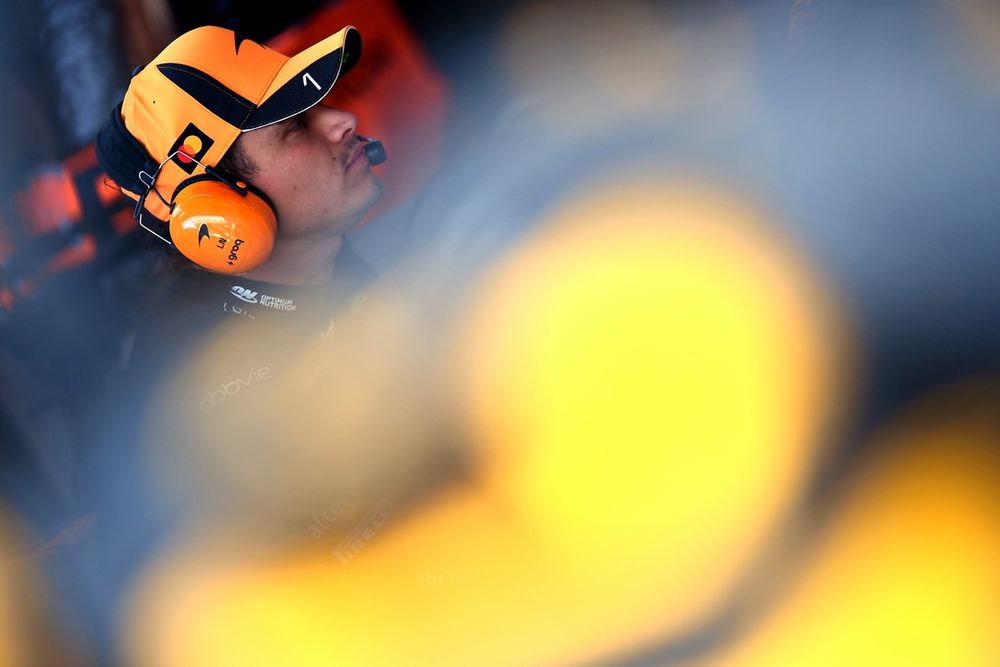
Lando Norris, McLaren
Photo by: James Sutton / LAT Images via Getty Images
All the while knowing perfectly well that the person on the other side knows exactly what is going on beneath the surface.
Perhaps, though, all of this is happening at precisely the right time. A storm that clears the air, at a moment when both Norris and McLaren can afford to let the thunder roll.
Remember Nico Rosberg in 2015? After a season that had gone badly off the rails, he started winning again in Mexico and went on to string together one victory after another. And we all know how that story ended in 2016.
Some Formula 1 world champions possess an almost mystical aura of invincibility. Ayrton Senna was one of them. When backmarkers caught sight of that famous yellow helmet in their mirrors, they practically moved aside in reverence as he came through to lap them. Because they knew just how uncompromising Senna could be.
Or take Verstappen. Even Lewis Hamilton, of all people, regularly thinks twice before going wheel-to-wheel with him. Because everyone knows that, when push comes to shove, Max is perfectly prepared to let things get ugly.
Norris does not possess that aura. He is not the kind of man who takes his insecurities to bed, wrestles with them behind closed doors and makes absolutely certain that the outside world never sees a crack in his armour.
Quite the opposite.
His willingness to be open about his doubts and vulnerabilities is precisely what makes him so immensely likeable as a human being. But perhaps it also leaves him just that little bit more exposed. A little easier to unsettle. A little more vulnerable to those who know where to press.
So what will his career ultimately look like? Will he join the ranks of Senna and Verstappen, drivers who turned one world championship into several?
Or will his story end up looking rather more like Jenson Button’s: one glorious, unforgettable season at the very summit of Formula 1, followed by years in which that ultimate triumph never quite came within reach again?
A great deal of that, of course, will depend on the car beneath him. But perhaps a small part of the answer also lies elsewhere.
In learning to develop a thicker skin. In becoming a little more resilient, a little harder to rattle. And in discovering that, sometimes, when someone is angry with you, the best response is simply to shrug your shoulders and let them be angry.
We want your opinion!
What would you like to see on Motorsport.com?
– The Motorsport.com Team
Disclaimer : This story is auto aggregated by a computer programme and has not been created or edited by DOWNTHENEWS. Publisher: motorsport.com