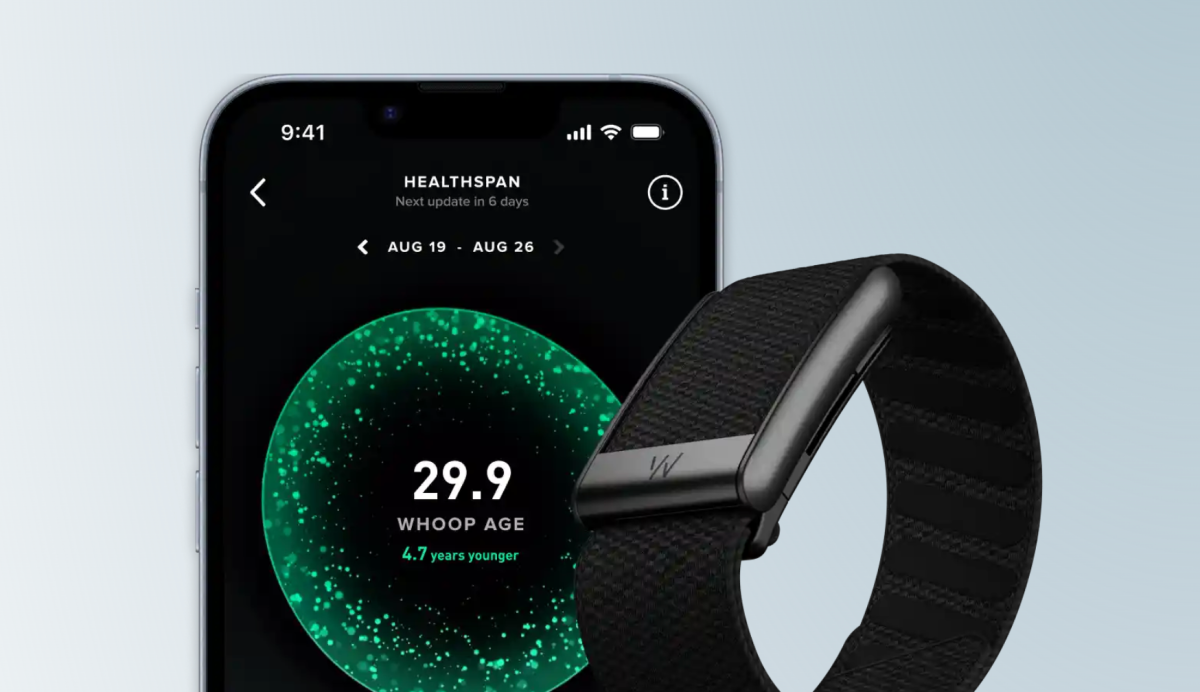
Whoop, the maker of screen-less fitness bands, is launching a social network on Thursday that lets its members follow friends and family and share their health data.
The network, called Whoop Humans, will be rolled out in the Whoop app to members at every membership tier at no extra cost. Members can follow anyone on Whoop and choose what to share, from sleep and recovery to workouts and achievements. Followers can react and comment; members can also attach photos and commentary to their data. It’s all opt-in, CEO Will Ahmed tells us.
Whoop already has a social feature, Teams, which a little more than half its customers use, according to the company. But Teams is built around groups and leaderboards, and everyone in a group sees everyone else’s information.
Humans is meant to be more intimate. Members decide who follows them and who sees what, so a trainer can track a set of clients without the clients seeing one another’s data, for example.
I found myself questioning how much a spouse wants to know about the other’s sleep score when Ahmed mentioned this particular scenario, so I asked him how else beta members used these newer social features. He said the company learned that people were more engaged when someone reported a low recovery score than a nearly perfect one, suggesting that the new feature may be particularly helpful for understanding when someone is struggling and might need attention.
Indeed, Whoop seems to be heading towards medical wellness. Like its most direct rival, Oura, the company is pushing faster and more aggressively into the wellness opportunity that an aging population presents.
Whoop had already added FDA-cleared ECG and atrial fibrillation detection, blood pressure insights, blood testing and medical-record uploads. Asked if older customers are gravitating to Whoop, Ahmed said, without offering specifics, that Whoop has seen “huge growth” among people over 60 over the past 18 months. He also said his was among the first companies accepted into a Medicare program that reimburses qualifying wearables that can show they improve health outcomes, and that it now has Medicare members.
He added that he expects families to be big users of Humans. (You can imagine adult children checking in on aging parents.)
But the company’s efforts to be thought of as the “brand for personal health,” raises questions, naturally, about privacy. Ahmed said members choose which metrics to share, can remove followers, and can switch on “stealth mode” to go dark for a few days without changing their settings. Activities marked sensitive aren’t shared by default, and Ahmed said health alerts and medical information aren’t shared at all. Members can also report any comment or photo that they deem disturbing, and the company said reported content is reviewed.
As for minors, Whoop’s minimum age is 13 for all members (higher in some countries), meaning customers of that age can share their data subject to consents and privacy settings. Asked whether a parent could follow a teenager’s data, he didn’t answer directly and pointed to the privacy controls.
Ahmed also said Whoop doesn’t sell member data. “Our product is not you; it’s the membership,” he said, adding that the company doesn’t license data to third parties.
He was candid about dealmaking. Asked about Oura’s announcement this week that it will pay $625 million for Counsel Health, a service offering on-demand physicians, Ahmed said he expects “more consolidation” among AI-focused, clinician-focused and wearable companies, and that Whoop is always on the prowl. Its deep relationship with members, he said, puts it “in a position to be an acquirer.”
He was more guarded about the company’s own finances, declining to share revenue or say whether Whoop is profitable. He did say that the company now has about 1,200 employees, membership on its software platform has increased more than 70% a year for three years running, and that it expects to have nearly 4 million members by year-end.
As for an IPO (the company raised a very big round earlier this year), he said only that Whoop “will certainly IPO in the future.” He also wouldn’t comment on Oura, which shelved its own IPO of up to $2.2 billion in September citing market uncertainty.
In the meantime, Whoop is widening its reach. The company announced that its devices will be sold through Ulta stores beginning next March (around 500 locations of the beauty retailer to start, and a target to retail in more than a thousand stores eventually). Indeed, Ahmed said Whoop’s female audience has more than doubled from last year.
As for competition, in addition to Google’s new Fitbit Air band, Whoop may soon have to contend with Apple, which is reportedly developing a Whoop-style band. But Ahmed mostly shrugged those concerns off, suggesting that building a product doesn’t guarantee success. Instead, he said, Whoop’s job is to stay true to the “aspiring” people it serves.
When you purchase through links in our articles, we may earn a small commission. This doesn’t affect our editorial independence.
Disclaimer : This story is auto aggregated by a computer programme and has not been created or edited by DOWNTHENEWS. Publisher: techcrunch.com