
Pete Hegseth’s plans to stage a public execution resemble a grotesque Iran-imitation game.
Having failed over the past seven months to defeat the Tehran regime on the battlefield, the self-styled “secretary of war” now proposes to mirror its notorious practice of enforcing the death penalty as a grand public spectacle.
“We’ll make sure that people are able to watch it, that it’s public, because people need to understand there’s serious consequences for these types of things,” Hegseth, with barely concealed relish, told the rightwing Real America’s Voice network of the planned execution of Nidal Malik Hasan, a former army psychiatrist who killed 13 people at a military base at Fort Hood in Texas in 2009.
The prospect conjures vivid flashbacks of my own experience witnessing such an event in Iran, days after arriving as a correspondent for the Guardian more than two decades ago.
Then, the Iranian authorities hung a convicted child serial killer, Muhammad Bijeh, from a crane – in contrast to the firing-squad execution Hegseth envisions – in the small town of Pakdasht, about 35 miles (56km) from Tehran.
The resulting report was published by the paper in March 2005. It was the first I had filed for the Guardian.
Reading it back now, almost 22 years later, my sparing, almost frugal, description barely does justice to the grim drama that unfolded – and its enduring effect on me.
It was a searing and unforgettable experience that deeply imprinted on me, as a new arrival, the ruthlessly repressive nature of the Islamic republic. In many ways, that seemed the intention.
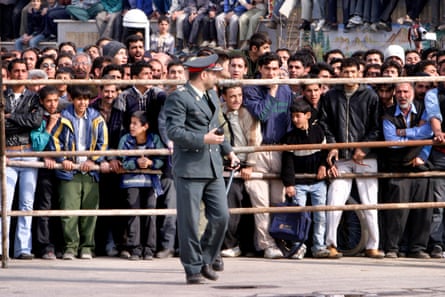
For the locals, it was an exhibition they were encouraged to attend. I clearly recall police cars touring the streets as officers inside with loud-hailers summoned the local population to watch.
I came to the authorities’ notice along with a BBC correspondent, who drew attention after sticking her microphone out of our car window to record the sound effects of the police summonses.
After the police stopped us and learned we were foreign journalists, they took us to a municipal office, where a local court official – who seemed to be in charge of arrangements – appeared rather pleased to see us.
What did I think of all this, he asked, as we looked out the window at the scene in a public square, where a makeshift gallows-like platform had been erected and a crowd was gathering.
Unsure of myself, and mindful of Iran’s reputation for expelling aberrant foreign journalists, I hedged somewhat uncourageously, ignoring the whispered promptings of the BBC journalist – who had not been asked and, unlike me, was visiting the country on a short-term visa – to “tell him you think it’s awful”.
How awful became gruesomely clear when we went outside.
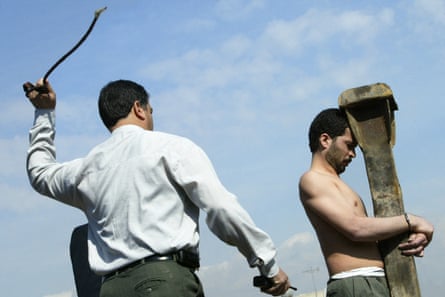
Before he was to be hung, Bijeh, who had reportedly murdered 17 children and three adults, was to be subject to the Islamic punishment of 100 lashes. My report describes how officials took turns to administer them.
My memory is of the condemned man’s muffled cries of agony as the blows inflicted bloody streaks on his bare back, prompting the feeling that this was an officially endorsed display of sadism.
As Bijeh stood awaiting execution, a youth said to be brother of one of the child victims stormed the platform and stabbed him with a knife.
The thirst for violence continued as he was hoisted from the crane. The crowd chanted “Allahu Akbar” (God is great) and “marg bar Bijeh” (death to Bijeh) while the father of one of the murdered children urged the crane operator to “turn him around, make him swing”.
When the operator obliged, Bijeh’s shoes fell off, one after the other, leaving him barefoot as the life drained from him.
I watched all this with rapt fascination, knowing I was witnessing a horror – yet also with a detachment that to this day gives me pause. I was working.
As Bijeh’s limp and lifeless body hung high up above the town square, I took, for professional purposes, a photograph – asking myself inwardly whether it was morally the right thing to do. Now, I am sure it was not. The ignoble act was all my own, but perhaps also an illustration of the uglier impulses of the human psyche triggered by a public execution.
As the dark carnival mood began to dissipate, the same court official who had canvassed my views earlier approached me to justify the scene. “Look at the way the emotions of the people have calmed down. We had to hold it in public,” he said. While I cannot recall my response, I was unconvinced.
It was not the first execution I had reported on.
I had been in Terre Haute, Indiana, in 2001 for the execution – by lethal injection – of Timothy McVeigh, the Oklahoma City bomber, who killed 168 people with a truck bomb outside a federal building in 1995. But that took place behind closed doors, in a federal prison. McVeigh’s high-profile crime accounted for the intense media and public interest in his death.
In Iran, by contrast, officials had deliberately fanned voyeuristic impulses for what seemed like the purposes of flaunting authoritarian power.
It amounted to a salutary first impression as I came to terms with life under an Iranian regime that took power after the 1979 Islamic revolution.
It served as something of a moral compass as I reported on the regime’s actions, and tried to understand how – and why – its ideology seemed so at odds with the values proclaimed by the US and the west.
How odd it now seems, therefore, for the US defense secretary to be proudly laying the groundwork for an event that feels as though it could be organized by the authorities in Tehran.
It raises the question of whether, at least under Donald Trump, Washington and Tehran’s values are really so different after all.
Disclaimer : This story is auto aggregated by a computer programme and has not been created or edited by DOWNTHENEWS. Publisher: theguardian.com




