
Ten months ago, the nation’s assumptions about itself were shattered by the alleged terror attack at Bondi. Then, like now, our leaders appealed for a more toned-down public discourse to push back the tide of rising extremism.
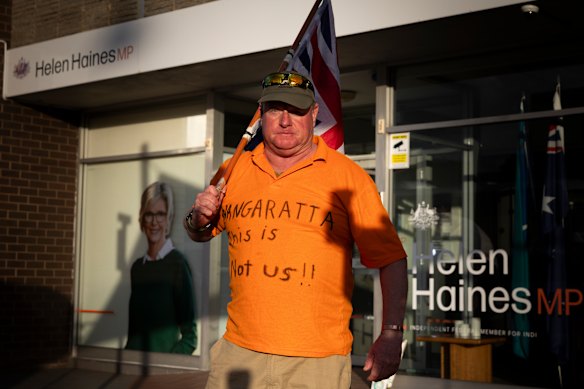
The dilemma is that the calls for civility after the alleged attack on Helen Haines clash with the political, social, and economic forces that have brought about a more dangerous and disunited nation.
Anthony Albanese’s call to “take the temperature down” comes at a moment of overlapping crises: financial stress and inequality caused by a quick succession of economic shocks; fears of job displacement from AI; existential worry about climate change; and historically high levels of migration causing anxiety over housing and cultural displacement.
A person’s political bent will determine which of these factors they emphasise. What is clear is that polls show more Australians feel like the country is headed in the wrong direction.
Australia is far from immune from the problems of its peers. Real wages have fallen since the pandemic. Overdoses among Gen X men, the same group shifting most strongly to the populist right, spiked 50 per cent to record levels, while other deaths of despair also grow.
Tribalism is worsening and the social media age means shared truths are a thing of the past. Which institution outside of sport still brings Australians together?
After the alleged attack on Haines and, by extension, the democratic fabric, Australia’s political and media class face a test of their ability to respond maturely, act firmly, and work with corporate and civil society leaders to generate a renewed confidence in the democratic process.
Failure will only lock the nation into a future of overheated political and social division. It will be difficult to feign surprise in the next instance of political violence, which has been rising at electorate offices and online before this dramatic escalation.
All major parties are struggling for a policy prescription to address economic and social dilemmas.
The left and right have split over the question of “social cohesion”, a buzzword amplified by Bondi. On hate speech, Islamic extremism, and regulation of social media, our politicians have failed to land bipartisan solutions.
The least our leaders can do is genuinely heed the warning of ASIO’s Mike Burgess.
“We are seeing spikes in political polarisation and intolerance, uncivil debate and unpeaceful protest,” Burgess said on Monday, echoing his repeated urgings after the 2023 Hamas terrorist attacks and Israel’s subsequent onslaught.
“Political differences, debates and peaceful protests are essential parts of a healthy democracy. ASIO has seen direct correlations between inflamed language, inflamed tensions and acts of violence.”
Mainstream voters will look more dimly upon politicians who associate with fringe actors for as long as the Haines alleged attack remains in the public consciousness.
It isn’t a fashionable time to be a political moderate, but Burgess’s message is simple: the behaviour you walk past today becomes the standard you tolerate tomorrow.
It is a standard our MPs haven’t lived up to. Matt Canavan recently brushed off a chance encounter with neo-Nazi associates who post about “Australia for the white man”. Pauline Hanson has supported her long-time ally Malcolm Roberts even as his views, often described as antisemitic, have emerged.
Greens leader David Shoebridge declined to rebuke a supporter who claimed Labor ministers were “beholden to the Zionist lobby” and subservient to a “cadre of genocidal paedophiles”.
Haines’ alleged attacker Brendan Nugent’s focus on alleged Israeli war crimes, including an X post made a day before the attack, makes the incident trickier to navigate for the left.
Shoebridge was the only politician besides Haines following Nugent on X, where the suspect had posted for years on environmentalism, anti-US sentiment, and Labor’s alleged subjection to foreign powers. Shoebridge unfollowed Nugent on Monday, with a spokesperson confirming he did not know the man.
Although Nugent’s far-left and often conspiratorial views were well known, his motives over the alleged attack remain unconfirmed. Mental ill health and personal misfortune may have played a bigger role than his diet of YouTube conspiracies.
On Tuesday, Liberal MP Andrew Hastie condemned Hanson for using the Haines incident to launch an attack on Albanese.
As NSW Premier Chris Minns suggested after Bondi, an increasingly volatile world may force a delicate rebalancing between civil liberties and public order. The scenes in France, beyond anything Australia has seen in terms of political unrest, should serve as a warning.
As further details emerge in the coming weeks, leaders across the political spectrum face an immediate challenge: narrowing the ground where extremism takes root.
More from our Helen Haines coverage
 Paul Sakkal is Chief Political Correspondent. He previously covered Victorian politics and won a Walkley award and the 2025 Press Gallery Journalist of the Year. Contact him securely on Signal @paulsakkal.14.Connect via X or email.
From our partners
Disclaimer : This story is auto aggregated by a computer programme and has not been created or edited by DOWNTHENEWS. Publisher: www.smh.com.au