Last week, I was enjoying a quick afternoon drag on my generation’s preferred vice — vertical short-form video — when I saw something striking.
A clip filmed at a recent PGA Tour Champions event with longtime pro (and former Ryder Cup captain) Zach Johnson.
In the video, Johnson — the golfer who has won a green jacket and more than $55 million in his career — is asked a question of premeditated inanity.
“Zach,” the host asks. “If you’re hungry and you go to the gas station, what’s the go-to snack lineup?”
If your brain is similarly dopamine-addled, you can probably already picture the interviewer. The “creator” responsible for this content series is a bit of an internet archetype: a normal-looking, mid-twenties guy holding a tiny microphone and hoping to capture snackable, repeatable, relatable celebrity soundbites.
And if your brain is similarly dopamine-addled, you probably already know how it works. If the video performs, it will generate the physiological equivalent of a sugar high — a pinprick of dopamine that can be measured in likes, shares and comments. If the video is really successful, the goal is something else entirely: not dopamine, but shock — ideally the thumb-stopping, ‘OMG LMAO’ variety.
In this particular video, Johnson gives the creator a gift. When the question arrives, Johnson doesn’t politely say he loves Snickers bars. He engages in an awkward, terse exchange in which he eventually claims he doesn’t buy anything at all from the gas station.
The answer ends abruptly, and Johnson is off to the rest of his day without further thought. But on Instagram and TikTok, it starts all over again, infinitely looping around the awkwardness of Johnson’s encounter like the contents of a Slurpee machine.
If I were to take part in my generation’s second-favorite vice, I’d make you a wager about this interaction. I’d bet that Johnson is trying to be boring. I’d bet he’s looking for the most efficient path between hearing the question and disappearing. Unfortunately, like Barbara Streisand’s lawsuit over a little-known photo of a Malibu beach, Johnson’s efforts to strangle the problem only make it larger.
The first commenter arrives quickly. And then the next. And then the next. Soon the video achieves its own kind of “virality,” and soon golf’s many aggregators are resharing it under a similarly archetypal, morally unimpeachable caption.
“Thoughts?”
Within a few hours, a few dozen of golf’s angriest fans have laid waste to Johnson’s entire career and personality.
As the judgments roll in, one commenter summarizes the interaction in plain terms.
“I don’t even think he’s human.”
***
<figure class="youtube-facade" data-content="
“>
This, my friends, is how the sausage is made on the internet in 2026. It’s not pretty. And it’s not for the faint of heart.
It’s also a perfect synopsis of the cultural environment that gave way to the explosion of YouTube Golf.
On YouTube, golf’s stars do not share Johnson’s instincts for boredom. Quite the opposite. They’re attention-maxers, camera-moggers — the kinda guys and gals who wouldn’t know how to skirt a viral moment if they tried. When they’re asked a question they don’t want to answer on camera, this group lapses into an extended comedy bit. If that doesn’t work, they try hard to be boring, since boring is the worst thing anyone can be on the internet — worse than bad. And if that doesn’t work, they don’t hide from the camera. They sit in front of it, press record, and publish a video titled: Why That Controversy Was Totally B.S.
This group, the YouTubers, knows as much about algorithms and headline writing as they do about hitting a particularly pure 5-iron into a breeze to an elevated green. Of course, some of them have traded golf success for affability and media savvy, but that hasn’t exactly hurt the bottom line.
Again, quite the opposite. YouTube golf is still booming, even if it suffered a blow after Good Good‘s recent Callaway TV ad saga. The stars are still stars. The sponsorships are still flush. The view counts are still high. And the money is … yes, still green.
The point here is not that golf has changed; it’s that entertainment has changed. Our brains crave dopamine. Our screens deliver it. And the internet’s biggest stars are the people who deliver it best. No form of media is impervious to these changes, not even golf.
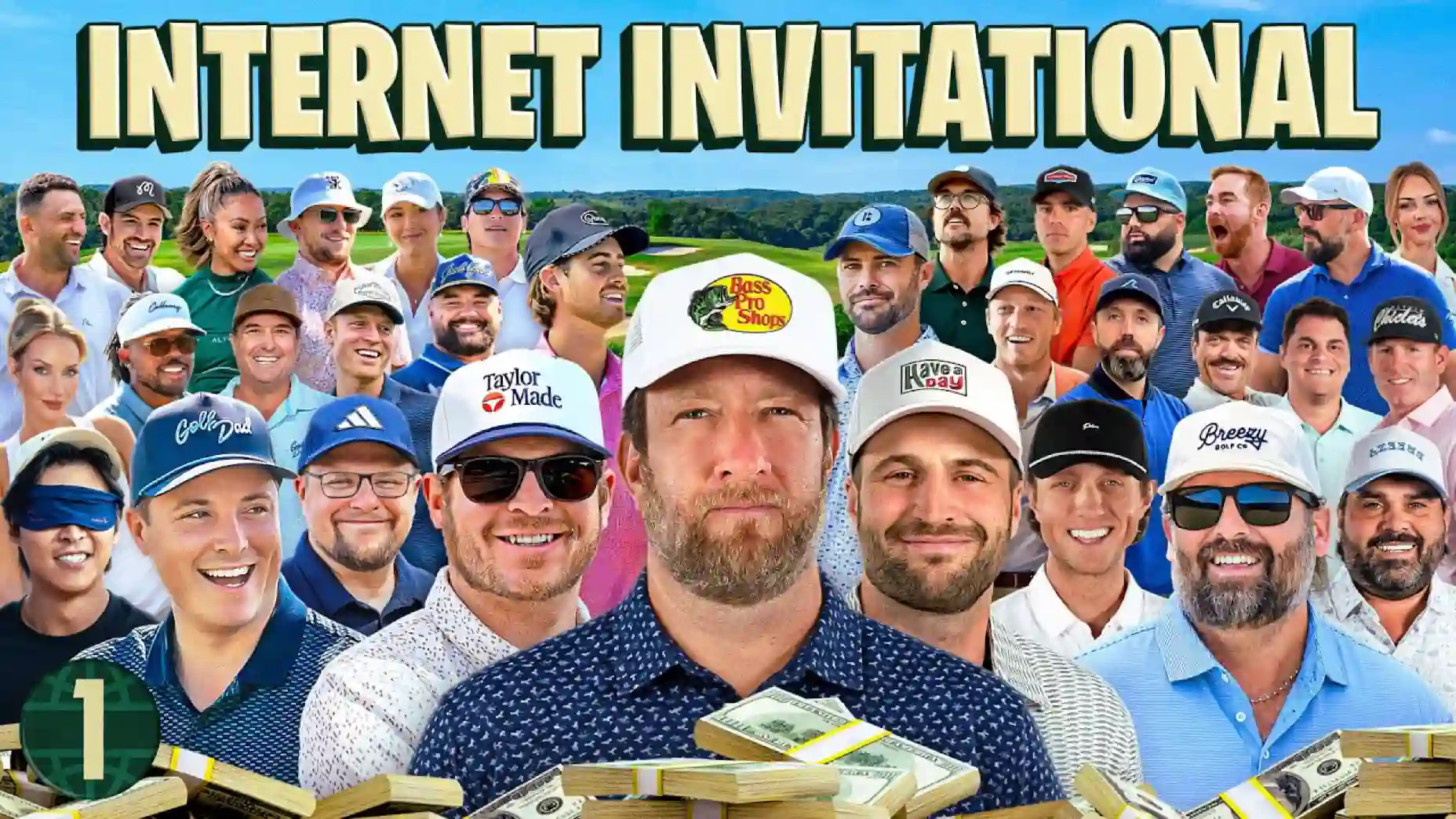
The surest sign of our changing media climate arrived on Monday afternoon, when the granddaddy of all golf social media experiments, The Internet Invitational, returned for its second year.
In 2025, the Internet Invitational was a sensation — a multi-part, 12-plus-hour odyssey attempting to name the best golf internet creator from a crowded field of applicants. The event, hosted by Barstool Sports in conjunction with Bob Does Sports, was a golf competition wrapped in a reality TV show — a multi-arc series complete with a lovable hero, a hated villain, and no shortage of drama in between. In the end, the tournament paid well for a golf competition or a reality show, giving $1 million split among the three members of the winning team.
In 2026, the Internet Invitational is orders of magnitude bigger. The first episode is 5 hours and 4 minutes long — nearly the same length as The Odyssey … if you were to watch Christopher Nolan’s marathon epoch twice. The second version of the Internet Invitational also has 64 players, up 16 from the 48-player iteration in 2025, and pays out $4 million. And that’s not including a special bonus prize: A $500,000 hole-in-one sponsorship that will pay out a cool half-million to the first ace-haver during the competition.
But the truest indicator of success for this year’s Internet Invitational exists in a place far more meaningful than a bank account. At the time of publishing, and less than 12 hours after the first episode went live, the first chapter of the 2026 Internet Invitational has more than 1.1 million views, more than 34,000 likes, and more than 2,000 comments. That is, as the kids say, viral.
More than any one metric of its brain chemistry, though, the Internet Invitational has something that most tournament golf can only dream of: It has entertainers. The field at the Internet Invitational does not need prodding to name their favorite gas station snack, nor do they need encouragement to deliver a pithy soundbite for the camera. They are personalities by definition, and sometimes (as with Luke Kwon’s ill-fated dalliance with his alarm clock in 2025) to their own detriment.
The result is one of the most infinitely watchable pieces of golf competition ever created, even if you much prefer your Sunday afternoon golf competition narrated by Jim Nantz and dotted with glorious humpbacks floating through Pacific Life commercials. The competition won’t keep your heart thumping the way Sunday at the Masters (or, for that matter, Sunday at the 3M) will, and it certainly doesn’t have the same aspirational quality that makes watching Scottie Scheffler hit a 7-iron feel like somebody is massaging your hippocampus. But it does have something that Scheffler doesn’t: relatability.
I know the traditionalists are tired of hearing from yuppies like me about the forthcoming — or maybe already here … or maybe long past — YouTube revolution. I know you believe “golf” will never need the modifier “YouTube” before it. I know you believe your golf will survive long after ChatGPT has learned to create a zillion artificial replicas of my golf, because no form of artificial intelligence can ever accurately recreate the feeling of witnessing true athletic brilliance. (Hell, after some of the things I’ve seen on the internet, an AI army of doe-eyed twenty-year-olds with broccoli haircuts and 5-handicaps sounds pretty good.) But I also know that arguments against new kinds of golf are a bit like arguments against new flavors of ice cream — you might not like ’em, but so long as they’re cleaning the scooper, it shouldn’t bother you!
In this instance especially, the traditionalists have nothing to worry about. The Internet Invitational is no more imminently threatening to pro golf than a passing asteroid, and no more likely to take pro golf’s money than LIV 2.0. The truth, as PGA Tour CEO Brian Rolapp has pointed out on a few occasions, is that these two entities are fundamentally and ontologically different. The PGA Tour is the place where people go to see great achievement; YouTube golf is where they go to see great entertainment. Sometimes the entertainers deliver a compelling achievement, and vice versa, but that’s not a sign of the apocalypse. It’s a sign that the world has changed.
Our changing world is why the Internet Invitational matters. Not because professional golf will become YouTube, or because pro golfers will become YouTubers (though Bryson DeChambeau certainly seems to be giving it the ole’ college try). But because this outcome is inevitable.
As time moves forward and the barrier to entry shrinks, the number of people capable of entertaining us through sports will only increase. And even if the number of spots in professional sports remains entirely unchanged, there will be days when people will rather watch YouTube.
If golf entertainment is growing, there are worse places for it to happen than at the Internet Invitational — a tournament where the watching is easy, the production quality is immaculate, and the commercial breaks don’t cost us any golf shots. The tournament will not change the course of anyone’s playing career, but it will change the course of someone’s life — either by virtue of an enormous check or a microwaved dose of internet celebrity.
In either case, a few more characters in golf might not be a bad thing. Personality, after all, is the skeleton key to legacy. Ali might not have been more technically skilled than Sugar Ray, but he is better known. In the end, a similar logic applies to today’s sports media ecosystem, even if we are loath to admit it.
At the Internet Invitational, the stars aren’t pros. But for a few days in a strange corner of the internet, they might be something even better: Humans.
Disclaimer : This story is auto aggregated by a computer programme and has not been created or edited by DOWNTHENEWS. Publisher: golf.com