Brisbane is at the beginning of its cosmopolitan journey. It’s a remarkable thing – cities breed art, culture, diversity, vibrancy and economic resilience the world over. This changing social landscape will mean our buildings change too. How do we hold on to what makes Brisbane, Brisbane?
If we look overseas at cities much older than ours – New York, London, Copenhagen, Paris – their unique identities developed long before globalisation in a time when building materials were bound by geographic proximity. Each city’s architecture is distinct, a representation of available building materials, and a response to climate and local culture.
The challenge for Brisbane, indeed any modern city facing rapid development, is the impeded ability of designers to safeguard a coherent city identity.
It’s not an easy job. Each new development competes with its predecessor, and the idea of hiring an architect to produce something that looks like the neighbour isn’t exactly a priority for a paying client.
On top of this, global trade networks have resulted in a universal sameness, as glass towers continue to emerge in our cities regardless of climate, culture or context.
Brisbane does have a lot to be proud of – the success of Howard Smith Wharves, South Bank and the Riverloop. These are urban interventions worthy of a global city.
But I also notice a blight, slowly spreading across the hallmark hills of our suburban city.
We’ve lost our appetite for colour.
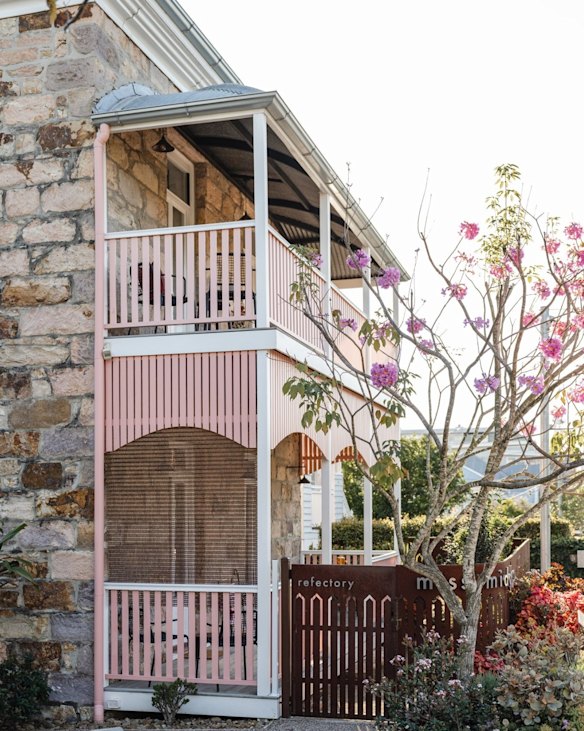
In response to this chromatic drought and in search of a cohesive city identity, I propose a new solution, however unconventional. We should paint the town pink. Literally.
Queensland architecture has been defined by its colourful character homes for more than a century. Standing atop Paddington or Highgate Hill, stilted timber cottages climb the rolling hillscapes painted every colour imaginable, from buttercup yellows to sage greens with frosted trims or deep olive accents. Why have we been such a colourful city for so long?
It’s not just aesthetics, it’s a climate response. Light colours have always been integral to the Queensland climate to reflect heat, but intense whites introduce unbearable levels of glare.
I know I’m not the only pedestrian to be unsuspectingly blinded when rounding a corner on a new development. It sounds light-hearted, but cities are nothing if not defined by the experience of walking through them. What’s a better alternative to keep our city cool but stop us disappearing under a sea of blinding anonymity?
Our heritage buildings have been kind enough to leave us a clue.
Brisbane is built on top of a volcanic rock called Brisbane Tuff, deposited by cataclysmic events a long time ago – meaning it’s finite and specific to our city.
It was a miracle material for the European colonists who quickly put the convicts to work quarrying the stone out of Kangaroo Point and other quarries around the city.
Perhaps the best standing example of tuff architecture is the All Saints’ Anglican Church on Wickham Terrace, Spring Hill.
Now, the stone is largely rationed for heritage restoration projects, famed for its colourful composition ranging from purples, teal and rust browns. But its most endearing colour is blush pink.
This blush pink is representative of a geology and history that only Brisbane has.
It extends beyond our European history, acknowledges a landscape swallowed by the slow and gradual development of our city.
As a paint colour, it shifts glare but reflects heat, but blush pink goes further. It mirrors our native bottlebrush, grevillea and blossoming gums – an alternative to the foreign but persistent Jacaranda purples and Poinciana reds.
Lucky for me, I’m not the first person to reintroduce our city to this charming colour. Local architecture firm Richards and Spence with artist Bruce Reynolds, alongside Hassell and REX architecture, recently delivered an office building that shows exactly how colour can be used to transform modern city making.
Located at 205 North Quay, the building could be mistaken for a typical office tower with delicate and lacey bronze shading system, if it wasn’t for the pink concrete landscape it hovers over.
This pink outdoor plaza weaves around landscape and towers above you in a way that feels remarkably like being in a quarry cut from pink stone. I wonder where they got that idea from.
With so much heritage, colour, climatic reasoning and personality to choose from, it is peculiar indeed to see so many new projects decide to plant olive trees instead of banksias, and choose all white instead of pink.
Understanding who we are as a city requires an intimate examination of our relationship with our land, landscape, First Peoples and climate – it is the basis of who we are as a city, and it will be what makes Brisbane, Brisbane.
Start the day with a summary of the day’s most important and interesting stories, analysis and insights. Sign up for our Morning Edition newsletter.
 Izzie White is an award-winning leading content creator specialising in Australian architecture and urban design. She draws on her architectural background to translate complex built environment concepts for public audiences, promoting the value of good design in Australian cities.
From our partners
Disclaimer : This story is auto aggregated by a computer programme and has not been created or edited by DOWNTHENEWS. Publisher: www.smh.com.au