
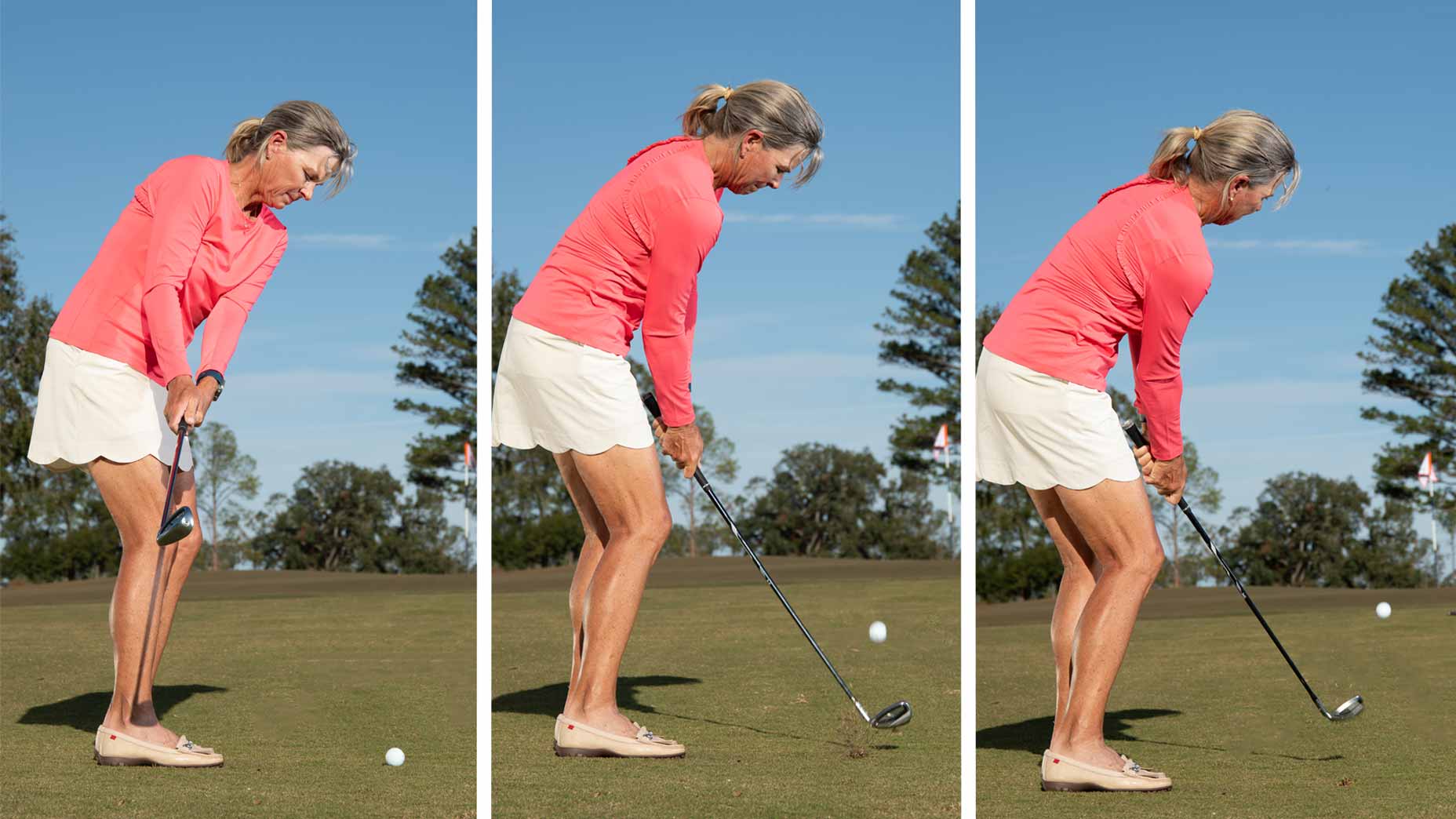
If you want to develop a great short game, it starts with building a consistent foundation — and that begins with calibration. As Kellie Stenzel, a GOLF Top 100 Teacher, explains, it’s one of the simplest ways to bring structure and predictability to your chipping.
When you know exactly how the ball will react to a consistent set up and swing, suddenly nerve-wracking up-and-downs start to carry less weight. Instead of guessing, you’re operating with a plan — and that’s where real confidence comes from.
Ready to build that system? Below are the two keys you need to calibrate your chipping.
Start with a consistent setup
If you want to maximize control around the green, it starts with a consistent setup. To get there, Stenzel says to begin by choking down on the club.
“You always want to grip down, almost to the bottom of the handle,” she says.
From there, build your base. Take a narrow stance — about a clubhead-width apart — and position the ball in the middle of your stance. Settle into good posture, then get your weight forward by leaning toward the target.
“When you lean toward the target, that’s going to do two things. It’s going to de-loft the clubface slightly and it’s also going to drop your lead shoulder,” Stenzel says.
Lowering the lead shoulder is crucial because the club naturally returns to the ground in the right spot. This adjustment encourages ball-first contact and helps you make clean, center-face contact every time.
Stenzel adds an important checkpoint here: As you shift your weight forward, don’t let the club shaft get too far ahead of your body.
“If you start to lean the shaft too much the club can start to dig,” she says.
Instead, she recommends moving your hands and body together so the club doesn’t outpace your center. Think of it as everything working in sync, so the handle stays aligned with your belly button as you make your swing.
Build distance control with your backswing and equipment
The next step in calibrating your chipping is identifying a motion you can repeat.
“Hit a few chips and define what is your most comfortable backstroke size,” Stenzel says, “And if you can identify that, you can repeat that with different clubs.”
This backswing baseline will become your go-to swing for every chip shot, making distance control much simpler. Instead of guessing how far to take the club back each time, you keep the motion the same and adjust your club selection. By switching clubs rather than changing your swing or tempo, you maintain consistency while also producing a variety of distances — making your chipping more predictable.
Ultimately, calibrating your chipping is about combining a consistent setup with a repeatable motion. As Stenzel emphasizes, you don’t need a bunch of different swings — just one reliable system. Stick with it, and even nerve-wracking shots will start to feel routine, giving you a short game you can trust when it matters most.
Disclaimer : This story is auto aggregated by a computer programme and has not been created or edited by DOWNTHENEWS. Publisher: golf.com



