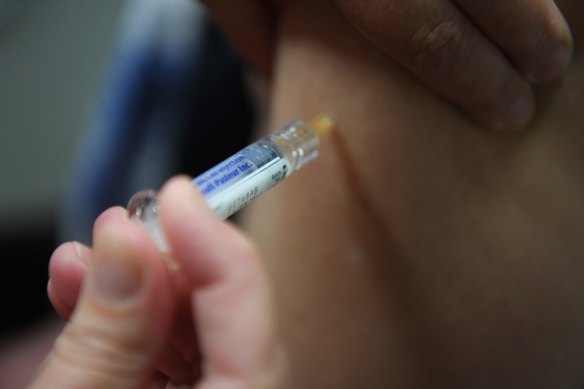

Experts have urged Australians to get their annual influenza shot after a highly pathogenic strain of bird flu, which is wreaking ecological disaster worldwide, was discovered in Western Australia.
Australia had been the last continent free from a virulent form of H5N1 bird flu that has utterly ravaged populations of penguins, seabirds and seals, but on Saturday its first case was confirmed after an infected brown skua was found on the remote Cape Le Grand beach, east of Esperance.
Alongside wildlife deaths, experts are monitoring the virus’s slim but real chance of mutating to better infect people, and they have said flu vaccinations can cut the chance of the bird-adapted virus melding with human disease.
“Influenza is an RNA virus with a segmented genome, meaning it can mutate and reassort. Every spillover into a new host is an evolutionary trial,” said Associate Professor Vinod Balasubramaniam, a virologist at Monash University.
“Seasonal flu vaccination will not prevent H5N1, but it reduces the chance of co-infection with human influenza, the scenario in which reassortment risk becomes more concerning.”
Bird flu’s risk to people remains very low. But scientists have repeatedly said every infection – particularly in mammals – offers a chance for the virus to mutate, gain characteristics to better infect us, and pose a pandemic risk.
“H5N1 remains fundamentally avian-adapted,” Balasubramaniam said. “But low public risk must not be mistaken for low biological significance.”
The problem type of H5N1 bird flu, called clade 2.3.4.4b, has behaved differently to other waves of avian influenza since it emerged in 2021, repeatedly jumping into mammals including dairy cows, dolphins, dogs and cats.
Some animal hosts worry experts more than others. Pigs, for example, can be infected by both bird and human influenza, which makes them perfect mixing vessels for the viruses to exchange genetic material and possibly give rise to a dangerous new strain.
The other place bird flu could meld with a human flu is, of course, a human.
The Australian Centre for Disease Control has also called for people to get their flu vaccination after the virus’s incursion.
Bird flu can infect people but it may never be able to spread from person to person. A number of changes are required for the H5N1 strain to gain that ability and pose a pandemic risk.
One is a tweak to polymerase genes that boosts the virus’s ability to replicate in human cells. The virus’s haemagglutinin – a protein which helps it bind to host cells – would also need to become less targeted to bird guts and better geared towards human cells in our upper airways.
“That final shift remains the major missing step for sustained human-to-human spread,” Balasubramaniam said.
“In other words, H5N1 is not a human pandemic virus today. But it is a virus actively exploring the biological routes that could make it more dangerous tomorrow.”
Despite the ubiquity of H5N1, less than 100 cases were reported in people between 2021 and early 2025. Most were in poultry and dairy farmers who probably caught the virus from their livestock.
Several people worldwide have died from their infection. However, of about 70 human H5N1 cases in the US, only one has turned fatal. The person who died was a resident of Louisiana infected by backyard chickens who had underlying health problems. (Another recent US death was caused by a different strain, H5N5.)
Experts therefore suspect the deadliness of clade 2.3.4.4b is significantly lower than the 50 per cent death rate recorded for other strains of H5N1.
Infectious disease specialist Sanjaya Senanayake, an associate professor at the Australian National University, said people should be aware but not alarmed.
He said the detection of the infected skua underscored the effectiveness of Australia’s surveillance system and that the chance of human infection is negligible.
But he said that if the next infected wild bird was close to poultry farms, “then the consequences could be devastating” for the industry.
Ecologists have said members of the public should report sick birds to the Emergency Animal Disease Hotline and they have urged people to keep themselves, and their dogs and cats, away from sick or dead birds.
The infected skua was discovered skinny and dehydrated in some seaweed on Cape Le Grand beach on June 14, the ABC reported. The bird was confirmed to have the H5N1 strain almost a week later.
A second exhausted bird, a southern petrel also found near Esperance, has returned a suspected positive result.
Both species cover vast distances across the Southern Ocean. The birds may have picked up the virus in the Antarctic region, where the problem clade arrived in 2023.
The virus was detected in Heard Island, an Australian territory in Antarctica, last year. Scientists reported this week the virus had killed 76 per cent of elephant sea pups, 13,359 animals, on the island.
The Examine newsletter explains and analyses science with a rigorous focus on the evidence. Sign up to get it each week.
 Angus Dalton is the science reporter for The Sydney Morning Herald.Connect via X or email.
From our partners
Disclaimer : This story is auto aggregated by a computer programme and has not been created or edited by DOWNTHENEWS. Publisher: www.smh.com.au