

For years, the comedian and reality TV host tried to tone herself down. Now she’s embracing the chaos.
While filming reality game show The Traitors, Gretel Killeen began to question some of the choices she’d made over the years.
“I thought, ‘Why have I been trying to be someone I’m not all this time?’” says the original host of Australian Big Brother. “I toned down how I dress because I didn’t want to be looked at. I toned down the things I say because I didn’t want to draw attention to myself. When you’re in the public eye, you can forget who you actually are. It made me realise that I don’t play enough in life.”
Now 63, the veteran broadcaster, comedian and author is making up for lost time – and she’s having a blast.
When I first interviewed Killeen in 2009, she styled herself in jeans and a brown jacket for the photo shoot. This time, she opts for a fabulous turquoise suit, a vivid orange blazer, snakeskin-patterned boots, a beret, several elaborate rings and a black toy cat, which she strokes in the manner of a Bond villain. She also brings a piece of her own artwork to use as a backdrop, having taken up painting several years ago.
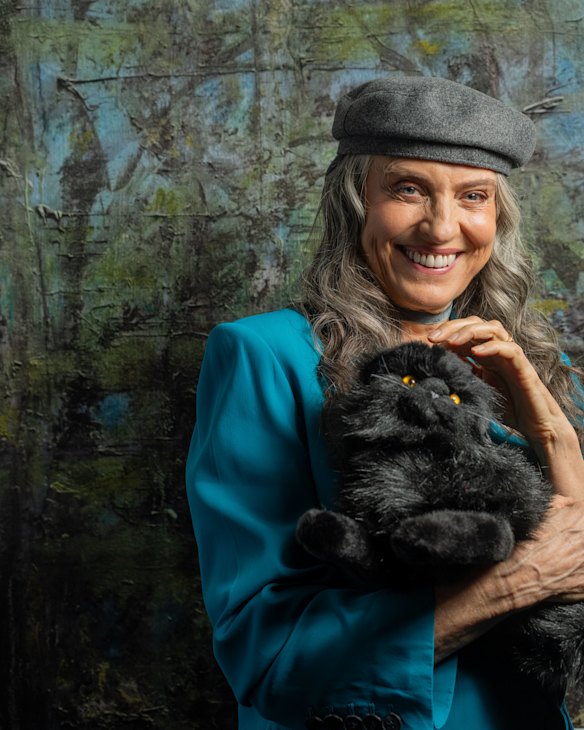
“I used to think fancy dress parties were embarrassing,” she says. “Talk about being a slow learner, but it’s only now that I realise why people like them: they’re being given permission to play and have fun.”
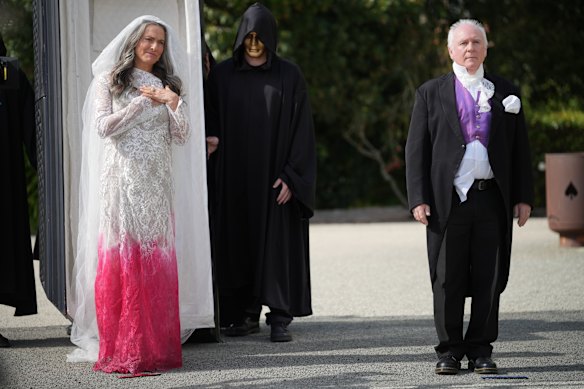
In The Traitors, Killeen encourages contestants to be as naughty as they wish. She certainly leads by example; in the first episode, she makes her grand entrance by stepping out of a coffin in a blood-soaked wedding gown.
Based on a Dutch format, the hit series has spawned 40 international adaptations, including an earlier Australian iteration presented by Rodger Corser. Filmed in a splendid New Zealand manor, this new season features 22 former reality show contestants and judges from programs including Australian Idol, Australian Survivor, The Bachelor, The Block, MasterChef Australia, the Real Housewives franchise and Drag Race Down Under.
The premise is simple: Killeen secretly anoints a few members of the group as “traitors”, instructing them to covertly murder as many “faithfuls” as possible. Meanwhile, the faithfuls try to unmask the traitors during roundtable banishment ceremonies, where accusations fly thick and fast. If they rid themselves of every traitor by the final episode, they share in a prize pool worth up to $250,000. If they fail, the remaining traitors claim the lot.
“It’s about human behaviour, which I’ve always been fascinated by,” Killeen says. “To succeed, you have to be liked and not stand out so you’re not perceived as a threat. It’s a bit like how women have had to be in the world. I’ve been in many meetings where women are the smartest people in the room, but they pitch their ideas as though they’re an afterthought.”
When Killeen arrives for our interview at Channel Ten’s Pyrmont headquarters in inner Sydney, she greets me warmly before frowning at the seating arrangement. “I like to see people’s faces when I’m talking to them,” she explains as we drag the sofas closer together. “It’s much nicer this way.”
Killeen is terrific company: intelligent, funny and entertainingly discursive. While she deems this last trait a weakness, I find it refreshing. “Just wait until you have to edit the transcript,” she counters. “Then you’ll be going, ‘Oh my god, this needs a flow chart.’”
When I spoke to her 17 years ago, she was promoting her “gleefully exaggerated memoir”, The Night My Bum Dropped. The book satirised the “you can have it all” ethos that, as Killeen put it, made many women feel they ought to “run a global empire, raise a family, help a crippled dog give birth and do the ironing while having multiple orgasms”.
“That was the real me,” she admits now. “And it was the real me having a kind of breakdown. I remember thinking, ‘People are reading this and not realising [how accurate it is]’. But that’s life, isn’t it?”
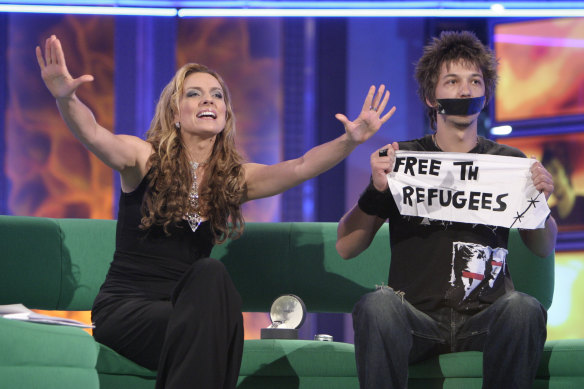
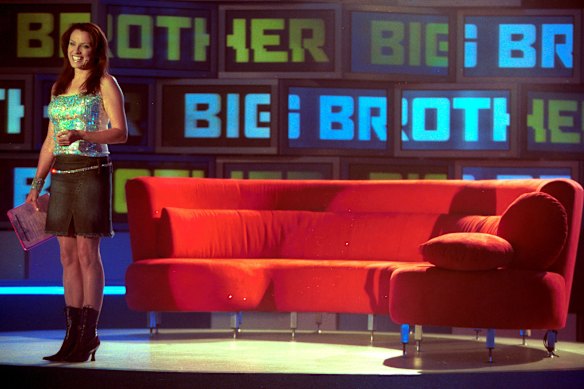
Although Killeen has been on our screens since the late 1980s, Big Brother made her a household name in 2001. As Australia’s first major reality TV host, she is also regarded as one of the genre’s finest. This is no surprise: she earned the marks to study law but quit to pursue live comedy and has since worked in radio, TV and musical theatre; acted and directed; performed for the troops; and authored more than 30 books.
As one critic observed, she lent a “muted wit, maturity and a wry smile to Big Brother, without ever being condescending”. Yet others were incensed by the very existence of the program.
“Big Brother elevated average Australians to a position of importance, which may have been threatening to those who liked the hierarchy of the status quo,” Killeen says. “And because we had such enormous numbers of people watching, some decided that was a sign the show wasn’t very smart. I think they’re ill-informed judgments.”
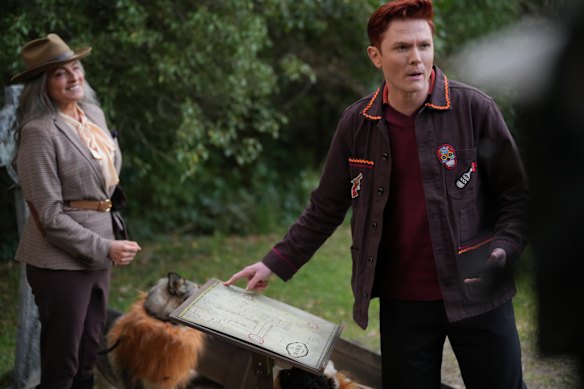
Since stepping down from the series in 2007, Killeen has competed in other reality series including The Masked Singer, Celebrity Come Dine With Me, Go Back to Where You Came From and The Amazing Race: Celebrity Edition. But The Traitors is her first major reality hosting role since Big Brother. One thing that attracted her to the project was the chance to be intimately involved in its production. She decided to play the host as a character of her own creation: a vampish widow with a string of ex-husbands who perished in mysterious circumstances. She even created a scrapbook detailing her character’s backstory.
“When Ten and the production company said to me, ‘Yeah, we can do it this way’, it was so exciting to me,” she says. “It’s very uncommon in television now because everything is so scripted and we were going the complete other way.”
The Traitors, Killeen says, illustrates many interesting aspects of human psychology. This includes our innate desire to form tribes and our susceptibility to confirmation bias, which makes us prioritise information that reinforces existing beliefs while dismissing contradictory evidence.
In The Traitors, contestants are required to test the strength of their arguments against those of their fellow players. In the real world, however, many of us self-sort into ideological silos, where our opinions are constantly reinforced by social media algorithms. This makes it deceptively easy to assume our views are more widely shared than they actually are.
“But The Traitors also shows that we all have this desire to play,” Killeen says, noting that the physical challenges offered participants a welcome reprieve from their scheming and second-guessing. “It’s a release for people to be running around and getting out of their own heads, because they’re connecting with the real world.
“We live in a society where loneliness is at epidemic proportions and as a grandma, I think, ‘What happened to playfulness in our lives? Where did it go? It’s so fun and joyful and healthy, so how did we become so focused on the most miserable elements of our existence?’”
When I ask her to answer her own questions, she doesn’t hesitate. “Money and accessories are measurable,” she says, “but the joy or kindness you give other people are not, so we dismiss them from the equation.”
Killeen, who has an adult son and daughter with her ex-husband, tries to keep her private life out of the spotlight. “Your life is not an entity that has a picket fence around it,” she says. “Even though I might want to comment on my life, there are other people whose lives will be impacted by those comments.”
But she needs little prompting to talk about her passions, including painting. (She accepts commissions to create original artworks through her website.)
“I grew up in an environment where academia was more important than artistic pursuits,” she says, while praising her father for prioritising his four daughters’ education at a time when many dads did not. “To know that I can hold my own in an academic arena gives me a strength … although I was ignoring the fact that the largest percentage of my character is artistic. With writing, I have to keep peeling the onion and getting back to what my voice is. With painting, I’m just a conduit and I try not to let my brain interfere with the work.”
Indeed, simple household tasks can be a source of inspiration.
“We live in a world where things that are vital to accessing creativity are done by other people,” Killeen says. “Mowing the lawn, cooking your own meal, washing up: they’re all creative processes that can be quite meditative. We give them to other people because we think it makes life easier – but it doesn’t make life richer.
“These are moments of contemplation, which is where ideas come from. [People assume] that ideas come from inside your mind, but for me, they fly in through the windows and doors. They come from the outside if you just give them space to let them in.”
The Traitors premieres at 7.30pm on Tuesday, August 4, on Ten.
Want more TV? We’ve got you.
Disclaimer : This story is auto aggregated by a computer programme and has not been created or edited by DOWNTHENEWS. Publisher: www.smh.com.au







