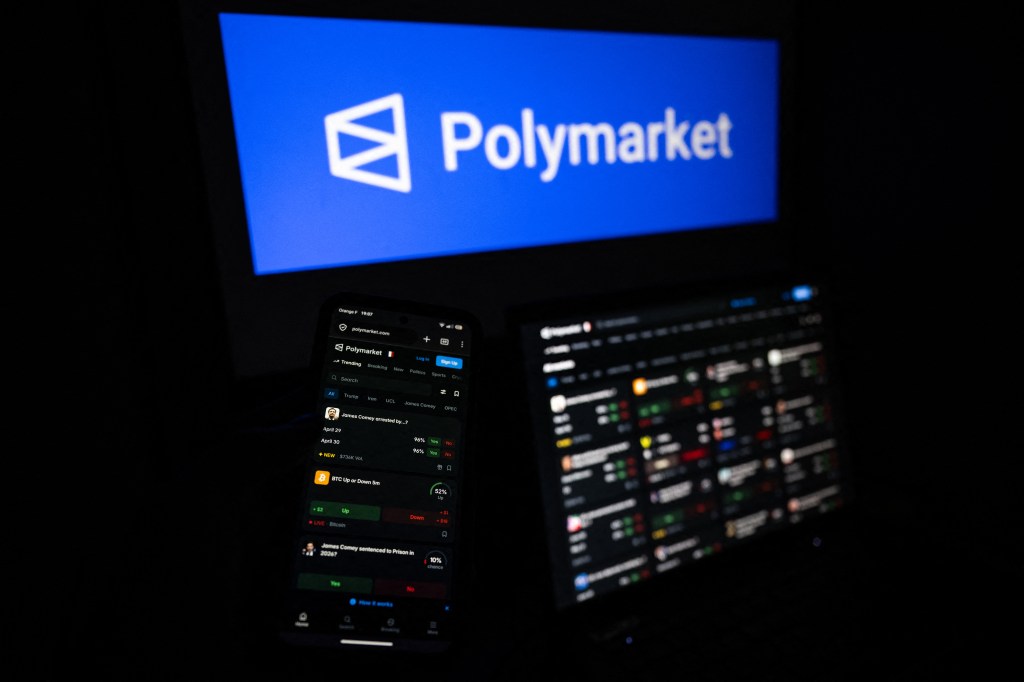
Prediction markets are omnipresent these days, but one thing you won’t find listed at prediction markets Kalshi or Polymarket is horse racing.
Despite the booming rise of sports event contracts over the past year, horse racing’s power brokers are drawing a hard line against letting prediction market companies touch the 151st Preakness Stakes at Laurel Park — or any other races for that matter.
And that’s not because there isn’t money to be made.
Last year’s Preakness Stakes generated over $110 million in wagers on the 14-race card. The day’s handle marked the second-highest total in Preakness history, climbing 11.3 percent from the $98.9 million wagered on the 2024 race card.
Like the other two Triple Crown races, the Kentucky Derby and the Belmont Stakes, a two-minute spectacle that garners national attention fits hand in glove with the nature of prediction markets.
Instead, the Interstate Horseracing Act of 1978 mandates any off-track wagering entities to secure approvals from racetracks and state regulators to accept bets, giving the industry unusual leverage over all gambling operators.
“The answer lies within the fact that there’s a clear law for our sport where there may not be for others,” National Thoroughbred Racing Association CEO Tom Rooney told The Post.
“That’s why you see Major League Baseball getting into relationships with [prediction market companies], and I wouldn’t be surprised if you didn’t see others.”
Last month, the National Thoroughbred Racing Association sent a letter to the Commodity Futures Trading Commission to remind them of the Interstate Horse Racing Act, arguing that horse-racing event contracts should be banned because they conflict with federal racing law.
The letter stated that event contracts based on horse racing outcomes are “contrary to the public interest.”
Rooney said that “there was talk” of an international prediction market playing in the Derby, but “backed off” in the wake of the NTRA’s letter.
Kalshi declined to comment on why it has no Derby-related offerings.
Polymarket’s offshore platformbriefly listed a Kentucky Derby market earlier this year before taking it down, according to ESPN.
Churchill Downs, the host track of the Derby, later confirmed it requested the removal and Polymarket complied.
Meanwhile, FanDuel and DraftKings — both of which have launched prediction-market products of their own — are also steering clear of horse-racing contracts.
The companies still offer traditional Preakness Stakes betting through their separate horse-racing apps, FanDuel Racing and DraftKings Racing, respectively, which are only available in certain states due to regulatory restrictions.
“It’s all about the bottom line,” Rooney said. “Does it help grow our purses? Does it help grow the sport? And if somebody does decide that, and getting into some agreement with one of these [prediction] markets helps the sport — and it shows to be true — then I’m sure you’d see others make deals as well.”
Horse racing wagering in the U.S. operates under a parimutuel system, where payouts fluctuate based on how much money is wagered on each outcome, rather than fixed odds set by a bookmaker.
Prediction markets, by contrast, use continuously changing prices driven by trading activity, with contracts settling at a fixed value depending on the outcome.

“Prediction markets were just sort of operating outside of any regulatory bodies. So, whether it be parimutuel or fixed odds, it didn’t really matter to them,” Rooney said.
Churchill Downs Incorporated, which sent out a warning against prediction markets during an earnings call in October, agreed to acquire the intellectual property rights to the Preakness Stakes and Black-Eyed Susan Stakes for $85 million from 1/ST Racing’s Maryland division on April 21.
The company plans to license the rights back to Maryland annually to continue running the races, with the deal expected to close after this year’s Preakness while Pimlico Race Course undergoes redevelopment.
Unless prediction market companies strike an unforeseen agreement with an influential player in the racing industry, Rooney doesn’t foresee any contracts tied to the Belmont Stakes on June 6 either.
Said Rooney: “Nobody knew that [acquisition] was happening until it happened. So, I’ll never say never [on an agreement].”
Disclaimer : This story is auto aggregated by a computer programme and has not been created or edited by DOWNTHENEWS. Publisher: nypost.com