KESWICK, Va. — I was parked in a stranger’s driveway.
Google Maps said otherwise. But a twice unanswered doorbell confirmed that I was misplaced, which is always a miserable place to be, but especially so given I’d have to make a walk of shame back to my rental car, along with a dial of disgrace. I grabbed my phone.
Hey! I think I’m at the wrong home.
Oh? We’re waiting outside, if you can maybe see us.
The Rotellas were right next door.
After I drove up their dogleg-right driveway, Dr. Bob then greeted me in a manner that would mark my stay.
Get lost?
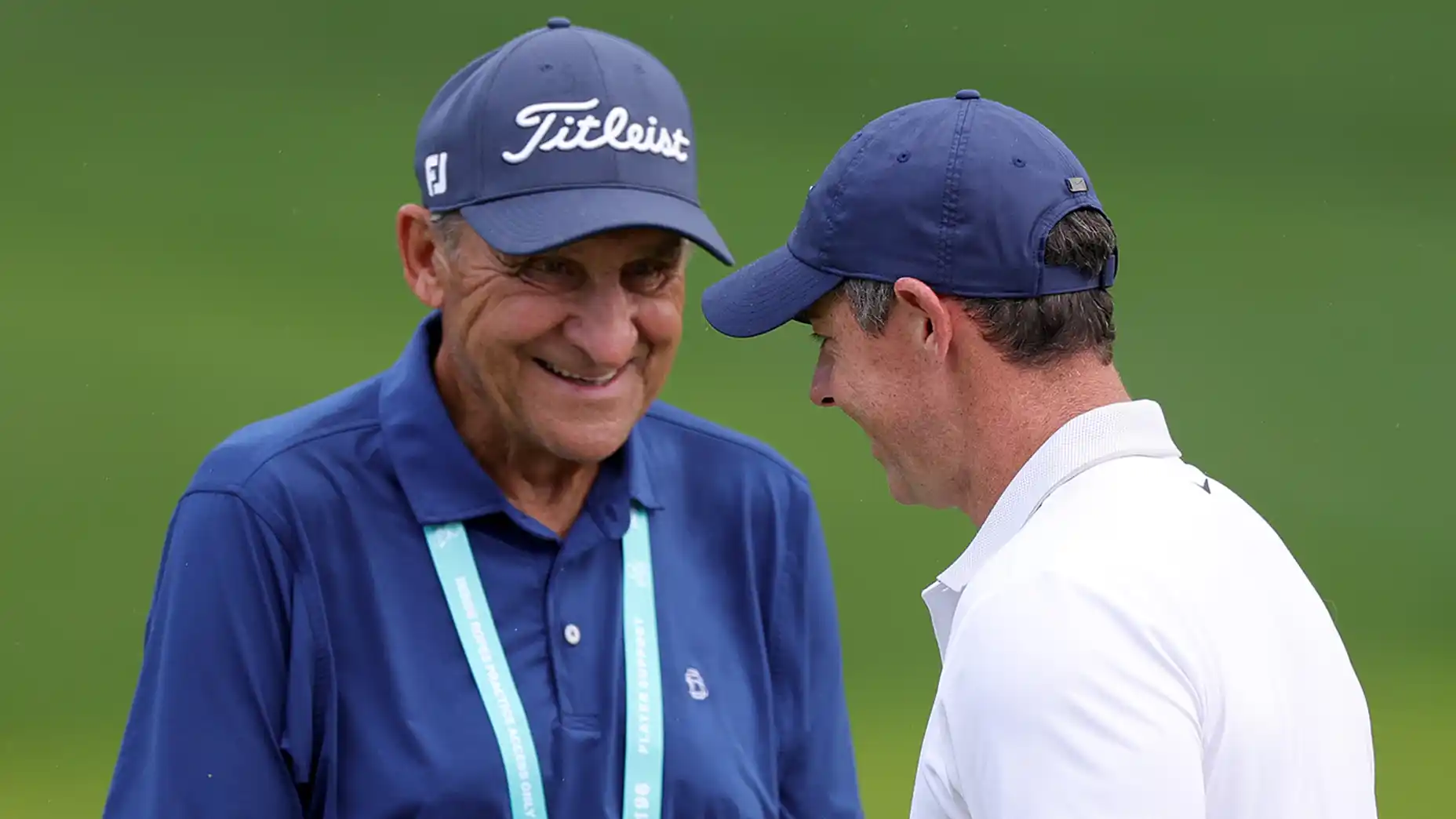
We joked about phone dependency, before entering the two-story brick home on a golf course, about 15 minutes south of the Charlottesville, Va., airport. Rory McIlroy has worked with the sports psychologist, most famously in the lead-up to his breakthrough Masters win in 2025. Justin Thomas. Ernie Els. Padraig Harrington. Pat Bradley. In all, his players have won some 80 major championships. Across some 50 years. Rotella’s start in golf came at, of all places, New York City’s Madison Square Garden, where he was presenting to a gathering of basketball coaches about a half-century ago — 1976 sounds about right, Rotella says, though he’s not entirely sure. Mixed among the couple of thousand chalkboard overlords were a few golf folks who liked what they heard and invited him to speak in front of a group that included then-sixtysomething Sam Snead, who liked what he heard. Rotella was on his way.
Bob Rotella and Rory McIlroy at last year’s Masters.
Getty Images
His words have helped. Rotella, who is 77, is matter-of-fact, though not clinical. He’s warm, though isn’t dissuaded from tough love. He’s not for everybody, yet thousands swear by him. And all of that came out even to me, a mere observer, while we tried to figure out how, for generations now, he’s gotten golfers to think that whatever they once imagined as unthinkable was just a figment of their imagination. There is also actual overnight success to Rotella, which is why I came here, to his home..
And didn’t leave until the following afternoon.
Dr. Bob’s house is your house. He runs a BB&B, if you will — bed, breakfast and brains. Rotella and golfers talk mostly at his home, and, for a couple of days, everyone lives there. Bob. Darlene, his wife of 53 years. Their daughter, Casey, grew up around all kinds of athletes. Most of my time was spent in the basement, where there’s a guest room. A workout room. There was also session space. At one end of that area was a golf hole cut into the floor, and putts broke ever so slightly right to left. At the other end, there were two brown leather recliners and a matching sectional that was deep enough to where, if I leaned back, my feet dangled. For about an hour after I pulled up, we made small talk — he liked that my dad was a butcher, a working-classer like his dad, a barber — before he said he needed to take some calls. It was about 9 at night.
At about 12:30 from the guestroom, I could still faintly hear a TV upstairs.
*Please clickbelowfor a YouTube video of the author’s visit.*
<figure class="youtube-facade" data-content="
“>
I FELL ASLEEP UNDER THE WATCHFUL EYE OF SAM SNEAD. An autographed picture of Slammin Sammy hung on the wall to the left of my pillow, which, in terms of firmness, bent but didn’t break; the same could be said of the king-size mattress. Behind the bed was a photo of Augusta’s 12th taken in 1991; to the right was a poster from the 1989 Open Championship. Toward the back of the room was a white wicker bench, propping up a section of basketball court signed by John Calipari, the decorated coach who’s worked with Doc for decades. Throughout the basement were hundreds of thank-yous from those who have put their faith in him. At the end of the staircase, tucked inside a cubby hole, was a Claret Jug replica from the early 2000s. On a wall was a framed photo of Darren Clarke kissing Dr. Bob on the left cheek at the 2016 Ryder Cup. There was an autographed painting from Ben Hogan, hanging above the mint-green carpet. There was a platinum record given by the lead singer of the Goo Goo Dolls, the preeminent earworm band of the ’90s. As for the bed, Rotella guessed it has said goodnight to 50 or so major winners and, now, a 14-handicap from New York City.
At 7 a.m., I was buzzing, because at 6:55, I had twisted the shower knob. Rotella had a request for the basement bathroom — no sprinkles — and the plumber listened. Occasionally, Dr. Bob said, he’ll use the shower himself, should he be in need of a scrub and a proper wake-up call.
Everything else in the home came from Darlene. Mrs. Rotella designed it. She checks you in. She’s the boss, though very much in the method of your favorite school teacher, which she once was. Her blonde hair is shoulder length. Her voice is gracious though assertive, even to one of sports’ most preeminent doctors. She’s a listener, but isn’t afraid to speak her mind, even to sports’ most preeminent athletes. What her and her husband do equally well is disarm.
Brad Faxon, the eight-time PGA Tour winner turned broadcaster, was one of the first golfers to stay with the Rotellas, in the mid-80s. He was fighting driver yips then. On his first visit, he arrived later at night. Bob was already asleep, but Faxon and Darlene played H-O-R-S-E on a Nerf basketball hoop in the basement. Darlene won. “There was more than one game, that’s for sure,” Faxon said. Pat Bradley started coming to the Rotellas around the same time when Faxon did, yearning to make the LPGA Hall of Fame. A pot of red sauce was always waiting for her. “It was excellent,” she said. “Oh, boy. I mean, we had it for breakfast, lunch and dinner. It was always hot and bubbling.” The recipe, Dr. Bob, said, came from his mother, who got it from his grandmother.
For my breakfast — sadly — there was only cereal and yogurt, along with milk and orange juice. And one cup of coffee, but only for me. “I can’t say I don’t like it because I’ve never tried it,” Dr. Bob said. At 8 a.m., he got his caffeine from a Coke Zero, bottles of which he stores throughout his home, including a few in a fridge near the guestroom. Darlene said the Irish players love it. About half an hour later, Bob and I went back downstairs.
Bob and Darlene Rotella
Robb Scharetg
The Rotellas bonded through sports as freshmen at Castleton State College in Vermont. (The name of their home wifi network nods to the school.) He played on the basketball and lacrosse teams; she was a fan. “This is a true story. I told everyone this story a gazillion times,” Darlene said. “I remember we were in a circle and I looked across and saw him and he was looking at me and I was looking at him and he was smiling. And I liked his smile. And I don’t know why we just started talking and we became really good friends. And somehow, as it went on, we ended up together.” They dated for six years. Ten years after their wedding, daughter Casey was born, and today, Bob and Darlene have 10 grandchildren. Along the way, he attended grad school at UConn and started a doctoral program and worked with teams at the University of Virginia before going off on his own, in his home. Countless golfers have come here. Countless other athletes. Countless others. Seal, the singer, stayed overnight. He played Beatles songs with Casey when she was 13. “And then he calls like two days later and says to me, ‘Oh, I wish I had asked Casey to come over to Wembley Stadium and she could sit backstage and listen to all this,’” Darlene said. “And I said, ‘Well, she’s only 13, you’re not going to Wembley Stadium.’ This is back when he didn’t have children and he didn’t understand that you just don’t send your child to Wembley Stadium.”
No one has come to the Rotellas from a website. He’s most definitely not on social media. “We did have someone having a Twitter that other people thought was us,” Darlene said, “My Bob does not Twitter.” Said Faxon: “I don’t think he’s ever sent an email in his life.” Doc said he picked up the idea to have people at his home from Vince Lombardi, whose name is on the trophy given to the winner of the NFL’s Super Bowl, and Thomas Jefferson, a founding father; Lombardi would have his players over for cookouts, and Jefferson, who designed the University of Virginia so students and teachers would live close to one other. Formally informal. Info comes mostly by word of mouth; appointments are all handled by Darlene. Bob had asked her to run his business, and she has run with it, all the way down to telling her husband to sit up during a photo shoot for this story. He did.
“Maybe his approach is very different than anyone else’s they’ve been to,” Darlene said of her husband. “You know, and I think, too, it’s a relaxed atmosphere. They’re not coming in, lying on a couch at all. I mean, they may go down to our big couch downstairs and hang out, but no, it’s not like that.”
I told her that the night before, I’d practically told Dr. Bob my life story, despite usually being reserved.
“Because he’s very relaxed, I think,” she said. “And he asked the right questions.”
Does Darlene tire of the visits, though? Of the strangers?
“You know, it’s interesting,” she said, “because I have friends who are neat-niks where everything has to be perfect. They know what they’re going to eat a week from now, and if they’re having a dinner with some friends, they know what they’re wearing and how the house is going to look. Well, I don’t do that. At all.
“And they’ll say to me, they used to say to my daughter when she was little, ‘How can your mother stand having strangers come to the house? I mean, and they’re living in your house and you don’t know them.’ My daughter said the most perfect thing.
“She said: ‘I get to sit down with people who want to be good at something. And I meet these interesting people.”
The space where Bob Rotella and players talk.
Robb Scharetg
SO WHAT EXACTLY DO YOU WEAR TO DR. ROTELLA’S HOUSE? Formal? Informal? Would pajamas be out of the question? Pro Bobby Wadkins once had those concerns, Rotella said. “He showed up in a sport coat and tie,” Dr. Bob said. “I had on a pair of jeans and a T-shirt when I opened the door, and he looked at me and said, ‘I told my wife you weren’t that kind of doctor.’” On my visit, he greeted me in the driveway in a polo and faded jeans with his gray hair combed neatly back, and I told him later that I also had stared into my closet as if I were lining up a 5-footer at Augusta. “Everything we do down here is to make things comfortable,” Rotella said. “I’ve spent my whole life trying to make stuff that we call psychology and/or philosophy very understandable, because I want the athlete to be the genius. I have no interest in being the genius. I want them to believe in themselves, and you can’t believe in yourself if you don’t understand this stuff.”
Dr. Bob and I sat across from each other in the matching recliners downstairs, talking for hours about what he and players talk about for hours. What drew him to his job was the idea of being a performance-based psychologist. “Everything I could read in sports psychology was really about pro athletes with clinical problems, which I had no interest in,” Rotella said. “I really wanted to study the psychology of excellence and greatness and performance.” On a wooden cabinet near his recliner, Rotella placed his cellphone face down. Occasionally, I heard it go off. He wouldn’t check it until the evening; he said he stresses compartmentalizing, so that was him compartmentalizing. As we talked, I was curious: What does Dr. Bob call those who work with him? Clients? Students? Patients? “I don’t know if I use any of those words,” he said.
But definitely not patient.
“Because I’m not a therapist. I ain’t doing therapy,” Rotella said. “Like every once in a while, I would see something about me being a shrink and I said, ‘I’m not a shrink, I’m an enlarger.’ I’m not trying to shrink anybody. I’m trying to take them places where they haven’t gone before. I’m trying to get them to believe at a level they never believed. I’m trying to get them to dream bigger. I’m trying to have bigger ideas for their life and their game.
“I don’t even know where that term shrink came from. Why would anyone want to be referred to as a shrink?”
In conversations with players, sometimes Bob will talk more, other times they will. Regardless, Harrington said, Dr. Bob quickly unriddles the answer. Harrington has stayed with the Rotellas since the late ’90s. He’d read Rotella’s books, and he wanted to visit the source.
“If you go to the house,” Harrington said, “he’s going to just talk to you, let you tell him about yourself. He already knows the answer. He’s letting you ask your own questions and usually you kind of answer them as you’re chatting away. So it’s just a chat about sport to start off with. Very relaxed. But he’s going to let you come up with the questions because he kind of already knows himself. So it’s a nice way of doing it. And players will get into it. You know, I suppose when they’re disarmed a bit, they will get into the nitty gritty and talk openly.” In In 2007, Harrington won the Open Championship. The next year, he repeated, and a month after that, he won the PGA Championship.
Bradley, whose 31 LPGA wins include six major titles, said she left sessions being reminded to be kind to herself, and that a routine would prepare her best for rounds. There were also sayings for her. Reaffirmations. None clinical sounding. Pat, you’ve gone through your routine, trust it.Your eyes have seen the line on your putt, trust it. On shots hit out to the left? That’s OK, Pat, that’s a good angle to come into that pin. On balls hit out to the right? That’s all right, Pat, you know, we’ll take care of this and we’ll move forward. In 1991, she was inducted into the LPGA and World Golf Hall of Fames.
Faxon, as he fought the driver yips, said he left his visits trying to be more creative, instinctive and reactive, a thought he probably could have come to himself. Dr. Bob sessions don’t necessarily invent thoughts as much as they reinvent them, and as Faxon sat across from Rotella in the basement, he spoke in a “plain language.” “There was no light show when you saw Bob Rotella,” Faxon said. Faxon also remembers sayings. It’s hard to be impatient when you’re having fun.It’s more important to be decisive than to be correct. “Those things meant the world to me,” he said. Rotella told Faxon another one on the eve of the final round of the 1995 PGA Championship, the last opportunity to earn points for that year’s Ryder Cup team. Hey, make your goal tomorrow to go out and have fun playing a meaningful round of golf, and when you’re done, look in the mirror and be able to say, ‘I did that.’ Faxon opened with a front-nine 28, shot 63 and made the team.
Then there’s McIlroy.
To an outsider, he had been Rotella’s most tragic player, by virtue of only one tournament. But it wasn’t just that McIlroy hadn’t won the Masters; it’s that nearly everyone believed he could win, that he should win, only for him either to fizzle out or self-destruct. Starting in 2014, McIlroy had also been a green jacket away from the career grand slam, a feat only five other players had achieved. He had become like Sisyphus, without the white rock, condemned never to reach Jim Nantz on Sunday at Butler Cabin. If you prefer Peanuts cartoons, he was Charlie Brown attempting a field goal, only Augusta National was pulling away McIlroy’s ball. Maybe he’d never do it. Now winning is all he does at the Masters. Last year, he finally succeeded. Then, in April, he won again.
Accept that you’re no longer a golfer who plays well only when you’re hitting it well.
“I think the more he accepted he’s going to miss a lot of putts, it made it a lot easier to putt,” Rotella said. “But people are going to spend all their time trying to study his stroke.”
A couple of months later, at this year’s U.S. Open, I asked McIlroy what has kept him with Rotella since they connected in 2010. Simplicity, he said. Simplicity in the message. Simplicity in how it’s delivered.
Which, in turn, makes it easier to understand an easier-said-than-swung idea like acceptance.
“Certainly it’s not like I’m going to him and looking for new stuff every time,” McIlroy said, “but just the way he frames it and the way he’s able to relate it back to maybe other parts of life or giving yourself perspective.”
At about 1 p.m. during my visit, Dr. Bob and Darlene joined a photo crew on the neighboring golf course; the Rotellas’ backyard, complete with a dinner table, grill and refrigerator, overlooked one of the holes. Rotella had a golf cart parked in his two-car garage, along with enough golf bags and clubs to put a Dick’s Sporting Goods to shame. Growing up in Rutland, Vt., he didn’t play much, but he did caddie for Bobby Locke, a four-time Open Championship winner, and, over time, became a serviceable golfer.
Harrington had a Dr. Bob golf story, which he started by noting that the doc has a “phenomenal” ability to move on to the next shot.
“He’s a very good golfer, a very effective golfer,” Harrington continued. “We played with him on some links golf in Portmarnock [in Ireland], going to say 20 years ago.
“It was a windy day, and after about six or seven holes, the ball wasn’t doing what it was supposed to be doing. It was moving around and Bob was decrying that the ball was hanging in the wind or moving with the wind or, you know, not going where it was supposed to be going.
“Like I was expecting to see Yoda on the golf course, you know, literally gliding down the fairways.
“My caddie, Ronan, who was playing with us at the time, he can have quite a sharp tongue on him. So he looks at Bob on the seventh tee and says, ‘Are you sure Darlene didn’t write those books?’”
My bed at the Rotellas. I did make it.
Robb Scharetg
BEFORE LEAVING, I MADE MY BED. I promised I would. Before this story, I’d never met the Rotellas, though I’d spoken with Dr. Bob by phone. My May visit had started weeks earlier, with a January email to Darlene. I was surprised she and Bob accepted my pitch, and during my stay, I told Darlene as much.
“We just always do it,” she said.
Dr. Bob is not naive. He knows his method may not fit everyone; he remembers telling at least one player to find help elsewhere. That player had told Rotella that God wasn’t letting him make putts — and Dr. Bob said in response that the player wanted to fail more than Rotella wanted him to succeed. “The bottom line is sooner or later you’re going to have to learn to think this way,” Rotella said he told the player. “Whether I do it for you or someone else does it for you or you do it yourself is irrelevant.”
Bob also is prepared should the day come that he and Darlene wake up and decide they’ve had enough visitors, including the likes of curious golf writers sleeping in their basement.
I’d come for help, too, of course. For a story. I wondered just how Dr. Bob had reached the 50-year mark of a job that, when he started, hadn’t been much of a job at all, and now he’s one of many in the role. Sports psychology is big business. Still, McIlroy and a whole bunch of other pros will tell you that Bob still is one of one. Harrington said if you took a road trip with Rotella and stopped for gas, he’d likely find someone to teach. It’s who he is.
“He just loves it,” Harrington said.
Just imagine, then, what he does inside his home.
At about 5 p.m., we called it a day. On my way out, Darlene gave me a Coke Zero for the drive. A sugar cookie, too, baked by a neighbor. As I pulled away, Bob and Darlene waved. I thought of the golfers who have seen that.
Who leave knowing that they’re no longer lost.
Who know that the Rotellas are right next door.
Disclaimer : This story is auto aggregated by a computer programme and has not been created or edited by DOWNTHENEWS. Publisher: golf.com