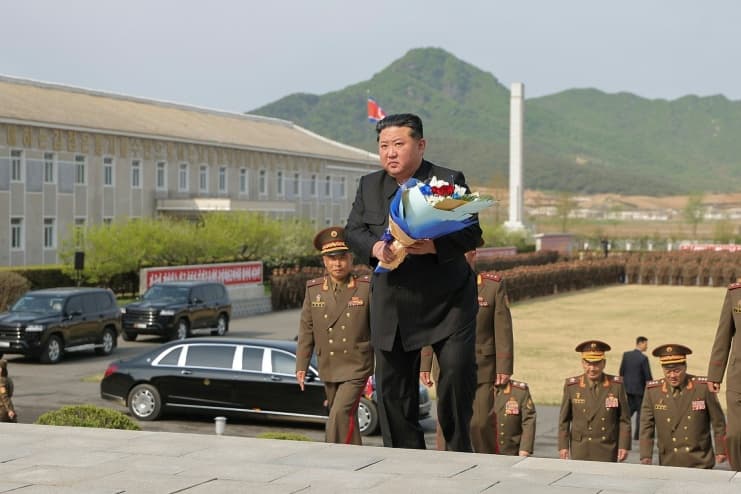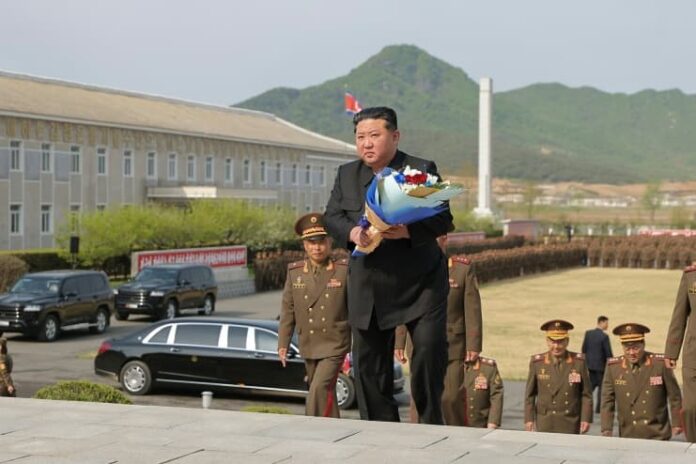
North Korea’s Ninth Party Congress in 2026 formally cemented Kim Jong Un’s status as the country’s supreme and unchallenged leader. Yet a recent destroyer commissioning speech and a national loyalty oath ceremony have quietly softened the language long used to describe him, suggesting Pyongyang may be recalibrating how it presents his authority to the outside world.
North Korea has steadily built out the legal scaffolding of Kim Jong Un’s one-man rule since the Ninth Party Congress, the Workers’ Party of Korea’s most important gathering, held once every five years. Two pieces of evidence make this especially clear, beginning with the constitution itself. Recent amendments erased references to Kim Il Sung and Kim Jong Il from the document. That change effectively placed Kim Jong Un at the pinnacle of constitutional authority in his own right. State power is now so concentrated around him that the document could reasonably be called the “Kim Jong Un constitution.”
North Korea framed 2024 as the year its “Kim Jong Un era” truly began, emphasizing a shift from “Kim Jong Il’s Korea” to “Kim Jong Un’s Korea.” By 2025, state media had gone further, promoting what it called the “great era of Kim Jong Un” and elevating him as the country’s most accomplished supreme leader. Viewed against this trajectory, Kim’s consolidation of power at the 2026 Ninth Party Congress was, in a sense, already foreshadowed. The congress simply locked his leadership authority into the state’s governing norms.
The second piece of evidence is the revised Workers’ Party of Korea charter adopted at the Ninth Party Congress. South Korea’s Institute for National Security Strategy, a government-funded think tank, released the revised charter publicly on Sept. 3. The document effectively re-establishes the WPK as, in practical terms, “Kim Jong Un’s party.” By substantially expanding the powers of the general secretary, the party has moved closer to institutionally completing Kim’s so-called system of monolithic leadership, the decades-old doctrine requiring absolute, unquestioned obedience to the supreme leader.
Rodong Sinmun, the Workers’ Party’s official newspaper, ran an article earlier this year describing Kim Jong Un as the party’s “great supreme leader.” Between the revised charter and the constitution, North Korea has moved at full speed to elevate Kim’s status to an absolute, unchallengeable position.
Kim Jong Un’s thought and leadership become the core of school curriculum
As supreme leader, Kim Jong Un’s greatness must be continuously demonstrated through his ideas and his leadership. That means “Kim Jong Un’s thought” must be learned and internalized, not only through propaganda but repeatedly in classrooms as well.
Making that internalization habitual through education has become a particular priority for North Korean authorities recently, and schools are no exception. The 15th National Teachers’ Congress, which opened Sept. 2, should be understood in this light. North Korean state media described the gathering as aimed at implementing the “education revolution” laid out at the Ninth Party Congress. Kim Jong Un himself used his remarks at the event to call for a fundamental overhaul of the school system.
One central goal is strengthening ideological education focused on Kim Jong Un throughout North Korea’s 12-year compulsory education system. Since 2013, North Korea has built three dedicated courses into its regular curriculum. Primary school students study “The Childhood of the Dearly Beloved Marshal Kim Jong Un.” Junior middle school students take “The Revolutionary Activities of the Dearly Beloved Marshal Kim Jong Un.” Senior middle school students study “The Revolutionary History of the Dearly Beloved Marshal Kim Jong Un.” Until recently, however, courses devoted to Kim Il Sung and Kim Jong Il received considerably more instructional time than those devoted to Kim Jong Un.
That balance appears likely to shift following the Ninth Party Congress. The National Teachers’ Congress likely served as another occasion to intensify what North Korea calls “greatness education,” centered on Kim Jong Un’s ideas and achievements. These educational changes are not confined to schools inside North Korea. They extend to Korean-language schools in Japan affiliated with Chongryon, the pro-Pyongyang General Association of Korean Residents in Japan. Teachers from those schools were reportedly summoned to this year’s congress for related instruction.
Two curious signals in recent weeks
North Korea has moved at full speed under the “Kim Jong Un banner,” yet two recent scenes caught my attention. The first was Kim Jong Un’s speech at the Sept. 6 commissioning ceremony for the Kang Kon, North Korea’s second Choe Hyon class guided missile destroyer. The second was the National Flag Hoisting and Central Oath Taking Ceremony, held Sept. 9.
The first event is not directly tied to Kim’s personal standing. The second, however, is closely connected to his authority, since it functions as a ritual symbolizing loyalty to him and the concentration of state power in his hands. The two events differ in nature, but both convey a similar impression, namely that the intensity of rhetoric surrounding Kim has been somewhat dialed back compared with previous years.
Kim Jong Un’s shifting language at the Kang Kon’s commissioning
Kim Jong Un’s remarks at the Kang Kon’s commissioning ceremony showed signs of a more measured tone compared with his comments last year. When describing North Korea’s destroyer program in 2025, Kim used forceful phrases such as “multipurpose strike platform” and “an ultra-powerful preemptive strike capability.” He also called the vessel “a forward base for aggression on the Pacific,” emphasizing his ability to project preemptive attack power, including nuclear weapons.
Assertive language has not disappeared entirely from this year’s speech. Kim still referred to “realizing nuclearization,” “operationalizing nuclear combat systems” and, in effect, an “offensive destroyer.” At the same time, he leaned more heavily on defensive framing. He described the ship’s purpose in terms of “responding to existing threats,” “defending maritime sovereignty,” “retaliatory strikes” and “carrying out deterrence against war.” The contrast with last year’s tone is unmistakable.
What is even more striking is how state media covered the story afterward. A Rodong Sinmun commentary published Sept. 8 focused heavily on North Korea’s “ideological might” but made no mention at all of the destroyer that had dominated coverage just days earlier. Even in discussing national defense, the newspaper appeared to keep the new warship and nuclear weapons systems at arm’s length, rather than foregrounding them aggressively as it typically has.
None of this suggests North Korea is retreating from its drive to strengthen nuclear forces. If anything, the Ninth Party Congress made clear the regime’s intent to further advance the operational deployment of its nuclear arsenal. The recent shift in language more likely reflects a recalibration of North Korea’s external messaging, rather than any change in policy substance. I read it as a strategic move, one that may be keeping open the possibility of future negotiations or a summit with the United States.
Signs of a softer loyalty oath at the flag ceremony
The National Flag Hoisting and Central Oath Taking Ceremony deserves closer attention. North Korea elevated the event to a national-level occasion starting last year. Ahead of the 2025 ceremony, Rodong Sinmun ran a special commentary defining loyalty to Kim Jong Un as the “greatest patriotism,” effectively equating Kim’s authority with the state itself.
The flag is the ultimate symbol of the state, so the 2025 commentary was designed to have North Korean people understand Kim Jong Un as synonymous with the nation. The flag-raising ceremony held the following day amounted to a public display of loyalty toward him. Senior party, government and military officials gathered en masse to pledge the following oath:
“State leading officials vowed to faithfully and wholeheartedly uphold the ideas and leadership of the great Comrade Kim Jong Un, who is opening a new chapter of tremendous transformation and miracles that will stand out in the history of the republic’s development, and pledged loyalty and devoted struggle for the eternal well-being and prosperity of our glorious fatherland, the Democratic People’s Republic of Korea, which will shine for generations to come.”
In context, it is fair to describe this as a loyalty oath directed at Kim Jong Un personally. That ceremony functioned as a political ritual reinforcing his authority.
This year’s event, however, looked somewhat different, though the shift is not obvious from Rodong Sinmun’s written coverage alone. It becomes clearer when examining footage from Korean Central Television. This year’s ceremony proceeded with Kim Jong Un arriving, the flag being raised, and Kim leading participants in reciting the oath. The core of this year’s oath read as follows:
“As a responsible member upholding the sovereignty of the Democratic People’s Republic of Korea and the interests of the Korean people, and serving the state and the people, I solemnly pledge before the sacred flag to devote my body and soul, without limit, to the people’s welfare and the country’s development, to thoroughly defend the republic’s constitution, to strictly fulfill my legal duties, to firmly uphold the socialist ideology and the socialist system, and to remain loyal to my beloved fatherland so that its greatness and beauty may endure forever.”
What stands out is that the center of gravity in this year’s oath rests less on direct personal loyalty to Kim Jong Un. Instead, it leans toward the “republic’s constitution,” the “state and the people,” the “socialist system” and “loyalty to the fatherland.”
Korean Central Television and Rodong Sinmun’s descriptions of participants’ reactions after Kim’s remarks also differed from last year. This year’s coverage stated that all participants resolved to uphold the great Comrade Kim Jong Un’s original idea of building a state that prioritizes the popular masses. It added that they would devote tireless energy and effort to the nation’s immortal glory and the victory of socialism in the country’s own style, fulfilling the weighty duty entrusted to them by the people.
Last year’s coverage read that participants would faithfully and wholeheartedly uphold the ideas and leadership of the great Comrade Kim Jong Un. This year, the phrasing shifted to upholding Comrade Kim Jong Un’s original idea of building a state that prioritizes the popular masses, a subtle difference that carries real weight. Last year’s language emphasized direct personal loyalty to Kim and his leadership. This year’s framing stresses devotion to the state and the socialist system instead.
This same pattern shows up in a Rodong Sinmun piece published Sept. 9. This year, the paper ran the piece on the day of the flag ceremony itself. Unlike last year’s special commentary, it took the form of a standard editorial, a distinction with its own weight in North Korean state media practice, and the content differed in tone as well. The editorial still described Kim as the “great supreme leader” and called on readers to deeply remember his “grace.” It stopped short, however, of equating him directly with the state, as last year’s commentary had.
Rodong Sinmun’s photo coverage of the flag ceremony revealed a similar pattern. Last year, the paper ran numerous photographs highlighting the event’s political symbolism. This year’s coverage included only two images, showing a wide shot of participants and a shot of Kim delivering his remarks. Taken together, the wording of the oath, the tone of the accompanying editorial, and the scale of photo coverage all point to a clear departure from how North Korea handled the same event last year.
What prompted this shift in pace?
I had expected the National Flag Hoisting and Central Oath Taking Ceremony to be held again this year. Given that the Ninth Party Congress formally institutionalized Kim Jong Un’s absolute authority, I anticipated even stronger loyalty language than last year.
The outcome was somewhat different from what I expected, since this year’s ceremony centered less on Kim Jong Un personally and more on the state, the constitution, the people and the socialist system, along with patriotism directed at the country as a whole.
Of course, it would be premature to conclude from a single ceremony’s wording that North Korea’s cult of personality around Kim has hit a wall. The changes to the party charter and state structure that followed the Ninth Party Congress point, if anything, toward Kim’s power becoming even more strongly institutionalized.
That is precisely what makes this shift interesting: North Korea has institutionally completed Kim Jong Un’s absolute authority, yet at one of its most symbolically charged state events, it appears to have dialed back direct expressions of personal loyalty to him.
To me, it feels like a regime that had been racing ahead suddenly tapped the brakes. If this really is a deliberate change of pace, it is worth tracing the reasons behind it. That small shift may hold an early clue to where North Korea is headed next.
The views expressed in this column are the author’s own and do not necessarily reflect the editorial position of Daily NK.
Disclaimer : This story is auto aggregated by a computer programme and has not been created or edited by DOWNTHENEWS. Publisher: dailynk.com