Die Linke’s election victory in Berlin has been overshadowed by a row about antisemitism. As the party pushes forward with efforts to take the helm in the capital’s next government, we look at the accusations and how the Left has reacted.
In Belin talks on forming a new city government began on Thursday between leading politicians from the Left Party (Die Linke), the Social Democrats (SPD) and the Greens.
But hanging over the talks were accusations of antisemitism against Die Linke, especially from members of the conservative Christian Democratic Union (CDU) and other groups, which have grown louder since the Left’s clear victory in the Berlin state election on September 20th.
The controversial issue has been at the heart of countless German media headlines for days, and continues to dominate the conversation.
We break down what’s going on.
READ ALSO: What does Die Linke’s election win mean for foreigners in Berlin?
What’s behind the antisemitism accusations?
Die Linke has taken a pro-Palestine stance amid Israel’s war in Gaza. But critics suggest some of its members and supporters have crossed the line into antisemitism or hatred of Israel.
Following Die Linke’s election win, a fresh controversy erupted.
One of its MPs, Ferat Koçak, was pictured at election celebrations in Berlin with Ibrahim Ibrahim, described by German media as an “anti-Israel activist” and a supporter of the “Popular Front for the Liberation of Palestine (PFLP)”, an organisation classified as a terrorist organisation by the EU and the US. In photos, Ibrahim was wearing a T-shirt with the slogan “See you in Palestine”.
Following the uproar over the photo, Koçak announced he was stepping back from public activities.
The party said it was a public event and that Ibrahim Ibrahim, along with others, was asked to leave once he was seen.
A different Die Linke event at the end of August also raised eyebrows. There Police reportedly launched an investigation following a performance by a rapper known as Dahabflex at the event in Neukölln on August 29th.
In a song reported to be called “Stop the Genocide”, he performed lyrics including “Yalla Yalla Intifada” and “Death to the IDF”, prompting further accusations of antisemitism and calls for the party to distance itself from him.
Elif Eralp, Die Linke’s lead candidate in Berlin who may become the next mayor, reiterated her opposition to antisemitism, saying that “celebrating violence and terrorism is absolutely unacceptable”.
After Die Linke’s election win, Eralp said, “I stand for the protection of Jewish life – just as I stand for the protection of every life – and I pledge to ensure that the people of our city can feel safe again.”
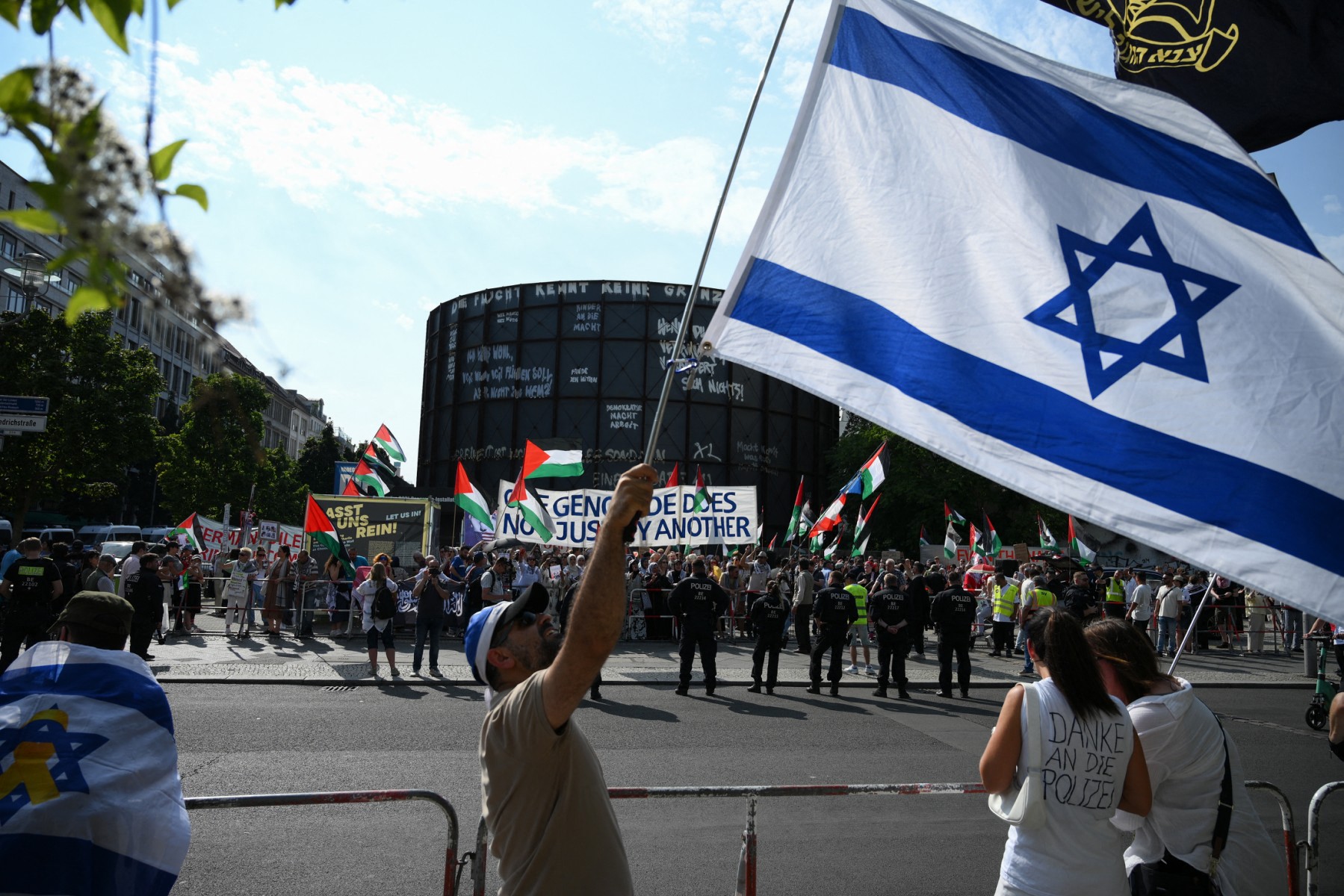
People wave Israeli flags as they take part in a “Solidarity with Israel” demo across the road from a “Solidarity with Palestine” demo in Berlin. (Photo by RALF HIRSCHBERGER / AFP)
What’s the reaction?
The controversy has prompted reactions from politicians across Germany.
Chancellor Friedrich Merz’s centre-right CDU party suggested that Die Linke should be monitored by Germany’s domestic intelligence services.
CSU leader Markus Söder has accused Die Linke of antisemitism and questioned funding arrangements for the capital in the event of the party leading the government.
“It is unacceptable that extremist politics, anti-democratic politics – and, above all, antisemitic politics – should still be rewarded,” he said.
In a statement, the SPD has also demanded that the party draw a clear line against antisemitism and organised crime.
Josef Schuster, president of the Central Council of Jews in Germany, acknowledged that Eralp had made her opposition to antisemitism clear.
“I have heard her statements,” he said. “But the problem I see is that her stance is obviously not shared within the party she represents in Berlin, at least not by everyone – I fear not even by a large majority.”
But Jewish voices in Berlin have also pushed back against the idea that Die Linke poses a danger to Jewish people.
Last week, around 150 Jewish residents of Berlin, many of them artists and intellectuals, published a letter in the left-wing daily Taz rejecting the idea that Die Linke poses a danger to Jews.
The letter argued that criticism of Israeli government policy should not automatically be merged with antisemitism.
The Left party itself has also filed legal complaints for defamation against Interior Minister Alexander Dobrindt (after he endorsed a television host’s description of Berlin Left leader Elif Eralp as ‘an antisemite’ during a live broadcast) and Economy Minister Katherina Reiche.
Some party members, including former federal party leader Jan van Aken have made suggested that comments from the CDU are aimed at keeping the Left out of power.
READ ALSO: Jewish group urges far-left vote winners in Berlin to tackle antisemitism
What is Die Linke doing about the accusations?
The party this week announced a step aimed at making its opposition to antisemitism clear and binding.
The incoming Die Linke parliamentary group in Berlin plans to include a commitment against antisemitism in its statutes, according to a statement from the party and parliamentary group leadership, reported broadcaster rbb.
All of Die Linke’s Berlin MPs had already signed a so-called Mandatsträgervereinbarung before the election.
The agreement commits them to following party resolutions, including opposition to antisemitism. It also says MPs should not cooperate with people or organisations that act in an antisemitic manner, or – for instance – glorify or legitimise Hamas’s October 7th 2023 attack on Israel.
The agreement is now due to become part of the parliamentary group’s statutes, which would make it binding for the duration of the legislative term.
The move comes as the SPD and Greens have called on Die Linke to make a clear commitment against antisemitism before coalition talks can move forward.
Why is the issue so sensitive in Germany?
German history and the country’s special relationship with Israel are key factors in this debate. After the Holocaust, when the Nazi German regime murdered six million Jews, modern-day Germany resolved to take a special responsibility towards supporting Israel.
This became known as Germany’s Staatsräson or ‘reason of state’. In a 2008 speech, former German Chancellor Angela Merkel said that every German government and chancellor was “committed to Germany’s special historical responsibility for Israel’s security”.
READ ALSO: Why Germany is holding back from recognising Palestine as a state
For this reason, accusations of antisemitism – and how it should be defined – remain highly sensitive.
To some, criticising Israel is seen as an act of hate against Jews. Others say that it is possible to condemn Israel, including its conduct in Gaza – and that this should not be conflated with antisemitism.
The debate has become particularly intense since the October 7th attack on Israel by Hamas, in which around 1,200 people were killed and around 250 people were taken hostage, and the subsequent war in Gaza, which has resulted in mass destruction and more than 72,000 Palestinian deaths.
German police have taken a hard line against pro-Palestine protesters, often using violence, with many people criticising authorities for not allowing freedom of expression.
With reporting by AFP.
Disclaimer : This story is auto aggregated by a computer programme and has not been created or edited by DOWNTHENEWS. Publisher: thelocal.de