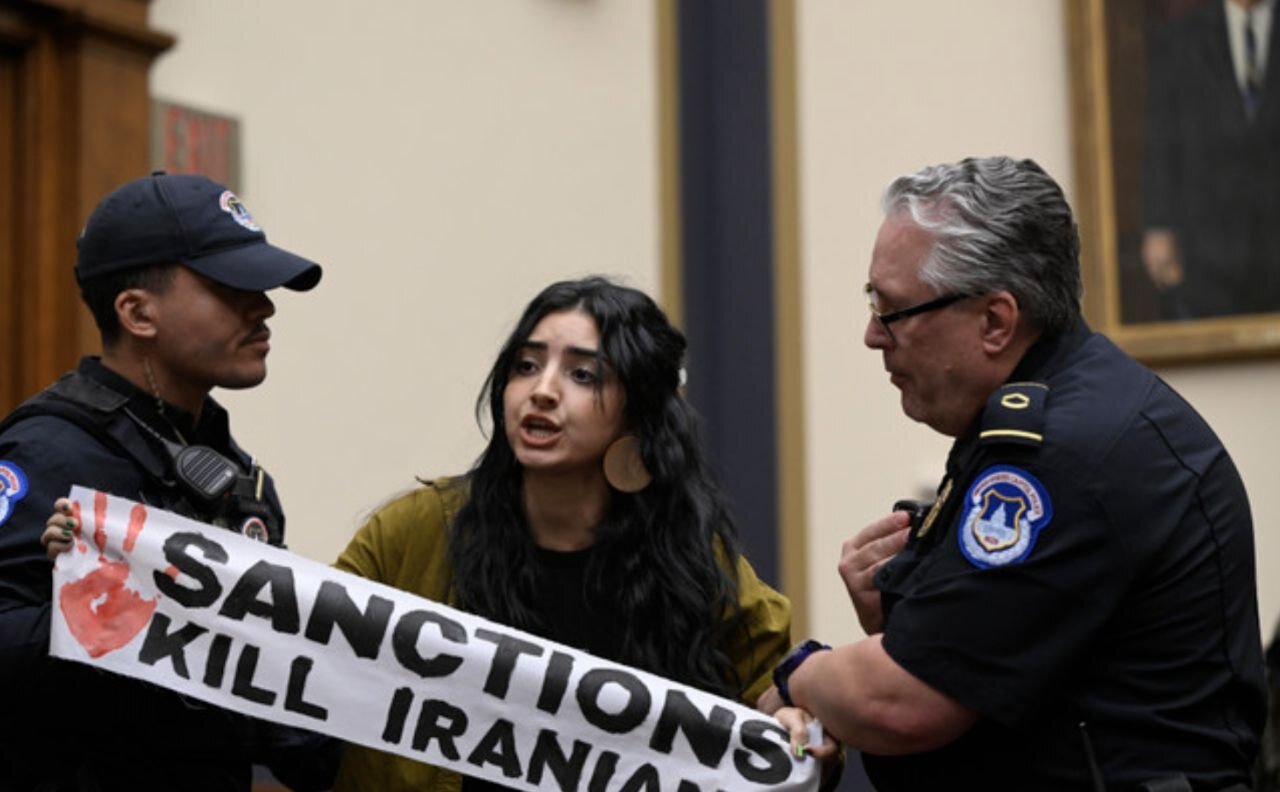
TEHRAN – Isabella Javidan, an Iranian-American staff member of the National Iranian American Council (NIAC), says she interrupted U.S. Treasury Secretary Scott Bessent’s testimony on September 15 to challenge what she described as Washington’s portrayal of sanctions as merely “technocratic tools,” arguing that they have “real human consequences.”
Javidan, who has also disrupted a hearing involving U.S. Defense Secretary Peter Hegseth over funding for the Iran war, says she considers civil disobedience one of several avenues through which she and other activists are trying to oppose U.S. sanctions and military policy toward Iran.
In an interview with the Tehran Times, she discussed her September 15 action, the impact of U.S. sanctions on Iranian civilians, cooperation between anti-war activists addressing Iran, Cuba and Palestine, and NIAC’s legal and political efforts against U.S. policy toward Iran.
Below is the full text of the interview:
What led you to interrupt Scott Bessent’s testimony on September 15?
I decided to participate in the disruption because I’m personally tired of watching policymakers talk about sanctions as though they aren’t deadly, as if they’re bloodless and just technocratic tools, because they’re not. They have real human consequences.
I’m an Iranian American and I have family in Iran, and I have been really disgusted sitting thousands of miles away watching the people of Iran and the people I love, millions of people that I don’t know but deeply care about, suffer because of the decisions being made here in Washington.
This is an action that NIAC hadn’t really participated in before, but I do think that at this point we’re in a war. The situation is just too dire not to use every avenue we have to try to stop the sanctions and stop the war.
As an American-born Iranian, it feels like a duty to use my position as a citizen and as a constituent of the U.S. government, which is imposing these policies, to fight to end them. I have access to the people and institutions that are making these decisions that directly harm the people of Iran, and I’m going to use that access as much as I can.
And it also just feels really, really good to scream at some of the most evil people on Earth.
I also think that right now there’s an opening to build real resistance in the U.S. to America’s cruel sanctions policies, and I hope many more people take the opportunity that I did.
We have a right and a responsibility to fight for one another and to defend innocent people, especially the people of Iran, who have already been put through so much by the United States and the Zionists.
And I wasn’t there alone. Other Iranian Americans were there. And we stand alongside Cuban Americans and the Cuban people, veterans and anti-war activists – because it’s not just about Iran. This is a larger system of using economic deprivation against civilian populations as a criminal instrument of foreign policy.
How did you feel before the protest, and what went through your mind after Capitol Police removed you?
Beforehand, it was a mix of emotions. There’s definitely fear because you never know what can happen. American police are really unpredictable.
But there’s also such a sense of purpose.So, yes, it was a little nerve-racking, but overall it felt good to get in the face of somebody who is committing crimes against my family and the country of my heritage.
Did you face any legal or professional consequences?
This is my second disruption. I pay a fine and then I have to sit in jail for the day. But if I do it again, if I do it a third time, then I have to go to court.
You have also used meetings with lawmakers, public protests and legal action. Why did you feel that a disruption was necessary?
It’s not that we don’t try, because we do that. We do that all the time. We’re always having meetings with lawmakers. We’re having public protests. But the war is still going on and the sanctions keep getting worse.
NIAC just announced that we have sued the president.We’re using every legal avenue we possibly can to try to put an end to the sanctions and an end to the war.
And, up to now, none of this has ended. So that’s why the disruption felt like something we had to do, or I had to do, personally.
You have said that U.S. sanctions target Iranian civilians as leverage. Which sanctions do you believe have the greatest impact on ordinary Iranians?
I am particularly upset and disgusted by the aviation sanctions because freedom of movement is an inherent human right, and to prevent Iranian civilians from having access to the rest of the world physically is so grotesque and criminal to me.
But there are so many examples of sanctions having a terrible impact on ordinary Iranians.
U.S. officials argue that food, medicine and other essential goods are exempt from sanctions and can reach Iranian people. They also say the goal is to pressure the Iranian government rather than ordinary people. Do you think this claim is realistic?
No. I don’t think that’s true.
I don’t think that sanctions only target the Iranian government. If anything, the Iranian government is more equipped to handle sanctions like this. And that is inevitable with any higher-class or elite members of society. They’re just going to fare better than ordinary people, than middle-class, lower-class and low-income people.
And also, we have no evidence to show that these broad sanctions, in any capacity, in Iran and Cuba, actually achieve any of the goals they say they’re trying to achieve.
The U.S. has had decades to test broad sanctions to try to topple governments, but all it’s done, from what we can see from the evidence, is impoverish people, cut them off from medicine and food and travel, and create terrible inflation and isolation.
Iranian students losing access to exams like the LSAT and TOEFL is another example where I struggle to see what this has to do with the Iranian government.
You were joined by Cuban Americans, veterans and military families. How did this coalition come together, and why do you think linking the issues of Iran, Cuba and Palestine is important?
Part of the anti-war movement, especially in Washington, D.C., where I live, is that all of us try to form coalitions together and have meetings together to see how we can best work together to end these wars, end the sanctions, and end any cruel policies that our government is enacting against other countries across the world.
And right now, that especially includes Cuba, Iran and Palestine.
Iran isn’t unique. Cuba demonstrates the same fundamental problem with broad sanctions. Policymakers impose economic suffering on an entire civilian population and then insist that the suffering will somehow produce political change.
That’s why it really matters to have Cuban Americans who are part of the action. We have different countries, different histories and different political systems, but a very similar shared basic principle, which is that ordinary people should not be economically strangled because Washington opposes their government.
And all of our countries and people are connected in the fight against American hegemony and imperialism. We all share this struggle together.
So it’s really important for those of us who are born in the U.S. to use our privileges here to do everything we can to try to stop the crimes that this government is committing.
You also interrupted Defense Secretary Peter Hegseth’s hearing in July over Iran war funding. How was that action different from the September protest?
The goals were similar.
For the sanctions action, I wanted to make sure that the key message was Iran and Cuba because they have been so, so devastated by sanctions specifically.
And then with Hegseth, he was asking for a trillion dollars for bombs, and we know that these bombs are used in Palestine and Iran. That’s why, for the Hegseth disruption, I made sure to include Palestine in that message.
But, yes, similar messages: end the war, end the sanctions end the blockade.
And call these people [Hegseth and Bessent] what they are. They need to be called war criminals and people who are committing crimes against humanity, and they shouldn’t have a room that they feel comfortable in while they’re committing these atrocities.
What would you consider a successful outcome from these actions? Do you plan to continue protesting or organizing future actions around U.S. policy toward Iran?
Obviously, the ultimate outcome is to end the war and end the sanctions.
But I also feel like it’s important for people in Iran to see that some members of our diaspora are actually fighting to end this, and we’re not all pro-war.
I just want people in Iran to know that we are with them and we’re fighting for them. And I don’t want them to feel alone and hopeless because I’m not going to stop, and I know everyone I work with isn’t going to stop.
We’re having more protests and rallies scheduled. On October 20, we have a big national day of action against the war in Iran, and we’re going to go to different lawmakers’ offices and demand an end to the war and an end to funding the war.
In terms of a disruption, there’s not one planned right now.
Beyond civil disobedience, what other activities have you and NIAC undertaken during the past year, when Iran faced two aggressions, first by Israel and then by the United States and Israel?
So many things.
On February 28, that day we participated in a huge protest outside the White House. Since then, we’ve helped organize manyprotests outside the White House.
We also have chapters all over the country, and in those chapters we have various volunteers who go to their lawmakers’ offices.
We also use social media campaigns: “End the war” and “End the sanctions.”
We also had a billboard in Times Squarewhich just said, “END THE IRAN WAR NOW..”
And that was really exciting to see.
We just announced that we are suing President Trump himself specifically over the war.
The basis of the lawsuit is that he entered into a war without congressional approval. He basically entered into a war by himself, which is illegal in this country.
We also put on cultural events to invite people to join the anti-war movement and have educational meetings for our members and their communities.
Those are some of the things we’re working on.
If you had five minutes with an American who supports the current U.S. policy toward Iran, what would you tell them?
I think I would try to appeal to their humanity. This is not something I do often. I don’t like to engage with people who are very pro-war personally.
But I think, in order to engage their humanity, I would maybe just say,, I was lucky enough to be raised with a reverence for Iran. My Bibi, and my dad raised me to love Iran and our culture very intensely.
The Iranian people, who are the victims of all of this aggression, do not deserve this. Not in any world do they deserve this collective punishment. The Iranian people are innocent.
There is no such thing as humanitarian military intervention. There is no such thing as humanitarian broad sanctions. Those are lies. cientifically, categorically, those two ideas are lies.
I’d also say to Americans: This is in our disinterest as well.
We are losing so much money as Americans. We don’t even have healthcare for ourselves, and we’re struggling to buy groceries. We can’t buy gas because gas is so expensive due to this war.
This president promised that he wouldn’t take us into another war, and he lied. He took us into another war, various wars!
And it’s our responsibility to protect American citizens from warfare that is completely unfounded. There’s no way that it’s going to benefit Americans.
And it’s put troops’ lives in danger for no reason.
And if you say you care about our troops, then why are we sending them into a war that we have no business being in? A war for the Zionists. For what?
Is there anything else you would like to add?
I want to say that these disruptions, while they are kind of scary, aregenuinely an act of love.
I love Iran. I love the people of Iran. I love my family who are there. My dear Grandmother is buried there.
And when I see the Iranian people suffering because of the decisions made by my government, I don’t experience that as something distant. I experience it as happening to my family and therefore to me.
And it just feels like my absolute responsibility to do anything I can to be loud against this war.
So I do just want to express how much I love Iran and the Iranian people and how much I support the Iranian right to self-determination. The Iranian people deserve that.
Disclaimer : This story is auto aggregated by a computer programme and has not been created or edited by DOWNTHENEWS. Publisher: tehrantimes.com