Qualifying no higher than the fourth row of the grid is just one of several developments vexing McLaren during the Formula 1 Monaco Grand Prix weekend.
Oscar Piastri and Lando Norris qualified seventh and eighth, over half a second off Mercedes polesitter Kimi Antonelli, which has the same engine as McLaren’s MCL40. If the size of that margin was “disappointing”, in the words of McLaren team principal Andrea Stella, it wasn’t altogether surprising given the known performance characteristics of the car.
One of the more problematic background elements of the weekend has been the new front wing, which McLaren trialled and set aside during the Canadian Grand Prix weekend. Here the team brought a revised version but again elected to revert to the previous specification ahead of qualifying.
This isn’t the road for this component, though, for two important and interconnected reasons. The first is that the new wing concept is the foundation for a whole set of developments which will iterate from it; the second is that McLaren needs to understand why real-world performance has deviated from the expectations set up by its simulation tools.
Lack of correlation between simulation and the track is worrying, even if the real-world results turn out to be better than expected.
“Certainly we want to understand a little bit more clearly the behaviour of the front wing at the track versus what we have in our development tools,” Stella told media including Motorsport.com.
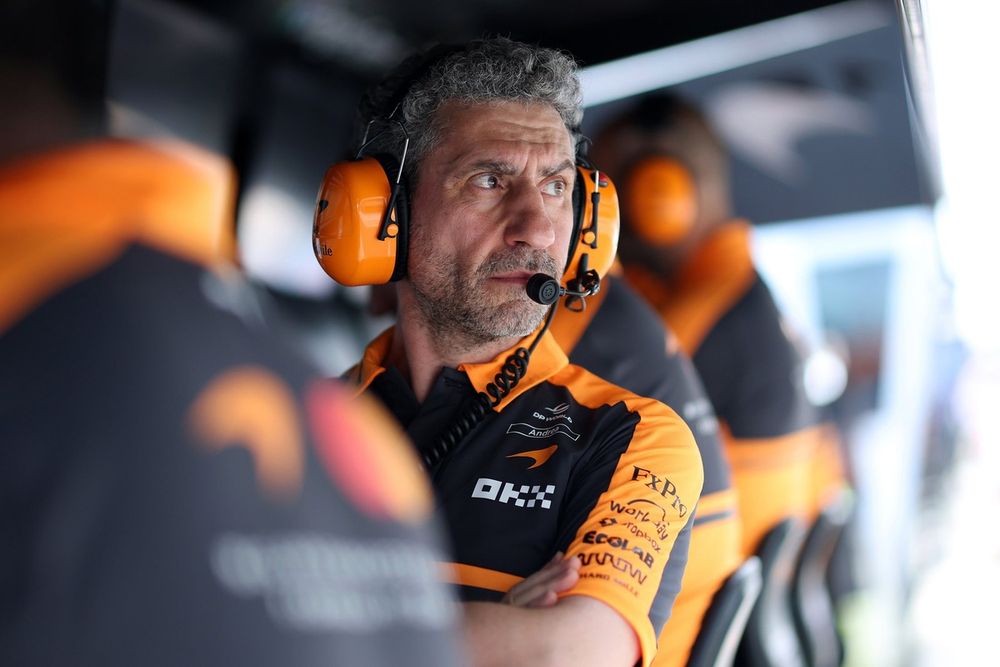
Andrea Stella, McLaren
Photo by: Ryan Pierse / Getty Images
“It’s very important that we do this characterisation very well, because based on this front wing there will be several developments. In itself this front wing wasn’t expected to be a large step from a numbers point of view, it was more the beginning of a new concept.
“We wanted to spend enough time, and definitely after Canada there were a couple of things that we needed to rectify. But here we are very close to the expectation, so I think we are happy with the data we have seen, and from this point onwards we will start introducing the developments that are based on this new front wing.
“I still think that rigorous and effective car development remains a point of strength of our team.”
So the new front wing was never expected to be a game-changer. Aerodynamic development is such an iterative process that no single component provides a ‘magic bullet’ which transforms car behaviour or delivers several tenths of laptime.
But what McLaren is feeling its way towards is a broader change of the MCL40’s behaviour. The team’s feeling is that it lacks peak downforce compared with the dominant Mercedes, and probably Ferrari too.
There is also an issue with lack of mechanical grip, largely a consequence of the team focusing on making it less aggressive to its tyres. Historically that has offered a benefit, given how sensitive the Pirellis have generally been to thermal stress, but the latest generation has proved more robust than expected. Both Piastri and Norris have struggled to get both axles up to temperature, especially in colder ambient conditions such as those which prevailed in Canada.

Oscar Piastri, McLaren
Photo by: Anni Graf – Formula 1 via Getty Images
In Monaco the team wanted to test the new front wing against the previous one across both cars, to remove some of the element of subjectivity that drivers bring, but this was complicated by Norris’s breakdown in FP2. Both cars ran the new wing in FP3.
It’s likely that the team will continue to add new parts to the mix when they are ready, rather than waiting to introduce them as part of a bigger package, because the newness of the technical regulations means there are more gains to be found.
“So here we ran the new front wing in a slightly modified configuration, which is part of learning on the response of this new component, based on which there are a few more developments coming for the next races,” said Stella.
“The behaviour of the front wing is closer to the expectation but requires a bit more work, so we will definitely see once more this front wing in the coming events. It was not very far from the baseline front wing, so it wasn’t much intrusive in the overall preparation from a driving point of view.
“Here, because there is so much margin of development, we are adding new components more and more. As soon as they are ready we add them to the car.
“We want to learn as much as possible about the new components and how they behave, because the aerodynamics of the car is not very mature as a consequence of the changes of regulations. So we will see more of many parts very often, rather than single packages at specific events.”
We want your opinion!
What would you like to see on Motorsport.com?
– The Motorsport.com Team
Disclaimer : This story is auto aggregated by a computer programme and has not been created or edited by DOWNTHENEWS. Publisher: motorsport.com