Peugeot’s decision to step away from the World Endurance Championship at the end of 2026 has come as a major surprise.
It was one of the first mainstream manufacturers to commit to the new Hypercar regulations, making its debut midway through the 2022 season, six months before the next wave of entrants joined the class.
Advertisement
Even as results remained below expectations, Peugeot stayed committed to the championship, evaluating the development of an entirely new car last year to solve its competitive woes. It eventually decided to revise the existing 9X8 design, taking advantage of a new rule granting additional evo jokers to struggling manufacturers.
This would have been the second major overhaul of the V6-powered LMH, following a similarly-sized update in 2024 that included the addition of a rear wing and a move away from ground effect.
Development of the 9X8 ‘evo2’ had reached an advanced stage, with the car hitting the track for the first time in July. The final tests were planned at Le Castellet in the South of France, before the car was due to head to the Windshear wind tunnel in mid-December.
Advertisement
As recently as this month’s Monza WEC finale, Peugeot staff were gearing up for the upcoming season, with team principal Emmanuel Esnault revealing plans to homologate the car in January.
However, just weeks later, Stellantis’ board decided to curtail all factory programmes based out of Satory, with the WEC project axed immediately and Citroen and Opel being granted only one season in Formula E before they have to wind down their operations.
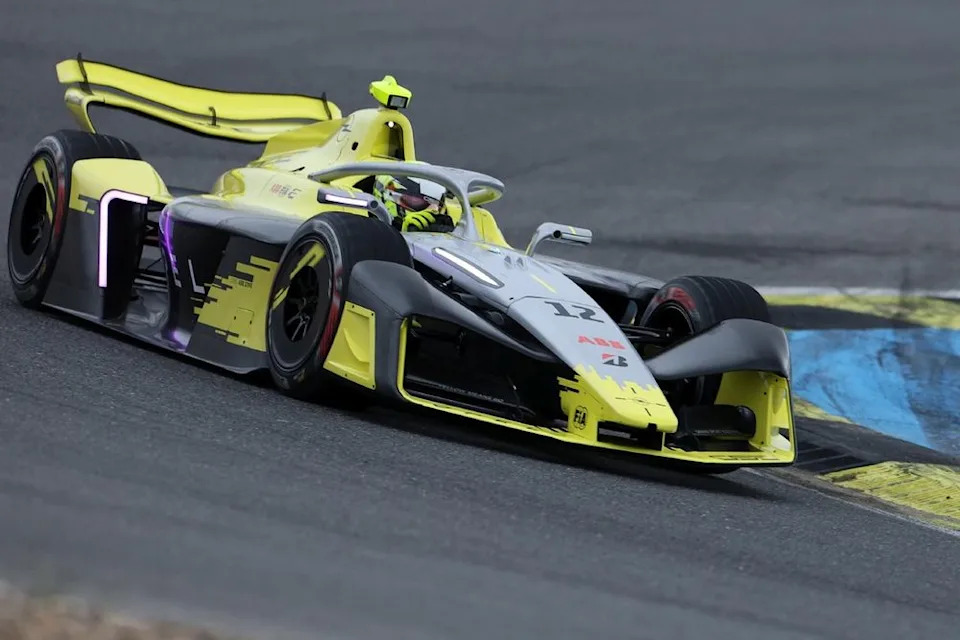
Theo Pourchaire, Opel GSE Formula E Team
Theo Pourchaire, Opel GSE Formula E Team
Official explanation
In a press release, Stellantis stated that it is “refocusing its motorsport activities and resources on customer racing and high-performance vehicle development”.
Advertisement
This means that the loss-making factory programmes will be dropped, while brands such as Lancia can continue to sell rally cars to customers at a profit. The technical expertise Stellantis gained from WEC, Formula E and other championships will be used to build “exclusive high-performance models for Alfa Romeo and Maserati, as well as newer variants of cars already in production at Alfa Romeo, Peugeot, Lancia and Opel”.
The Netherlands-headquartered group further announced that the decision was part of a five-year strategic plan it originally shared in the summer, aimed at driving growth and profitability.
Stellantis further said that it would “retain and redeploy” staff to other parts of the business, although it remains unclear how they will be reassigned.
Advertisement
On paper, Stellantis’ strategy is similar to what Alpine initially adopted when it announced the shutdown of its in-house F1 engine programme in 2024. At that time, it announced the creation of the new ‘Hypertech Alpine’ centre at Viry for developing “high-performance vehicles and innovations in cutting-edge” technologies. Renault has since sold the Viry engine facility to Belgian company Dumarey Group.
Read Also:

Belgian firm to take over Renault/Alpine engine facility in Viry
Advertisement

Signatech exploring options to remain in Hypercar after Alpine/Geely deal falls through
Financial issues
While Stellantis never explicitly said so, the company’s financial woes were likely the main reason behind Peugeot’s sudden departure from WEC. Stellantis’ share price has fallen more than 62% this year, trading at just €3.2 on the day the decision was made public. Even as quarterly revenue increased marginally to €37.6bn between July-September, the company posted a loss of close to €500m. The combined profit for the first nine months of the year was a meagre €217m.
Advertisement
Last year, the automotive behemoth posted a record loss of €22bn, including a €25.4bn write-down related to EV plans. This marked a major shift for a company that had record profits exceeding €5bn just the previous year.
The sudden losses reflected a broader sentiment within the automotive market, but one that was particularly pronounced for legacy car brands. Manufacturers like Peugeot had committed billions to new technology and designing electric cars for the masses, only to scale back plans and halt launches as the demand remained far below expectations. Increased competition from Tesla and new-age Chinese brands only compounded the problem.
Under new CEO Antonio Filosa, Stellantis is undertaking a major cost-reduction programme to steer the company back towards profitability. Only a few months ago, Filosa announced that Stellantis would exceed its original cost saving target of six billion for 2027. With reports suggesting the group was spending nine figures across all its motorsport programmes, it’s fair to assume that the decision has been fuelled by Stellantis’ savings drive.
Advertisement
While Stellantis was previously one of the most heavily invested groups in motorsport, Filosa has adopted a more aggressive strategy based on numbers rather than sentiment. And whenever an automotive major hires a CEO with that mindset, racing programmes are often the first to be culled.
Poor results
Ultimately, Peugeot’s poor results are likely to have played little role in the board’s final decision. Just over a decade ago, Peugeot – then part of the PSA group that was later merged with Fiat Chrysler to form Stellantis – axed its new hybrid 908 programme just months before the inaugural season of the World Endurance Championship.
Advertisement
At that time, Peugeot was a much stronger force in sportscar racing than it is today, and yet the company willingly turned its back on what was then the LMP1 class.
Race winner #7 Peugeot Sport Total Peugeot 908: Sébastien Bourdais, Anthony Davidson

Race winner #7 Peugeot Sport Total Peugeot 908: Sébastien Bourdais, Anthony Davidson
Likewise, Citroen and DS have enjoyed reasonable success in Formula E in recent years. In fact, this year, Stellantis had committed to building an all-new operational team for Opel’s entry into Formula E, after sister brand DS Automotive pulled out of its deal with Jay Penske and quit the championship.
Advertisement
Impact on drivers and staff
Much like those involved in Renault’s erstwhile engine programme, employees now essentially face a choice between taking up a different role within the same company or looking elsewhere to continue working in factory-level racing.
Stellantis also had several top-tier drivers in its line-up, many of which would now have to search for new jobs.
Le Mans winner Loic Duval will be left completely without a seat next year, having primarily raced in the WEC since the end of his contract with Audi in 2020.
Advertisement
Several of the team’s other signings will continue in Formula E, including Nick Cassidy, Jean-Eric Vergne and Robert Shwartzman. However, Cassidy and Vergne will have to look for a new long-term employer, as they are contracted to the Citroen team that will be pulling out of Formula E at the end of the 2027 season.
Alex Quinn and Paul Di Resta will contest the IMSA SportsCar Championship in LMP2 with CrowdStrike by APR and United Autosports respectively, but Stellantis’s decision leaves them without a top-level Hypercar/GTP drive in 2027.
To read more Motorsport.com articles visit our website.
Disclaimer : This story is auto aggregated by a computer programme and has not been created or edited by DOWNTHENEWS. Publisher: Sports.yahoo.com