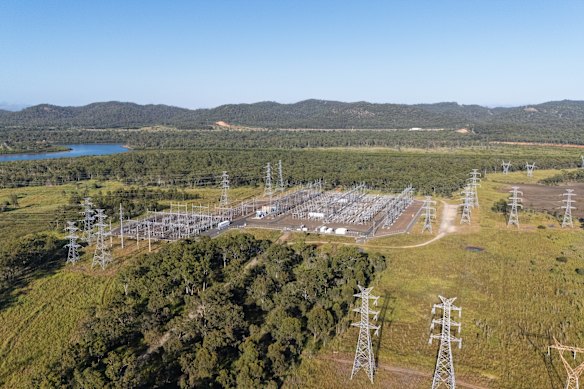

Queensland has secured four huge machines worth hundreds of millions of dollars to keep the state’s power system stable when it transitions to renewable energy and avoid the chaotic delays forced on the planned shutdown of the Eraring generator in NSW.
State-owned transmission company, Powerlink, signed an agreement with Japanese giant Hitachi Energy to install the machines in Central Queensland to stabilise the grid and spare Queensland from widespread blackouts when relying on wind and solar energy.
The LNP government last year pushed back Queensland’s plan to end its reliance on coal-fired power by 10 years through to 2046, but Energy Minister David Janetzki has said the state would invest in a future network powered by renewable energy sources.
Tony Wood, a senior fellow at the Grattan Institute, said coal-fired generation is less disruptive to the energy grid because the power is firm and frequent.
Whereas energy from renewable sources can fluctuate, causing power outages. This is why these machines, known as synchronous condensers, are required to act as a stabiliser in the grid, Wood said.
“Not only do they provide the energy, but they also provide it in a way that can be synchronised and stable,” the leading energy expert told this masthead.
“So they’re big spinning things that will run for a long time, depending on how well it’s made, and they can ride through disruptions to the power supply and in ways that, as currently configured, wind farms and solar farms cannot.”
Queensland’s move to secure the machines, which are due to be operational in 2029, follows similar deals in Victoria and South Australia to rely on large syncons to support renewable energy.
Meanwhile, in NSW, the country’s largest coal power station, Eraring, will run for two years longer than planned because it lacked the infrastructure to secure the energy supply without it.
In 2025, the NSW government was racing to install the state’s first five machines.
“This transition requires some very careful navigation,” Wood said.
“We always knew that we’re going to have to deal with building more transmission for wind and solar, and we know that’s run into a lot of problems, which is why Eraring and others are now being asked to stay open a bit longer.
“This [synchronous condensers] is more what people normally describe as security.
“We’ve been talking about security – how do you make sure the system is stable in a technical sense, and can ride through nasty storms or whatever that might be? That’s what this is about.
“It was one that was understood by the power engineers, but certainly not understood by governments, and not very well by regulators or by the general public.”
Janetzki said two machines will be located at the Calliope River Substation near Gladstone, and the other two in Nebo and Stanwell.
“Powerlink’s essential work to reinforce our transmission network in Central Queensland is vital to ensure Queensland’s energy security and reliability into the future,” he said.
“Work to upgrade, strengthen and enable new generation in Central Queensland will benefit industries, local communities and our state’s economy for generations to come.”
The government refused to reveal the cost of the deal, citing commercial in confidence reasons, but the machines typically cost about $135 million each, according to a report from the Australian Energy Market Operator.
Start the day with a summary of the day’s most important and interesting stories, analysis and insights. Sign up for our Morning Edition newsletter.
 James Hall is the News Director at the Brisbane Times. He is the former Queensland correspondent at The Australian Financial Review and has reported for a range of mastheads across the country, specialising on political and finance reporting.Connect via X or email.
From our partners
Disclaimer : This story is auto aggregated by a computer programme and has not been created or edited by DOWNTHENEWS. Publisher: www.smh.com.au