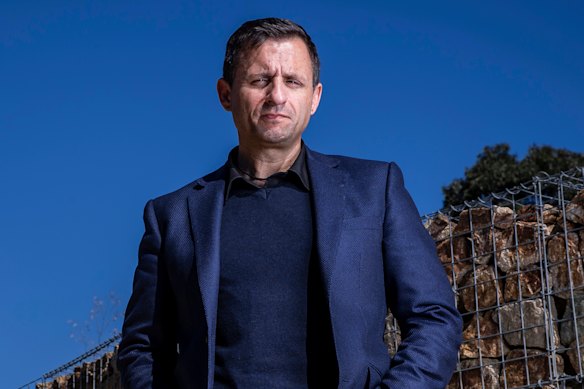

Kos Samaras has spent much of his time lately explaining why Pauline Hanson’s One Nation has eaten into the voting bases of the major parties, identifying the demographic and social change behind the drift away from the Coalition and ALP and the fragmenting of the old order.
On Monday, Samaras made comparisons between the forces that have shaped Australian politics and the challenges facing the AFL and the clubs, and of the differences between Generation Z and Generation X in outlooks, and what this might mean for the AFL and the code.
Samaras, a former political operative for the ALP in Victoria who founded the polling/research company RedBridge, told club chief executives and AFL brass that, like the ALP and the Coalition, they can no longer count on what he called “inherited loyalty”.
Samaras offered the examples of those who, such as himself, who had grown up with allegiance to a particular political party (Labor in his case) and footy team.
Today, he posited, when one in three Australians had been born overseas, inherited loyalty to a team/party, wasn’t assured.
Further, Generation Z were “digital nomads” and the AFL and the clubs were competing for attention, not only against other sports, like soccer and cricket, but with everything they could access digitally.
These nomads, for example, could follow European soccer or the NBA and American sports in preference to the local codes (AFL, NRL, cricket, soccer).
Samaras told the gathering for the CEOs conference on the Gold Coast that they needed to earn the loyalty of these fans. They couldn’t assume they would simply follow the game (or a club) automatically. This masthead gained an account of the pollster’s briefing from two sources who attended it.
Another message from the pollster was that community distrust of institutions was a global phenomenon, driven by demographic and economic change.
Distrust of the AFL head office, though, is hardly novel; it has been part of the game for decades, pre-dating the digital revolution.
The background to the Samaras briefing is that the AFL is confronting the reality that many recent immigrants and multicultural communities are not natural followers of Australian football, at local or AFL level, which contrasts with the Italian, Greek, Balkan and middle-Eastern post-war migrant groups, who used footy as a passage for assimilation.
The competition with soccer – and the global game’s more obvious connection to multicultural Australia – was highlighted. Samaras used the example of Tarneit, in Melbourne’s expanding western sprawl, where soccer was well ahead of Australian rules in appeal to the newest Australians.
Naturally, the comparison with soccer is one that has more relevance when the Socceroos are front and centre in the World Cup finals, and holding their own with a team that is replete with players from myriad and visibly immigrant backgrounds, such as Nestory Irankunda, who scored the critical first goal against Turkey.
The collision of two ideas of Australia – the “monocultural” version Pauline Hanson spruiked at the National Press Club – and that multicultural paradigm that the Socceroos implicitly represent, was on display in the days following that first World Cup game.
The AFL’s decision to bring Samaras to explain the changing face of Australia demonstrated a level of anxiety from the nation’s richest sporting body about their struggle to connect with many of the most recent arrivals. The generational differences – such as his observation that Gen X was the most hooked on footy – added a demographic layer.
The push to increase their presence in India was on the agenda Monday, too, when AFL executive Walter Lee outlined the league’s ambition to gain a toehold in India, which had the highest participation of the dozens of other countries where the game is played, despite minimal investment.
The more optimistic comment from Samaras about the game was that, as the custodian of the code that was uniquely Australian, the AFL could still make a strong pitch to new Australians who wanted to assimilate.
He reckoned sport had the capacity to connect people – to bring them across divides – when politics was fragmenting the citizenry.
The overall take-out, however, was evidently that the game had to adapt to the new Australia, rather than the reverse.
Keep up to date with the best AFL coverage in the country. Sign up for the Real Footy newsletter.
 Jake Niall is a Walkley award-winning sports journalist and chief AFL writer for The Age.Connect via X or email.
From our partners
Disclaimer : This story is auto aggregated by a computer programme and has not been created or edited by DOWNTHENEWS. Publisher: www.smh.com.au