On the Thursday afternoon ahead of the Japanese Grand Prix, Jack Miller spoke to the media as usual. He was asked about the tyre allocation made by Michelin, the championship’s supplier, for the weekend at Motegi.
There were three options for dry conditions: the conventional soft, medium and hard compounds – with the caveat that the latter featured a stiffer carcass.
That ‘stiff carcass’, however, does not necessarily mean that the rubber compound covering that internal structure is harder. In this particular case, the ‘hard’ specification featured a layer with the same composition as the soft version.
Miller has had his share of experiences with ‘stiff carcass’ Michelins, most recently a nightmare weekend in Austria last month. And when he was asked about that hard compound, his response summed up opinion across every garage: “That’s not an option.”
With those preconceptions in mind, none of the teams wanted to use the hard tyre at any point on Friday or Saturday. Not even to find out how it behaved on Motegi’s newly resurfaced track, where the work had been carried out to perfection, producing a surface that offered plenty of grip while also being highly abrasive.
It was not until after the sprint, in which Jorge Martín and Pecco Bagnaia finished with their soft rear tyres torn open through the central section, that a crisis meeting was held and a number of decisions were made ahead of the full-length race. Along with Michelin banning the use of the soft tyre, the warm-up session was extended from 10 to 20 minutes, giving the riders some time to familiarise themselves with the hard tyre that none of them had been willing to try earlier.
To the surprise of most of the riders, the hard rubber worked brilliantly, to the extent that the entire grid opted for the medium front and hard rear combination for the main event of the weekend.
When he crossed the finish line to win the race, Marc Marquez was 37 seconds faster than Bagnaia had been the previous year, a comparison that underlined the quality of both the new track surface and the tyre. Enea Bastianini also set four consecutive fastest laps in the closing stages of the race. These examples of performance and durability meant many riders were left kicking themselves for not having tried the much-maligned tyre earlier in the weekend.
“It is the riders’ fault that we didn’t try that tyre. Michelin told us it was a reserve, and normally you avoid using it. But I think from now on it is important to try every option available,” Bagnaia, one of the most outspoken riders on the subject, said after finishing eighth.
“On Monday we already have Michelin’s selection. And we got it wrong by not considering that the new asphalt, combined with the soft compound [of the ‘hard’ tyre with the stiffer carcass], could be a valid option,” added the Italian, who accepted full responsibility even though neither he nor any of his rivals had tried the tyre.
“The problem is that, in these situations, you always hope somebody else will try it first to see how it works,” admitted Alex Marquez, who crashed with six laps remaining.
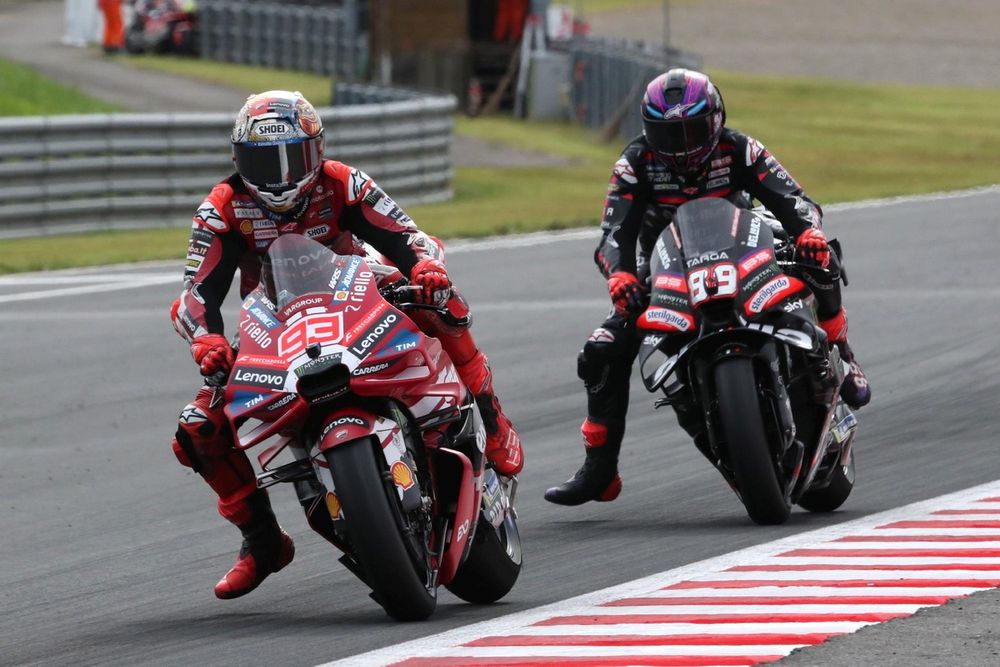
Marc Marquez, Ducati Team
Photo by: Gold and Goose Photography / LAT Images / via Getty Images
“Not trying the hard tyre until the warm-up is down to the teams and the riders. But that comes from the lack of time we have. Nobody wants to sacrifice a run when there is so little time to get the bike set up,” said Alex Rins.
While those riders were effectively accepting their share of the blame, others, such as Luca Marini, pointed the finger in the opposite direction.
“We have experience with that exact type of tyre at other circuits. And we know whether it works or not. That’s why we ruled it out. Then, miraculously, we put it on in the warm-up and it turned out to be magic. I think that’s something Michelin needs to understand,” said the Honda rider, who finished inside the top 10.
“Our previous experience tells us that, at different tracks, whenever they have brought this tyre, it has always performed worse than the others. You have to remember that five manufacturers and 22 riders all reached the same conclusion, so there must be a reason for that,” added Valentino Rossi’s half-brother.
“We asked the riders to try the hard tyre in the warm-up. And the choice was clear. The teams didn’t want to try it in practice because of the lack of time,” confirmed Piero Taramasso, Michelin’s MotoGP boss.
“It was clear that they got it wrong, and it is a good lesson for the races to come,” concluded the Italian engineer.
We want your opinion!
What would you like to see on Motorsport.com?
– The Motorsport.com Team
Disclaimer : This story is auto aggregated by a computer programme and has not been created or edited by DOWNTHENEWS. Publisher: motorsport.com