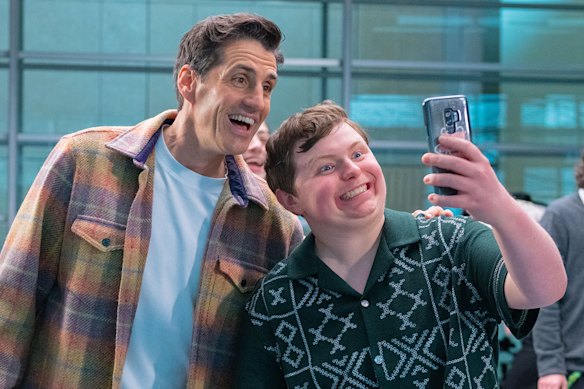
It’s a surprise when Andy Lee reveals the career he’d considered before he met Hamish Blake at university. In the first episode of the current season of The Assembly, the author, TV host and producer is asked about his aspirations before he became a comedian: “I wanted to be an accountant,” Lee replies. “I love numbers, I love spreadsheets, I love schedules.”
But, he goes on to explain, this ambition was torpedoed by a mistake he made while working at a summer job, an error that could’ve cost his employer $80 million. He reassessed his goals, enrolled in a branding and marketing course, and the rest is entertainment-industry history.
It’s an engaging, enlightening and essentially encouraging anecdote, typical of a show that’s become an annual ABC attraction. With a winning grin and an equally winning serve of self-deprecation, Lee illustrates that people, even successful people, make mistakes and that there’s always hope of rebounding from them.
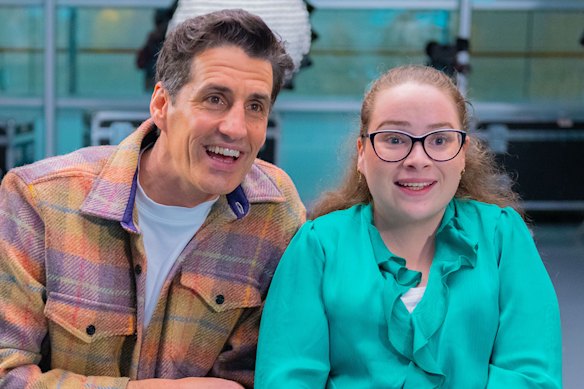
For the 19 autistic journalism students gathered to interview him and for the show’s viewing audience, this is what the series reliably offers: an insight into a high-profile person, with questions asked and answered in good spirits, producing an interaction that’s entertaining to watch. It neatly fulfils the requirements for family-friendly viewing in the Sunday evening slot vacated by The Piano, another cleverly adopted local version of an imported concept.
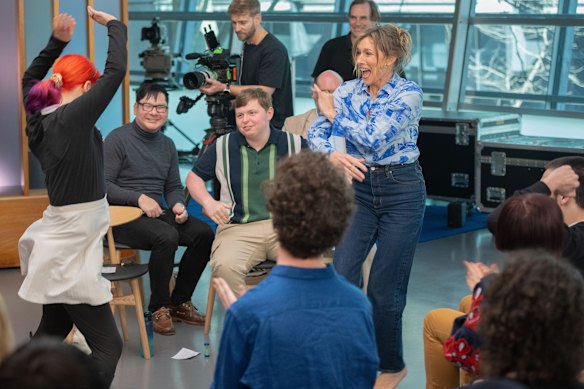
Based on a French format that has been picked up in more than 20 countries, The Assembly is now in its third season. The series has deservedly won a solid audience, regularly averaging 500,000 to 600,000 viewers on broadcast TV, a number that would increase if the undisclosed iview figures were added. This season has been a celebration of sorts, with graduates from the previous two seasons furthering their real-world journalism training under the mentorship of host Leigh Sales.
The show’s success hasn’t come without some criticism. The Assembly has been accused of being “inspiration porn”, of condescending to and patronising its participants. However – like past factual and light-entertainment shows for which the ABC is rightly valued, such as Attitude, Race Around the World and Hungry Beast – it aims to provide talented young people with access and opportunity, assets that can be valuable stepping stones to careers in the media and entertainment industries.
Abbey’s involvement, we learn, has led to an internship with ABC Sport, and she’s also worked with the ABC’s social media team. Andrew has earned an internship with ABC Canberra. Angus doesn’t appear in the new season because he’s working at Triple J.
The other drawcard is the guests. The original French version of the show, Les rencontres du Papotin (created by filmmakers Éric Toledano and Olivier Nakache, who made The Intouchables), featured President Emmanuel Macron, Call My Agent! star Camille Cottin, and singer and actor Julien Doré. Those choices for interview subjects set the template: prominent people who are typically insulated by teams of minders. These are people usually protected by guard-dog publicists vetting questions and decreeing areas to be off-limits, and media managers who set boundaries before interviews and sometimes insist on signed contracts to that effect.
Yet part of The Assembly’s manifesto, read by one of the students at the start of each episode, is that “No subject is out of bounds, no question is off the table and anything might happen”. So those who agree to front-up do so knowing that they might face unpredictable inquiries. And they inevitably do.
With that in mind, though, it’s worth noting that everyone in the room at the ABC’s Ultimo HQ understands this exercise is framed by a fundamental goodwill, so even unexpected, and often disarming, questions won’t be nasty. The students aren’t aiming to ambush the guests: there’s a genuine curiosity and desire to unearth some essential truths, which is evident as they research the subjects and workshop their questions.
In the episode featuring actress, writer and producer Claudia Karvan, Silas – who reliably comes up with probing and insightful questions – asks how growing up around nightclubs has shaped her views on recreational drug use. Later Finn explains that two people close to him are schizophrenic and can be volatile and asks how Karvan maintains a good relationship with her brother, who also has the disorder. He then follows up with, “Before having children, were you worried about the strong genetic component at all?”
It’s hard to imagine another public situation involving the media where such questions might be allowed, let alone asked and answered with candour.
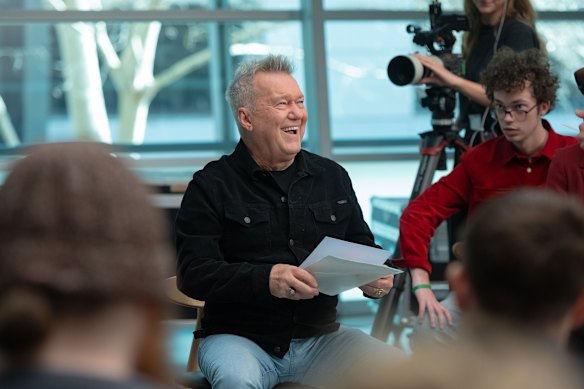
In a standout episode that had the highest ratings of the past two seasons, Abbey asks Jimmy Barnes about his daughter Elly-May, a musician who lives with cerebral palsy: “What’s one thing she has taught you that no one else could?” The question is inspired and the response inspirational.
In that episode, Oliver observes the dichotomy of Barnes: once a hard-rockin’, hard-livin’ working-class man who’s openly emotional about his devotion to his wife of more than 40 years and their family. Not the classic rock-god stereotype. And, in the final episode, Oliver asks former Olympic swimmer and anti-bullying activist Ian Thorpe, who came out as gay in 2014, “How can Australians do a better job at widening what Australian masculinity looks like?”
Many of the guests, such as Lee and Barnes, seem at ease in The Assembly arena, conveying the impression of people comfortable in their own skin and confident enough to be candid. Thorpe seems a little more vulnerable, but also makes an effort to answer honestly, and his responses to questions about mental health are thoughtful and revealing.
The Assembly is cleverly constructed. The guests are astutely chosen, as are the students, many of whom have become increasingly confident and skilled over the seasons. Sales also brings a wealth of experience and supportive spirit.
Beyond the show’s value as entertainment, Finn says, “Since being on The Assembly, I’ve learnt what I’m capable of and feel a sense of worth. Now I’m more optimistic about the future.”
It’s hard to imagine a more persuasive endorsement.
The Assembly airs 7.30pm Sunday on ABC and ABC iview.
Want more TV? We’ve got you.
Disclaimer : This story is auto aggregated by a computer programme and has not been created or edited by DOWNTHENEWS. Publisher: www.smh.com.au