
A woman who drugged her terminally ill husband with a cocktail of medications after he begged her to end his life has pleaded guilty to aiding his suicide, with a judge finding her actions were motivated by love and affection.
Kylie Ellina Truswell-Mobbs, 52, was handed a two-year suspended sentence, for the 2023 death of her husband David Ronald Mobbs.
Mobbs was suffering from motor neurone disease and had deteriorated significantly in his final months.
On Monday in the Supreme Court in Brisbane, Truswell-Mobbs pleaded guilty to a lesser charge of aiding Mobbs in killing himself, which the prosecution accepted as an alternative to murder.
The court heard the pair had a 20-year relationship, and they had raised their family before Mobbs was diagnosed in April 2023.
While it was initially thought Mobbs would have 15 years to live, his condition significantly deteriorated, and he lost the ability to sleep or move independently. He communicated through a letter board and required constant care.
Deputy Director of Public Prosecutors Caroline Marco said when Mobbs was discharged from hospital, and he returned to their Alexandra Hills home, the family had a meeting, where they discussed his ongoing care.
Truswell-Mobbs raised the fact voluntary assisted dying would take several weeks. Marco said one of Mobbs’ sons asked him to hold on for at least another week, which Mobbs agreed to.
Later that day, Mobbs suffered an episode of incontinence, which caused the family considerable concern, Marco said.
Mobbs’ son told his father he understood if he no longer wished to continue suffering. Marco said later that evening, Mobbs communicated to his wife he wanted to end his life.
“After other family members and carers had left the immediate area, Truswell Mobbs administered a combination of medications to the deceased,” Marco said.
After multiple doses of the medications, which included morphine and diazepam, were administered, Truswell-Mobbs made admissions to carers and others she gave him an overdose to end his suffering, Marco told the court.
Mobbs died about 5pm on December 6, 2023. His cause of death was mixed drug toxicity, while motor neurone disease was identified as a significant contributing condition.
Truswell-Mobbs was later arrested, and participated in a voluntary interview, where she said her husband had repeatedly pleaded with her to end his life, and had communicated his wishes through a letter board.
Truswell-Mobbs told police she acted because she could not bear to watch her husband suffer and believed she was carrying out his wishes.
“Her actions arose from compassion for a terminally ill loved one and was a desire to relieve suffering, rather than selfish, improper or ulterior motives,” Marco said.
Defence barrister Ruth O’Gorman KC told the court the case had unique circumstances, and submitted her client should only be sentenced to the time she had already served in custody, being 14 months.
O’Gorman said Mobbs’ condition deteriorated in such a way a few weeks after his diagnosis, he was no longer able to walk.
Mobbs, who worked for the police and the Queensland Fire and Emergency Services, required one or two people to move him to bed, required a wheelchair, and became incredibly frustrated with his condition, O’Gorman said.
A week before his death, a nurse noted he was no longer able to use his ipad, and was unable to tolerate oral medications. His condition worsened, and he became entirely reliant on a ventilator, and suffered through incontinence and was in significant pain, O’Gorman said.
In the days before his death in early December, his family visited him, bringing a Christmas tree and putting it up for him. One carer noted he was in more pain than anyone she had ever come across, the court heard.
O’Gorman said the family were told they could not be helped with voluntary assisted dying, and in essence the only option would result in Mobbs starving to death over a number of weeks.
O’Gorman said voluntary assisted dying only took effect in January 2023, and was not a scheme that was well established.
O’Gorman said it was uncontentious Truswell-Mobbs was a devoted carer, who was facing grief, loneliness, and fear.
“That night Mobbs could not continue and begged his wife to end his life. She did that by administering pain medication over the course of the night,” she said.
“There was nothing secretive about it. She did it in full knowledge of all of those in the household, which included one of their sons, but also a number of carers,” O’Gorman said.
In sentencing, Justice Tom Sullivan took into account her early guilty plea and her 14 months in pre-sentence custody.
He said Truswell-Mobbs made full admissions to the carer who had arrived at the house, and subsequently made admissions to police.
“I accept that what you did on the occasion was motivated by love and affection in your case,” he said.
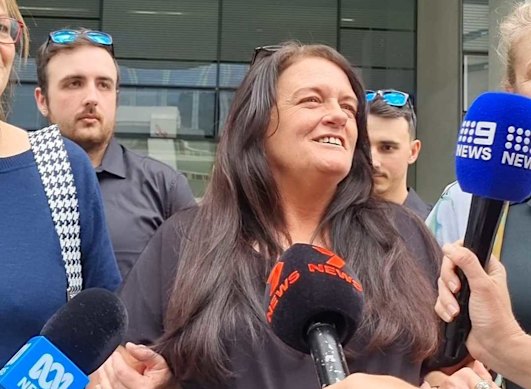
Outside court, supporters cheered for Truswell-Mobbs as she left the court.
She told reporters she was happy the court process was over, and confirmed it felt like a weight had been lifted.
When asked about her husband, she said: “He was beautiful, never ever forgotten about.”
If you, or someone you know, needs support you can call Lifeline on 13 11 14 or Beyond Blue on 1300 224 636.
Start the day with a summary of the day’s most important and interesting stories, analysis and insights. Sign up for our Morning Edition newsletter.

From our partners
Disclaimer : This story is auto aggregated by a computer programme and has not been created or edited by DOWNTHENEWS. Publisher: www.smh.com.au