
CHIBA –
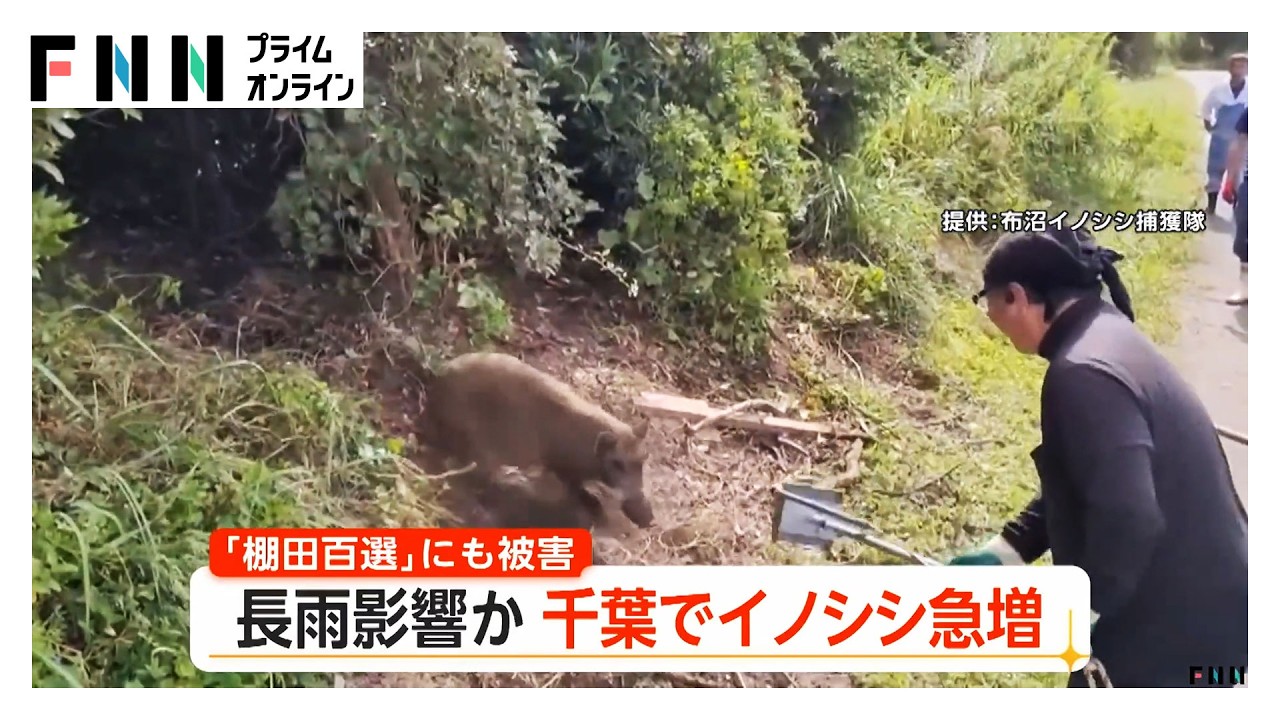
Wild boar damage is spreading across Japan, with farmers reporting destroyed crops and increasing encounters near residential areas as record-breaking autumn rainfall and landslides are believed to have disrupted food supplies in mountain forests, driving more animals into populated areas.
In Akiota, Hiroshima Prefecture, the picturesque Ini Rice Terraces, recognized as one of Japan’s 100 most beautiful terraced rice fields, have become the latest agricultural site to suffer damage. The stepped paddies, which form a distinctive landscape along the surrounding hillsides, have been repeatedly invaded by wild boars during the autumn harvest season.
Farmers discovered that harvested rice plants left hanging to dry had been eaten by the animals, leaving stalks scattered across the ground. The damage has added to concerns among local residents, who say wild boars have increasingly entered cultivated fields and destroyed crops just before they could be harvested.
“We’ve heard about the damage. They walk through the rice fields and leave footprints. Sometimes they attack the crops when they’re almost ready to harvest,” one resident said.
The animals have also been spotted outside farmland. In September, a group of wild boars believed to be a parent and its young was seen walking along a road near the terraces. Similar sightings have continued around the settlement, forcing residents to strengthen measures to protect their crops.
Authorities and local farmers conducted two aerial surveys during the week using drones equipped with infrared cameras capable of detecting body heat. The drones searched nearby forests and surrounding areas for approximately an hour, but no wild boars were located.
A farmer at the Ini Rice Terraces explained that the animals could easily escape detection by hiding in dense vegetation. “If they’re in the bushes or behind weeds, we can’t see them. In the end, we still couldn’t determine where they were,” the farmer said.
Despite approximately four kilometers of protective fencing surrounding the settlement, farmers say damage continues to expand, illustrating the difficulty of keeping wild boars away from agricultural land.
Similar problems are emerging in Chiba Prefecture, where unusually heavy autumn rainfall has been blamed for disrupting the animals’ natural feeding grounds.
In Tateyama, the number of wild boars being captured has risen sharply this autumn. A group of 17 local farmers known as the Menuma Wild Boar Capture Team has been conducting daily trapping operations to reduce the damage.
During an inspection of traps on the morning of October 30, wild boar footprints and freshly disturbed soil were found at numerous locations. Although no animals had been caught in the traps that morning, evidence of their activity was widespread.
Records maintained by team leader Mitsuru Hayakawa showed that 17 wild boars had been captured over the previous month, equivalent to approximately one animal every two days.
Hayakawa believes the increase in encounters is closely connected to the heavy rainfall that struck Chiba, triggering landslides and bringing down trees in mountain forests.
“Particularly with the recent heavy rains in Chiba, when landslides occur and trees fall, the animals lose the food they normally eat. That’s probably why more of them have come down from the mountains,” Hayakawa said.
The damage has become a serious financial concern for rice farmers, whose fields are being dug up and contaminated by the animals.
Rice farmer Ryota Sano showed extensive areas of farmland where wild boars had overturned the soil, leaving large sections of the paddies visibly damaged.
“As you can see, all these dark areas have been torn up by wild boars,” Sano said.
The consequences extend beyond the immediate destruction of crops. Wild boars entering rice fields before harvesting can leave odors on standing rice plants, affecting the crop’s commercial value even when the rice itself has not been eaten.
“When the rice plants are still growing, the smell of wild boars can get onto them. By the time the rice is harvested and sold, the damage can amount to several hundred thousand yen in lost sales,” Sano said.
The growing number of animals has also become apparent at facilities that process captured wild boars into game meat, known as gibier in Japan.
At the Tateyama Gibier Center, which processes and sells meat from wild boars and other animals captured in Tateyama and surrounding communities, deliveries have been arriving at an unusually rapid pace.
Center representative Hiroshi Oki said approximately 650 wild boars had already been brought to the facility in just over six months of the current fiscal year, placing it on course to exceed the previous year’s record volume.
“Last fiscal year was our busiest, with around 800 animals brought in over the year. This year, we’re only a little over six months in, and we’ve already received about 650. At this rate, we could end up exceeding 1,000,” Oki said.
The figures suggest that wild boar activity around Tateyama has intensified substantially, even as local capture teams continue their efforts to control the population and protect farmland.
Oki pointed to changes in the mountain environment following the autumn downpours as a possible explanation for the growing number of animals entering populated areas.
At one location, heavy rain and landslides had swept away an entire grove of chestnut trees that had previously provided wild boars with an important seasonal food source.
Chestnuts are among the foods that wild boars seek out during autumn, when the animals consume large quantities of nuts and other forest products.
According to Oki, the grove had once attracted animals because of the abundance of fallen chestnuts, but the heavy rainfall and subsequent landslides destroyed much of the feeding area.
“Originally, there were plenty of chestnuts falling here. But during the heavy rain disaster, they all came down, and then a landslide occurred. The wild boars that had been feeding on chestnuts here lost their food supply,” Oki explained.
With their normal feeding grounds destroyed, the animals dispersed into surrounding areas, including farmland and nearby settlements.
“They spread out into other areas, and some of them came down into the villages,” Oki said.
Wild boars are highly adaptable animals that feed on a wide variety of plants, roots, nuts, insects and agricultural crops. During autumn, when they normally take advantage of abundant forest food supplies, disruption to natural habitats can increase their movements in search of alternative sources of nutrition.
The recent cases in Hiroshima and Chiba highlight the challenges facing rural communities as wildlife moves closer to human settlements. Even where protective fences, trapping operations and aerial monitoring are in place, farmers are finding it difficult to prevent repeated incursions.
The problem is particularly serious for rice-producing communities, where damage shortly before or after harvesting can wipe out months of agricultural work and substantially reduce income.
With wild boar captures in Tateyama already approaching last year’s total and reports of crop damage continuing in other parts of Japan, farmers and wildlife management groups face mounting pressure to protect agricultural land while responding to environmental changes that may be pushing animals out of their traditional mountain habitats.
Source: FNN
Disclaimer : This story is auto aggregated by a computer programme and has not been created or edited by DOWNTHENEWS. Publisher: newsonjapan.com




