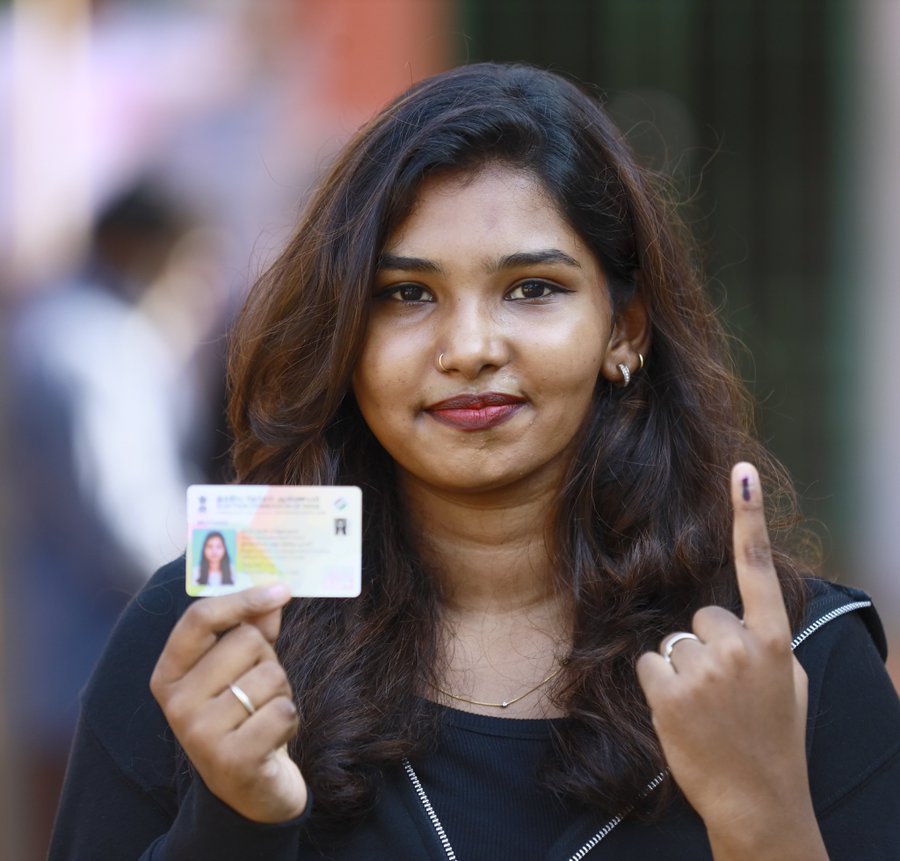
Chennai : The dust has settled on the polling booths across Tamil Nadu and the state nowholds its breath for May 4 when the winners of an intensely fought election will be declared. While the headlines focus on the clash of political titans and the survival of Dravidian legacies, a quieter but more profound transformation is being measured in the electoral ledgers. Elections to 234 Assembly constituencies were held on April 23, and the polled votes will be taken up for counting on Monday.
This year, a record-breaking 443 women stood as contesting candidates — a stark climb from the numbers seen just a decade ago. Yet, as the talk of the Nari Shakti Vandan Adhiniyam and the promise of 33 per cent legislative reservation dominates national discourse, Tamil Nadu’s own history reveals a journey that has been as much about regression as it has been about progress.
The statistical journey of women in the Tamil Nadu Assembly is a study in contradictions. At its peak, it yielded a 31.37 per cent participation from women, a few percentages short of 33-mark that India aims at present.
However, perhaps the most startling entry in the Election Commission archives is the year 1971. In a state that had seen women winners as early as 1951, the 1971 Assembly election recorded zero women contestants. Historians point to a unique political squeeze: a strategic alliance where the Indira Gandhi-led Congress, which till then had fielded women candidates, focused solely on the Lok Sabha, leaving the Assembly to the DMK and the K Kamaraj-led Congress (O).
In the high-stakes battle between these male-dominated fronts, women were entirely sidelined from the final ballot. It remains the only time the Tamil Nadu Assembly sat without a single female voice.
Twenty years down the line, in 1991, the state saw its highest-ever representation of women, with 32 members elected to the House. of the 171 women nominated, 102 finally ended up contesting of which 32 won (31.37 per cent). It was a year that felt like a threshold. But history rarely moves in a straight line. By 1996, that number had plummeted to just nine.
As we approach the 2026 results, the central question remains: can the “cradle of social justice” finally break its own 35-year-old record and move toward a truly representative House?
In the 2026 cycle, the narrative has shifted significantly. The surge in nominations — peaking at nearly 1,000 filings before the final count of 443 contestants — suggests a growing appetite for political participation that transcends party tickets. A significant portion of this growth comes from independent candidates and smaller regional outfits, challenging the traditional gatekeeping of the major Dravidian parties, including the DMK and AIADMK.
The 2026 cycle also continues a trend where nearly 46 per cent of women candidates contest from urban centres like Chennai, Madurai, Coimbatore, and Tiruchirappalli. This is often attributed to higher literacy rates and more accessible campaign infrastructure in cities.
While the number of women in rural constituencies has grown, the pace is slower than in urban areas. Most rural female candidates are fielded by major parties or are high-profile local leaders, whereas independent women candidates are significantly more common in urban lists.
However, the gap between “contesting” and “winning” remains a chasm.
In 2021, despite a then-record 413 women candidates, only 12 managed to secure a seat in the 234-member house-a dismal 5 per cent representation. This discrepancy highlights the “ornamental” nature of many candidacies, where women are often fielded in seats where the party expects to lose, or as independents without the financial muscle of their male counterparts.
The conversation around the 33 per cent reservation bill has added a layer of nuance to the May 4 results. As the leads begin to trickle in from counting centres, the “Women Winners” column will be watched as a barometer for the state’s political maturity.
Will the 2026 Assembly finally reflect the demographic reality of Tamil Nadu, or will the 33 per cent mark remain a distant promise, discussed in rallies but absent from the halls of power? For the 443 women in the fray, the wait is almost over.
Disclaimer : This story is auto aggregated by a computer programme and has not been created or edited by DOWNTHENEWS. Publisher: deccanchronicle.com