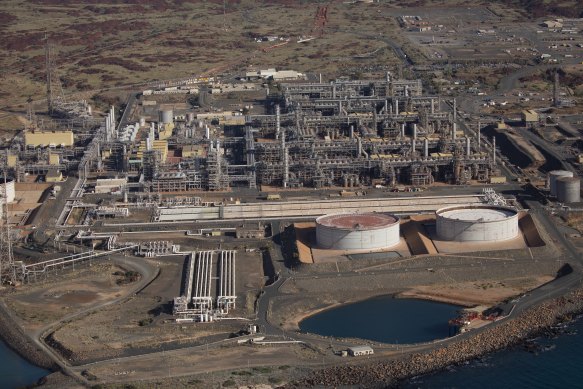
Western Australia’s Premier Roger Cook warned last week the state might be forced to frack the Kimberley unless Woodside’s controversial Browse gas project goes ahead, stating there was a “Browse-sized hole in our energy supplies in the early 2030s”.
However, Cook has ignored a much more certain option to ensure gas supply: requiring liquefied natural gas exporters to meet their 15 per cent domestic reservation obligations on an annual basis.
WA’s 15 per cent reservation policy is often held up as an example for the eastern states to emulate, but the reality is it is not living up to expectations.
LNG exporters had supplied only 8 per cent of production by 2023, and contract gas prices have trended towards east coast levels in recent years.
The key issue is LNG producers have discretion over when they supply gas domestically, and financial incentives to delay this because LNG export prices are typically higher than domestic prices.
This is not merely a theoretical point – Woodside’s Pluto LNG has supplied just 3 per cent of its production domestically.
As noted by former WA Nationals leader Mia Davies (now spokeswoman for the DomGas alliance): “The problem is a system failing to deliver on the intent of the policy.”
A WA parliamentary inquiry initiated by Cook also found the system had key limitations, including around timing of supply.
Quite remarkably, the new federal reservation scheme, which requires 20 per cent domestic supply and annual supply obligations, now provides an example for WA.
The consequence of WA’s current model is forecast supply gaps by 2028, according to the Australian Energy Market Operator.
Fortunately, the forecast supply gaps remain small, at least over the 2030s, relative to forecast LNG export volumes.
Diverting small volumes of gas destined for export – just 7 per cent by 2040 – to the domestic market would be enough to fully avoid supply gaps even without Browse.
While the Institute for Energy Economics and Financial Analysis has not modelled whether the existing reservation obligations would be enough, our analysis does show that supply gaps can be avoided through diversion of export volumes.
Crucially, existing LNG contracts with key trading partners will not be impacted because LNG exporters anticipate exporting much more than they need to meet their contracts.
Exporters may need additional infrastructure to increase domestic supply (noting infrastructure development is a requirement under WA’s reservation policy).
This will take time and government should act now to ensure any required infrastructure is in place before supply gaps emerge.
Relying on speculative new gas supply a risk for all WA gas users
The WA plan to rely on either the Browse project or new fracking projects in the Kimberley carries with it material risks for future gas supply.
There remain questions about the financial viability of the Browse project and whether it will be approved.
IEEFA estimates that Browse LNG delivered to Asia will cost at least US$7.80 per million British Thermal Units (MMBtu) – uncompetitive with Qatar’s much lower costs, and higher than the International Energy Agency’s (IEA) pre-war forecast long-term LNG price of US$7.50/MMBtu.
The Iran war is likely to have an impact on the price buyers will accept for Qatari LNG supply (to account for geopolitical risks), but Qatar’s very low costs mean it could absorb much lower prices.
Industry analysts have also raised doubts about the project.
For example, Macquarie analysts advised last year that they “don’t expect Browse to proceed”.
MST analyst Saul Kavonic similarly noted that new emissions requirements “add another small cross on top of the many other economic, commercial and technical burdens of that project”.
Even if approved, the Browse project will take years to develop and is highly unlikely to be online before forecast supply gaps emerge in 2028 and the early 2030s.
There is also the question of how much gas from Browse WA would receive in the early years of the project given LNG exporters’ historic pattern of delaying domestic supply.
The alternative of fracking the Kimberley-based Canning basin is even less likely to address supply gaps in the early 2030s.
There have not yet been any commercially recoverable reserves booked by any company, and the only company actively focusing on fracking is still waiting on approval to undertake the initial appraisal drilling crucial to determining commercial viability.
Other companies have previously looked at the basin but subsequently walked away. Proving up this resource is likely to take years and require many millions of dollars in investment, with hundreds of millions needed for physical infrastructure to connect to WA’s broader gas network.
With gas supply gaps looming, the WA government faces a choice between a solution that will work but be unpopular with LNG exporters, or a solution that creates supply and price risks for all gas users in WA.
The past decade is eastern Australia presents a stark warning that the WA government should heed.
 Joshua Runciman – Josh Runciman is the Institute for Energy Economics and Financial Analysis’ lead analyst for Australian gas. His work focuses on key issues in Australia’s gas and LNG sector, including gas market policy.
From our partners
Disclaimer : This story is auto aggregated by a computer programme and has not been created or edited by DOWNTHENEWS. Publisher: www.smh.com.au