
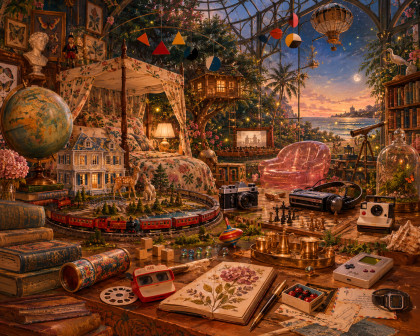
Our first apprenticeship in abstraction began in the crib: Kandinsky’s geometries and Calder’s suspended forms turning overhead, while engraved silver rattles bearing our initials, Channapatna lacquer rattles and palm-leaf kilukiluppai containing seeds rested in our hands, as we were swaddled in Atelier Choux. I used to gurgle with elation whenever my father whistled to me as he returned in his heritage automobile, distinguished by its half-circular horn, while my mother, a professor, used to write on acetate sheets with markers, archive her presentations on floppy disks, and participate in feminist and civil liberties demonstrations.
During my childhood: Secret Seven-style societies, Edison bulbs regulated by rotary dimmers, and brass toggle switches on wooden pattresses lent the hour their amber lustre. Globes and vintage steamer trunks peppered with travel patches and decals; advertising airships floating overhead; ornithological observation through binoculars, viewed from the quietude of a glass-enclosed conservatory, amidst verdant foliage; epistolary nostalgia and the art of handwritten correspondence.
The bioluminescence of fireflies like Tinker Bell’s fairy dust; treehouses commandeering the role of private headquarters as we made sundials, harnessed the sun in solar cookers, and spun the Lazer Dazer. We peered through kaleidoscopes at their ever-shifting tessellations, their prismatic colours casting a rainbow upon the glass. Pressed-flower journals preserved botanical specimens between their pages, while ladybirds, carefully ensconced in matchboxes, became miniature entomological curiosities. Joules and Hunter boots aided us as we picked our way gingerly through the mire during torrential downpours, with peanuts served in little cones of folded newspaper.
The campus became our terrain for Enid Blytonian adventures as we cooked alphabet soup in makeshift cauldrons on a bonfire. We cycled on our Bromptons to open-air cinema screenings viewed from our hammocks, and photographed these reveries with Petite, Rolleiflex and Riga cameras, their film held in canisters. Flossy Bunny and Fleur Harris’s Tooth Fairy captured childhood’s peculiar economy: milk teeth and a nocturnal gratuity.
The children’s bedroom featured Nathalie Lété’s hand-painted flora and fauna on the doors, headboards and windowpanes. The four-poster bed was appointed with Rifle Paper Co. linens, their botanical prints complementing de Gournay’s whimsical chinoiserie illustrations. The wooden wardrobes held camphor-wood keepsake boxes embroidered with motifs, reminiscent of our grandmothers’ embroidery.
Birthdays were adorned with Meri Meri paper buntings, while Comic-Con costumes seemed as though lifted from the pages of Cath Kidston — childhood through a rose-tinted, floral-printed lens. The familiar refrain of Oranges and Lemons found its way from the punch bowl to the playground, alongside London Bridge Is Falling Down and Pop Goes the Weasel. There was Pin the Tail on the Donkey, limbo, treasure hunts, a piñata suspended overhead, musical chairs, the newspaper dance and Kim’s Game.
The rooster’s call from the talking clock heralded the mornings, alongside the insistent peal of twin-bell alarm clocks, the cuckoo emerging from its carved wooden chalet, and the sonorous ticking of mantel and grandfather clocks. While milk simmered on the stove, we found ourselves leafing through Tehelka, Seminar, The New Yorker, Economic and Political Weekly, The Economist, Rolling Stone and MAD, tuning in to WorldSpace, and pausing to admire Mario Miranda’s inimitable illustrations in Bal Bharati.
On my visits to my maternal grandparents in Chennai, I used to sculpt sandcastles with moats or create Christmas trees entirely out of seashells by the shore, watching the green waves roll in, their curling forms reminiscent of banana fronds. Wooden Scrabble, carrom, Jenga, Mahjong, tangrams, peg solitaire and labyrinth ball mazes were part of the repertoire too. Brass bath buckets made evening bathing an alfresco pleasure, accompanied by green gram exfoliants, montmorillonite clays, Savon de Marseille soap blocks, vetiver brushes and volcanic pumice, alongside Hermès L’Ora(n)ge and Lush bath bombs that turned the brass bateau into an olfactory interlude, their citrus and berry notes suffusing the water. Wind chimes provided the accompaniment, with Orion overhead.
The nursery unfolded like a Benjamin Pollock pop-up cut-out, while a trunk from FAO Schwarz seemed to contain within it the phantasmagoria of Jumanji. Playing here obeying the capricious laws of the dice, each throw propelling the odyssey onward. Perhaps Snakes and Ladders was an inadvertent metaphor for my childhood: the expansiveness of make-believe and adventure juxtaposed with the rigours of the classroom and sports field, where academic demands and physical exertion were compounded by thalassemia.
My childhood repertoire ranged from Polly Pocket and LEGO, where miniature worlds could be constructed, inhabited and endlessly rearranged, to G.I. Joe and Barbie’s bed and bath playset, each furnishing its own mythology, populated by distinctive characters, alongside ventriloquist dummies rendered in a distinctively Caravaggesque tenebrism.
Board games such as Guess Who?, Mastermind, Operation, Candy Land and Cluedo turned the dining table into an arena of deduction, strategy, dexterity and chance. Etch A Sketch and Spirograph transformed drawing into an interplay of precision and pattern, while View-Master offered a carousel of miniature worlds through its stereoscopic reels.
From magic slates that rendered drawing endlessly renewable to Mr. Sketch markers redolent of fruit and erasers moulded into miniature produce, the repertoire extended to Paint by Number, which imposed chromatic order on the blank canvas. Lenticular holographic picture sharpeners, with a brush incorporated into the design; push-point crayons; pencils personalised with names; and ingenious musical stationery cases from Sanrio, with push-button mechanisms and multiple pop-out compartments, completed the repertoire.
My father delighted in Matchbox cars, which supplied pocket-sized motoring fantasies, while Lionel electric model trains conjured miniature railways and the theatrical promise of locomotive crashes, their tracks encircling me in a miniature world of their own. Brass miniature crockery sets invited elaborate domestic tableaux; Delft ceramic houses lent a collector’s air to tiny architecture, their blue-and-white façades concealing miniature measures of Dutch gin. Maileg’s Little Sister Mouse in a Box from Anthropologie compressed an entire domestic idyll into a tiny keepsake, alongside Sylvanian Families rabbits and their picnics, arranged in dioramas. The Westminster Magnetic Dolphin, the Slinky, Jacob’s Ladder and Radical Blox fostered finger dexterity, ambidexterity and hand–eye coordination.
Post-war Japan saw the emergence of lithographed tin dollhouses, marketed as Kitchen Sets, in which even miniature refrigerators could be replenished with bottles containing faux liquids. Jean Tag was known for her miniature porcelain, distinguished by gilded rims and delicate floral motifs. Eurasian production, meanwhile, was not immune to the vagaries of mineral impurities: manganese contamination in cobalt pigments could produce unexpected brownish hues. Queen Mary’s Dolls’ House, Sir Edwin Lutyens’s celebrated feat of architectural ingenuity, was complete with functioning plumbing, electricity, a wine cellar, a garden and silver cutlery. John Carlsson, by contrast, explored mechanical ingenuity through dollhouses equipped with ringing telephones and working elevators. Japan’s shokuhin sampuru tradition perfected the art of handcrafted food replicas, displayed in exhibition vitrines with such verisimilitude that they appeared almost indistinguishable from their edible counterparts.
Sky Dancers sent glittering figures spiralling skyward, while Stick ’Em Stones supplied a touch of portable ornament, adorning hair and faces with jewel-like decals. Perler beads turned play into making, yielding little bracelets, pendants and tokens of friendship. Jelly sandals carried childhood’s joie de vivre into the wardrobe: translucent and almost confection-like. Juicy Couture’s glow-in-the-dark stars turned ceilings into constellations, while its gumball machines became miniature dispensaries of colour, alongside hamburger-shaped novelty telephones that gave this otherwise prosaic household object an improbable, whimsical form.
The visual vocabulary of childhood extended from the theatrical intricacies of Froebel-Kan’s three-dimensional, paper-engineered pop-up books to the oneiric surrealism of Czech animator Jan Švankmajer’s stop-motion films, taking in the hand-drawn animation of Richard Williams, Nooruddin Zarrinkelk, Manuel García Ferré, Walt Disney and Hayao Miyazaki. It extended further still, from the surreal pinscreen technique pioneered by Alexandre Alexeïeff and Claire Parker to the unconventional paper-cut-out animation developed by Trey Parker and Matt Stone, alongside the folkloric paper-cut silhouettes and theatrical shadow-play animation associated with Lotte Reiniger and Michel Ocelot.
Multimedia educational computer games—including Knowledge Adventure’s 3D Dinosaurs, JumpStart 1st Grade, Treasure MathStorm, Reader Rabbit’s interactive reading games, Super Mario Bros. and SimTown—extended play into the digital realm. Minesweeper and Pac-Man opened onto the early enchantments of electronic play, culminating in Solitaire’s cascading animations; Go Fish and Patience offered their own card-table diversions.
Bewitched and I Dream of Jeannie offered suburban witchcraft and domestic enchantment, while The Crystal Maze led contestants through its labyrinthine zones. Malgudi Days conjured the unhurried rhythms and quiet eccentricities of R. K. Narayan’s fictional South Indian town. Television, too, became part of the childhood pantheon: the perspicacious sleuthing of Poirot and Byomkesh Bakshi, Sherlock Holmes alongside ‘Murder, She Wrote’ and Midsomer Murders; the farcical hauteur of Are You Being Served?, Fawlty Towers and ’Allo ’Allo!; and the quick-witted repartee of Mind Your Language.
Charlie Chaplin’s silent physicality and Laurel and Hardy’s exquisite comic misadventures held their own against Hitchcock’s apprehension and Woody Allen’s urbane absurdities, while ‘Yes, Prime Minister’ supplied its own brand of political wit. Blackadder brought historical irreverence to the fore, while Whose Line Is It Anyway? turned improvisation into an art of comic spontaneity. Carry On Cleo lent antiquity a bawdy theatricality, while The Three Stooges embodied the essence of vaudevillian farce, and Two of a Kind captured the idiosyncrasies of sisterhood, while The Fresh Prince of Bel-Air juxtaposed streetwise irreverence with aristocratic pretension.
Star Trek ventured into speculative futures; M*A*S*H mingled military absurdity with the poignancy of wartime life; Petticoat Junction evoked rural idylls and family entanglements around a country railway, while Gilligan’s Island revelled in the misadventures of castaways. The Addams Family made the macabre deliciously domestic, while Batman revelled in pop-art absurdism. Madhur Jaffrey’s culinary programmes celebrated India’s regional ingredients and culinary traditions.
Moomin Trolls brought their eccentric Nordic charm in enamel camping mugs repurposed as candles. My Little Pony gave childhood its pastel cavalry; Gay Purr-ee added its own peculiar animated charm through its Parisian settings and Impressionist sensibility; Tintin turned the comic strip into a passport, carrying his adventures across continents; Snoopy made a doghouse a cockpit, a writing desk and a Red Baron’s aerodrome by turns. Wallace & Gromit mistook the moon for cheese, giving lunar exploration a distinctly gastronomic motive while Elmo’s infectious melodies and Cookie Monster’s unapologetic gourmandise, were alongside the pawprint-marked adventures of Blue’s Clues. Billie Turf, too, arrived from the comic pages, the gluttonous schoolboy whose appetite was as prodigious as his roguish escapades. These accompanied our adventures beneath bedsheet tents, alongside compressed Disney-print pellets that unfurled in water into illustrated handkerchiefs.
The picture books of my childhood opened up entire worlds through the distinctive visual vocabularies of their illustrators. Their pages were animated by the botanical and zoological naturalism of Beatrix Potter and Jerry Pinkney, the Art Nouveau grotesquerie of Arthur Rackham, the anthropomorphic characterisation of Richard Scarry, the Pre-Raphaelite medievalism of Laurence Housman and Kinuko Y. Craft along with the sinuous refinement of Kay Nielsen. The chromatic idealism of Maxfield Parrish and Mary Blair sat alongside the Edwardian domesticity of Jessie Willcox Smith and Eloise Wilkin.
Other illustrators brought their own distinctive sensibilities: the cross-hatched chiaroscuro of Ron Brooks, the mythopoetic dramaturgy of Maurice Sendak, the mimetic verisimilitude of Michael Hague and the folkloric marginalia of Jan Brett and Gustaf Tenggren. There was also the Renaissance classicism of Paul O. Zelinsky, the antiquarian preciosity of Barbara McClintock and the Baroque profusion of Anton Lomaev.
The visual worlds extended further still, encompassing the chromatic phantasmagoria of Edmund Dulac, the quotidian pathos of Raymond Briggs, the microscopic pastoralism of Jill Barklem, the Victorian sentimentalism of Tasha Tudor and the bucolic bestiary of Feodor Rojankovsky. The Expressionist disquiet of Thomas Baas, the gestural caricature of Quentin Blake, the domestic anthropomorphism of Cyndy Szekeres, the anecdotal plenitude of Steven Kellogg, the winsome eccentricities of Anna Bond, and the medieval romanticism of Trina Schart Hyman completed this rich panorama.
My neighbours, whose children appear almost uncannily composed like Shirley Temple walkie-talkie dolls: brown ringlets framing green eyes, long lashes lowering as they recline, floral dresses cinched with ribbons, their porcelain delicacy concealing a distinctly Jekyll-and-Hyde duality. Their other selves emerge with plastic pistols in hand, defacing walls and floors with slurs.
At night, ensconced beneath a down quilt, fairy tale in hand and Celestial Seasonings herbal tea by my side, I would inhabit a farraginous nocturne of Cartoon Network’s final hour, before its valediction by Chuck Jones or Hanna-Barbera—“That’s all, folks!”—and the subsequent advent of TNT, while Beanie Babies accumulated their own menagerie of soft, collectible personalities; Ritz and Harrods bears lent teddy bears a touch of plush hauteur.
As the Sherman Brothers so aptly put it, “It’s a Small World After All.”
Adolescence was like inhabiting a snow globe, insulated from the world beyond its glass, until the slightest upheaval set our suspended equilibrium into disarray. Play had acquired circuitry and a certain patina of sophistication: handheld gaming consoles like the Game Boy; digital watches by Casio, including G-Shock and Baby-G; instant cameras by Polaroid; and iPods by Apple. These culminated in Swarovski-encrusted mobile phones like the Vertu Signature Cobra, the Pink Motorola Razr and BlackBerry Bold, accessorised with Tamagotchis as charms. Some of us, meanwhile, missed the rotary dial and the candlestick telephone, even as the BeoCom became the new landline.
Furniture, too, acquired a sculptural vocabulary: the modernist ingenuity of Charles and Ray Eames, Eero Saarinen and Arne Jacobsen, alongside Anna Castelli Ferrieri’s pioneering explorations in moulded plastic and modular forms. Quasar Khanh’s inflatable Aerospace collection introduced a new vision of domesticity, with transparent PVC, buoyant volumes and bubble-like forms dissolving the boundaries between furniture and sculpture.
Gadgets, too, assumed a certain distinction, with tape recorders and typewriters retaining the romance of the mechanical. The listening apparatus ranged from gramophones and cassette players—including El Taller Pino’s tape machines—to systems by Nakamichi and Bang & Olufsen; Crosley and Roberts restored the rituals of analogue listening, while Marshall and Bose gave the modern age a different sonic vernacular. VCRs belonged to the same analogue era; live concerts, by contrast, returned music to its most unmediated form.
The jukebox and the multi-disc CD changer cycled through an eclectic repertoire: the solemn resonances of Gregorian chant and the meditative cadences of Tibetan Buddhist incantations; the polyphony and contrapuntal mathematics of the Baroque era; the frenetic Charleston and the clandestine speakeasy culture of the Jazz Age during Prohibition; the plangent melancholy of blues and the syncopated phrasing of rhythm and blues; the gospel-rooted fervour of the Soul era and the tuxedoed crooners of traditional pop. The repertoire extended to the insistent drive of rock ’n’ roll, the evocative lyricism of folk, the interplay between swaras and matras in Carnatic classical music, the poetic yearning of ghazals and the devotional ardour of qawwali.
Art, too—with its pigments, lacquers, easels, brushes, wax stamps, piston fillers and pocket pens; palettes, ink, paper and canvases from L. Cornelissen & Son, Crayola, Winsor & Newton, Sakura, Copic, Sennelier, Holbein, Caran d’Ache, Kobaien, Daler-Rowney and Nakagawa Gofun-sho—had me absconding from lessons to borrow books published by Taschen or Encyclopaedia Britannica from the library. Lava lamps cast their liquid luminescence, while the bedroom walls became a gallery of pop-idol iconography. Bickford’s arabesque clothbound classics lent the bookshelf its own distinction, sharing its space with Tiffany lock journals—the little repositories of childhood secrets.
Crabtree & Evelyn, William Morris and Lollia’s Folklore clothed their creams in botanical finery, while stackable lip balms and glosses became gustatory temptations, redolent of gelato, buttercream and effervescent sodas, from Philosophy, Flower Knows, Milk, EOS and Lip Smacker.
Serums by Le Labo, Neal’s Yard Remedies and Aesop; candles by Trudon and Diptyque; salts by Mullein & Sparrow; perfumes by Penhaligon’s; and unguents by Kindred Black and Burt’s Bees formed part of the ritual. Afternoons were spent reading Kinfolk, listening to sound bowls, balancing chakras with geodes and nursing remedies by Anima Mundi Herbals, all while watching my father wield tortoiseshell straight razors, the musky traces of shaving foam, Molton Brown eau de toilette or L’Occitane lingering in the air, as my mother spent more of her time embodying Rex Harrison’s Dr Dolittle and Professor Henry Higgins.
From Liesl and Rolf’s “Sixteen Going on Seventeen” to Maria and Captain von Trapp’s Ländler, adolescence gave way to adulthood—The taxonomy of toys had evolved: BE@RBRICKs and Labubus had graduated from nursery curiosities to coveted objets de collection. One took the form of Alice, while the other bore Van Gogh’s Almond Blossoms across its sculptural form, each refracted through the artistic and literary pantheon. Puzzles, too, had acquired a more recherché vocabulary: some unfurled like Liberty scarves, while others bloomed into Monet’s Impressionist gardens. Judith Leiber, meanwhile, recast cupcakes and teapots as jewelled receptacles—an elaborate elevation of the nursery into the realm of connoisseurship. Miniature Zen gardens and verdant terrariums now punctuated these collections, accompanied by vintage parfum atomisers.
The domestic sphere, too, had its own design vocabulary: La Cornue’s vaulted-oven ranges, Smeg’s retro-futurist appliances and Le Creuset’s enamelled cast iron; Sabre Paris flatware, Mario Luca Giusti stemware, Royal Albert’s Miranda Kerr collection of butterfly-and-peony porcelain, and Murano-glass serving platters, alongside a SICIS-mosaic swimming pool recalling Hokusai’s The Great Wave off Kanagawa. Suspended from the ceiling was Laila Gohar’s sugar chandelier, its intricate fluting, delicate crimping and floral flourishes transforming confection into a sculpture of edible decadence. All of it was housed within a mirrored apparition of an Invisible House in a desert, complete with its Hermès sculptural rocking horse.
In the 90s, we could simply unplug our telephones; there was no doomscrolling, rage-baiting, ghosting or bricking. Walt Disney remains a testament to the possibilities of imagineering. Yet the very adults who deride objects of play as puerile depend upon the ingenuity and innovative sensibilities of the designers who conceive them through animation and narrative for the emotional enrichment, engagement and entertainment of their own children.
Like a Russian Matryoshka, the human self is a succession of embodiments, each nested within the next. The infant persists within the child, the child within the adolescent, and the adolescent within the adult. For we do not replace our former selves as we traverse the successive phases of life; we accumulate them. Beneath the acquired composure of adulthood, the child we once were continues to endure, an inalienable part of our very being.
Disclaimer : This story is auto aggregated by a computer programme and has not been created or edited by DOWNTHENEWS. Publisher: deccanchronicle.com









