- Delhi recorded first single-digit minimum temperature this season.
- Daytime temperatures remained above normal; no rainfall recorded.
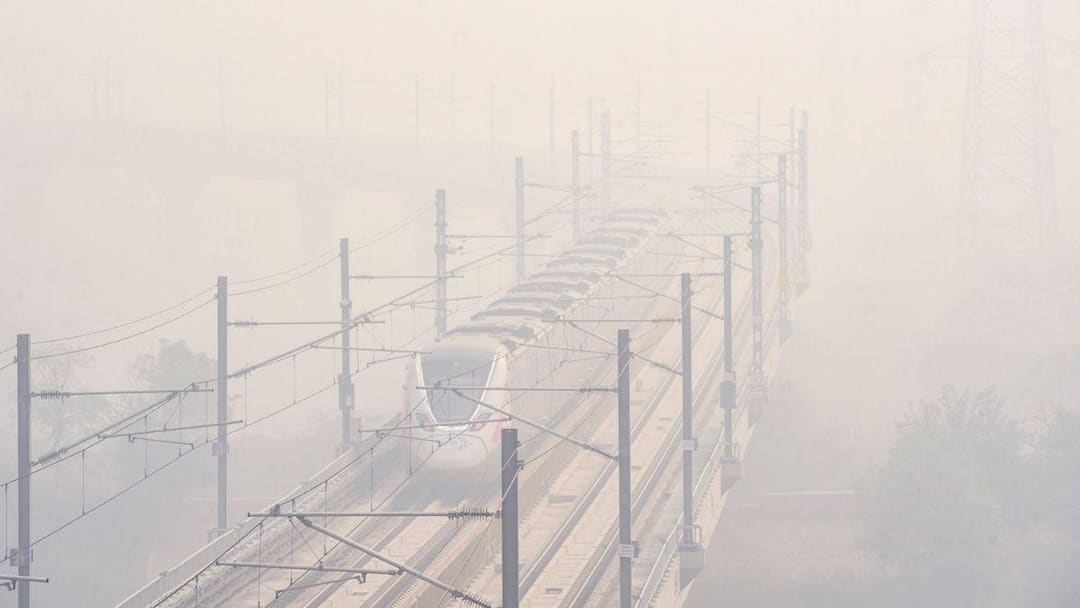
- City’s air quality remained ‘poor’ despite colder nights.
- Weak winds caused pollutant accumulation, PM2.5 was primary.
Delhi recorded its first single-digit minimum temperature of the season on Thursday, with the mercury dropping to 9 degrees Celsius at the Safdarjung weather station. However, the early signs of winter brought little relief from pollution, as the city’s air quality remained in the ‘poor’ category.
According to the India Meteorological Department (IMD), Safdarjung’s minimum temperature was 2.3 degrees Celsius below the seasonal average. The reading was also one degree lower than Wednesday’s minimum of 10 degrees Celsius.
Other weather stations across the Capital also recorded relatively low temperatures. Palam registered a minimum of 9.9 degrees Celsius, while Lodhi Road recorded 9.4 degrees Celsius. The Ridge and Ayanagar stations reported minimum temperatures of 11.4 degrees Celsius and 10.5 degrees Celsius, respectively.
Maximum Temperature Above Normal
Despite the dip in night temperatures, daytime conditions remained relatively warm. Safdarjung recorded a maximum temperature of 28 degrees Celsius, which was 1.3 degrees above normal.
The IMD reported no rainfall at any of the five monitoring stations, indicating that the temperature drop was not accompanied by any precipitation.
Delhi AQI Remains Poor
While temperatures continued to fall, pollution remained a concern across Delhi. The city’s Air Quality Index (AQI) stood at 226 at 7.05 am on Thursday, compared with 220 recorded on Wednesday.
Weak winds and a strong temperature inversion restricted the dispersal of pollutants, contributing to the persistence of poor air quality.
According to the Central Pollution Control Board (CPCB), 13 of Delhi’s 56 monitoring stations recorded ‘very poor’ air quality, while 25 remained in the ‘poor’ category. The remaining 18 stations reported ‘moderate’ air quality.
Anand Vihar recorded the city’s worst AQI at 355, placing it in the ‘very poor’ category. Sri Aurobindo Marg reported the lowest reading at 131, which falls in the ‘moderate’ category.
PM2.5 Dominates Pollution
The CPCB classifies air quality into six categories: good (0-50), satisfactory (51-100), moderate (101-200), poor (201-300), very poor (301-400) and severe (401-500).
Pollutant data collected at 6 am showed that PM2.5 was the predominant pollutant at 46 of the 56 monitoring stations. PM10 was the main pollutant at the remaining 10 stations.
A day earlier, PM2.5 had been the leading pollutant at 44 stations, while PM10 dominated at 12, indicating a slight increase in the number of stations where fine particulate matter was the primary pollutant.
Disclaimer : This story is auto aggregated by a computer programme and has not been created or edited by DOWNTHENEWS. Publisher: abplive.com