
Updated ,first published
Beijing: A failed attempt by Chinese officials to remove Australian journalists from the Great Hall of the People has overshadowed the start of Foreign Minister Penny Wong’s whistle-stop trade mission, as she urges China to resume critical jet fuel exports to Australia.
One Chinese official moved in front of the Australian government’s official cameraman obstructing his efforts to film Wong’s prepared statement.
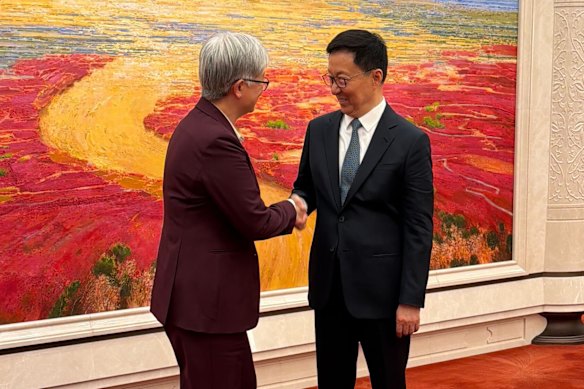
Wong had arrived at the hall in Beijing at the start of a busy day of meetings in the capital to discuss fuel and trade.
Ignoring the efforts to move them on, Australian media remained in place until Wong finished speaking, where she stressed that the Middle East conflict and the closure of the Strait of Hormuz had hit Asian refineries and the Indo-Pacific Region disproportionately.
“In that context, it’s more important than ever that we continue to engage and find ways to work together to keep fuel and goods flowing,” Wong said in her opening remarks, addressing them to Vice president Han Zheng, who was seated across from her at a long table, flanked by Chinese officials.
Wong and Australian Ambassador Scott Dewar, who was seated next to her, looked up in the direction of the Australian media pack as officials began insisting they leave, despite protests from the journalists that the foreign minister was still speaking.
Eventually, the Chinese officials used a rope to usher media from the room, with media voluntarily departing once Wong had finished her remarks.
In an interview with this masthead after the meeting, Wong did not confirm if she had secured any assurances that China would resume jet fuel exports to Australia after a weeks-long defacto ban has constrained supply.
She said the case she would make to Chinese Foreign Minister Wang Yi in a meeting on Wednesday evening was that Australia could only be a reliable supplier of LNG, iron ore and other goods China needs if those industries had access to fuels.
“We supply you with iron ore, we supply you with coal, we supply LNG, and we supply food, and we want to see a reliable supply of liquid fuels, including jet fuel,” she said, describing Australia’s pitch to China.
“We have a shared interest in this, because those inputs are required for us to continue to be a reliable supplier. You can’t run a mining industry without jet fuel and diesel. You need to get your FIFO workers there.”
Wong’s visit comes as China signalled that its fuel export restrictions may soon lift, with UK Newspaper The Financial Times reporting on Wednesday that China’s largest state oil companies have applied for export permits to ship fuel in May.
Pressed on whether she hoped to leave China with a concrete commitment that exports would resume by a certain date, Wong said: “Ultimately, China’s got to make its decision.”
Wong’s trip to Beijing is part of a quick trip through east Asia this week, flanked by stops in Tokyo and Seoul to discuss fuel security, with the Iran-US chokehold over the Strait set to continue into its ninth week without a clear pathway for resolution. It builds on Prime Minister Anthony Albanese and Wong’s oil diplomacy tours to key Asian trading partners, Singapore, Malaysia and Brunei this month.
Asia has born the brunt of US President Donald Trump’s tariffs and now is among the worst-hit regions by the energy crisis.
Asked about the feedback she was hearing from Asian neighbours about how these issues were impacting the standing of Australia’s closely security ally, Wong said there was a “shared understanding” that US was repositioning its place in the world affairs.
“I don’t think there’s any doubt that this President Trump envisages a different role for America and the world, and a different approach to the countries of the world,” Wong said.
Wong decline to engage directly on whether she was concerned diminishing US credibility in Asia would translate to a rising reliance on China in Asia and strengthen Beijing’s global leadership aspirations, but she acknowledged “this is a time of great change”.
“You have a different US. You have a different China. We have to have the confidence in ourselves to navigate a different world, and we do that by building relationships in the region and beyond, which is what the government’s been doing,” she said.
 Lisa Visentin is the North Asia correspondent for The Sydney Morning Herald and The Age based in Beijing. She was previously a federal political correspondent based in Canberra.Connect via X or email.
From our partners
Disclaimer : This story is auto aggregated by a computer programme and has not been created or edited by DOWNTHENEWS. Publisher: www.smh.com.au