
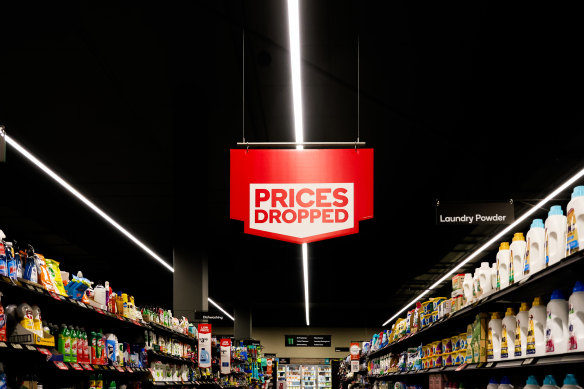

Woolworths negotiated with suppliers to put products on “discounts” at the same time as it agreed to raise prices, resulting in hundreds of pantry staples being sold on special for more than the supermarket had been charging months earlier.
Court documents published on the eve of a landmark trial between the Australian Competition and Consumer Commission and the supermarket giant show that of 276 products, 265 had been sold under the “Prices Dropped” program for amounts that were higher than they had been for the previous 180 days.
In 254 of the cases, prices and supplier funding behind the red and white tickets were planned before the temporary price spike had begun, according to the statement of agreed facts between Woolworths and the consumer watchdog.
Woolworths quietly discontinued the “Prices Dropped” program in December 2024, after the commission sued it and rival Coles over their allegedly illusory discounting strategies. Woolworths replaced it with another discounting strategy promising lower prices for longer periods.
The watchdog’s case against Coles finished in late February, and its outcome will be released by the Federal Court only once a different judge has heard the related case against Woolworths that begins in Sydney on Tuesday.
In court, the ACCC’s barrister Michael Hodge, KC, will argue that Australia’s largest supermarket sold popular products such as Tim Tams, Tiny Teddy biscuits and Sakata rice crackers under fake discounts.
In one instance, the price of a family pack of Oreos, sold for $3.50 for nearly two years, was hiked 43 per cent to $5 for 22 days before being placed on the “Prices Dropped” program to a price of $4.50. Although the customer was being told it “was” $5, they were paying a dollar more than the month before.
“Woolworths represented to consumers that the prices of affected products promoted on ‘Prices Dropped’ were discounted when, in fact, the purported discount was illusory,” the ACCC says in its concise statement.
It accused the supermarket of making “false or misleading representations” by promoting the discounts as helping shoppers make long-term savings on groceries at a time of rapidly climbing cost-of-living pressures.
In its defence, Woolworths says its discounts were real. It said supplier negotiations typically included the new undiscounted price and the promotional price, and were “a standard feature of the Australian supermarket retail industry”.
“Those discounts were not ‘illusory’,” the company says in court documents.
“The labels for the products accurately identified that the prices had been ‘dropped’, accurately identified the previous higher price, and identified the date at which the product had been sold at that previous higher price.”
Woolworths introduced the “Prices Dropped” program in 2015. It kept products at discounted prices for at least 12 weeks, and up to six months or longer. Included products were marked by red and white shelf tickets, displayed in store and online, with the “dropped” price alongside a “was” price.
The ACCC filed proceedings in September 2024, just weeks after Amanda Bardwell took over as Woolworths chief executive from predecessor Brad Banducci.
Woolworths confirmed to this masthead that its Prices Dropped program had been retired last year as the $45 billion supermarket giant pivoted to “Lower Shelf Prices”, which promised to lock lower prices for several months on end.
In May that year, Bardwell told shoppers the company was lowering prices on hundreds of products, including staples like Greek yoghurt, chicken schnitzel, bread, flour, rice and nappies.
Lower Shelf Price does not have the “was/is” prices of the Prices Dropped program.
Woolworths’ decision to retire Prices Dropped contrasts with Coles, which has maintained its “Down Down” program despite the ACCC suing it over that discount campaign. Coles rejected those allegations in court.
Both supermarkets run multiple promotional programs, or “pricing mechanics”, at the same time. On top of its Lower Shelf Price program, Woolworths has online-only specials, half-price specials, Autumn specials, Everyday Low Price, Buy More Save More, and Bundles.
One former supermarket executive, who declined to be named so they could speak freely, said the number of programs often perplexed employees within the company.
“I do find those confusing as well,” they said. “You’ve got all these different pricing mechanics, and you’d go, ‘what do each of those mean?’. They are a little bit different [to each other].”
The Business Briefing newsletter delivers major stories, exclusive coverage and expert opinion. Sign up to get it every weekday morning.
 Jessica Yun is a business reporter covering retail and food for The Sydney Morning Herald and The Age.Connect via X or email.
From our partners
Disclaimer : This story is auto aggregated by a computer programme and has not been created or edited by DOWNTHENEWS. Publisher: www.smh.com.au


